






History & Culture
10 Most Famous Katanas in Japanese History

Some blades get melted down. Others get passed between warlords, enshrined in temples, and argued over by historians for eight centuries. The ten swords on this list belong to the second category. They are famous samurai swords not because of clever naming, but because of who made them, who carried them, and what happened when they were drawn.
A few of these are real, dateable objects sitting in Japanese national collections right now. Others blur the line between history and mythology so thoroughly that scholars still debate whether the sword or the story came first. Both kinds matter if you want to understand what the katana actually meant to Japanese culture.
We will cover what each blade was made of where that information survives, who the smith was, and why it ended up famous. That is the only honest way to talk about legendary Japanese swords.
1. Honjo Masamune
Start here, because every serious conversation about famous katanas starts here. The Honjo Masamune is widely considered the finest surviving work of Gorō Nyūdō Masamune, the Soshu-school smith who worked between approximately 1264 and 1343. Masamune is credited with perfecting nie-based hamon, the crystalline martensite pattern visible along a properly tempered blade’s edge. Under good light, a Masamune hamon looks less like a line and more like a galaxy.
The sword passed through the hands of several powerful daimyo before becoming a symbol of the Tokugawa shogunate. After World War II, it was surrendered to an American soldier named Sergeant Coldy Bimba during the occupation disarmament. After that, the trail goes cold. Its current whereabouts are unknown, which makes it simultaneously the most famous sword in Japan and the most frustrating entry on this list.
What we know about Masamune’s technique: he worked in a jitetsu (steel texture) that was so refined the grain appears almost mirror-smooth in the ji, with the nie activity concentrated in the hamon. That is the opposite of the wild, aggressive hamon associated with later Muramasa work. Restraint was the point.
2. Kusanagi no Tsurugi
This one lives in mythology more than metallurgy, but no list of legendary Japanese swords omits it. Kusanagi no Tsurugi, meaning “Grass-Cutting Sword,” is one of the three Imperial Treasures of Japan. According to the Kojiki and Nihon Shoki, the storm god Susanoo found it inside an eight-headed serpent he had just killed. The blade was reportedly inside the creature’s tail.
The sword eventually came to Prince Yamato Takeru, who used it to cut surrounding grass and redirect a fire started by his enemies, hence the name. Whether any physical object matching this description exists is impossible to verify. The blade is reportedly housed at Atsuta Shrine in Nagoya, but it has not been publicly displayed in recorded history. Shrine priests are the only ones who handle it, and they are not talking.
From a historical standpoint, the sword predates the curved katana form entirely. If the legend has any physical basis, the object would more likely resemble a straight chokuto than anything we would recognize as a katana today. That distinction matters if you care about what Japanese swords actually looked like before approximately 900 AD.
3. Dojigiri Yasutsuna
Here is where the list gets into blades you can actually go look at. The Dojigiri Yasutsuna is housed in the Tokyo National Museum and is designated a Japanese National Treasure. It was forged by Yasutsuna of Hoki Province, traditionally dated to the late Heian period, around the 10th or 11th century. That makes it one of the oldest surviving tachi in Japan.
The sword takes its name from the legend that Minamoto no Yorimitsu used it to kill the demon Shuten-doji on Mount Oe. Set aside the demon. Focus on the construction. The blade measures approximately 80cm and shows a ko-midare hamon (small irregular pattern) typical of early Hoki school work. The steel grain is tight and even, remarkable for its age. Nine hundred years of survival without the blade cracking or warping tells you something about how it was made.
Yasutsuna is also traditionally credited as the smith who taught the curved blade form to Amakuni Yasutsuna, though the connection between these two smiths remains a subject of academic debate. Either way, the Dojigiri sits at the origin point of the entire katana tradition.
4. Mikazuki Munechika
The Mikazuki Munechika, or “Crescent Moon,” is the work of Sanjō Munechika, another Heian-period smith. Also a National Treasure and also housed in the Tokyo National Museum, it is considered one of the five greatest swords in Japan, a grouping called the Tenka Goken.
What makes Mikazuki distinctive is the hamon. Along the entire length of the blade, the temper line forms a repeating crescent pattern, which is where the name comes from. Achieving that kind of regularity in a hamon requires precise clay application before quenching, and it requires knowing exactly how your steel will behave at temperature. Munechika knew his steel.
The blade has a pronounced tachi curvature consistent with Heian-period mounted combat use. The kissaki (tip) is a ko-kissaki, small and elegant, which is typical of the era. Later Muromachi-period smiths moved toward larger kissaki to handle the demands of infantry warfare. Studying the Mikazuki is essentially studying the physical evolution of the Japanese sword’s form.

Ink Meteor , San Mai Katana
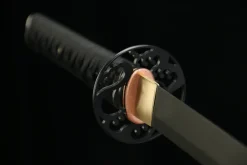
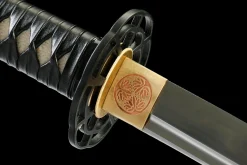
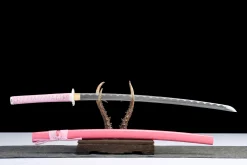
Three-layer san mai construction with a high-carbon core. $775.

Silent Thunder , T10 Katana
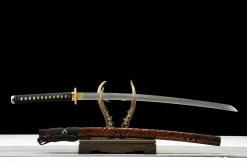
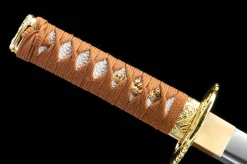
T10 high speed tool steel, clay tempered hamon. $280.

Dark Ravine , T10 Katana
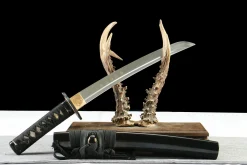
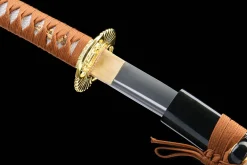
T10 steel with a visible clay-tempered hamon line. $340.
5. Onimaru Kunitsuna
The Onimaru Kunitsuna is the second of the Tenka Goken and is attributed to Awataguchi Kunitsuna, a Kamakura-period smith from the Yamashiro tradition. Unlike the previous entries, this blade has a ghost story attached to it. The Hojo clan, who owned the sword, believed an oni (demon) appeared to one of their sick lords in a dream and repaired the blade. Hence the name: “Demon Round.”
Currently held by the Imperial Household Agency, this sword is not on public display. What is documented is the school it came from. The Awataguchi smiths were known for a tight, fine-grained jigane with a nie-rich hamon that ran consistently from hamachi to kissaki without the wild variation you see in some later work. Clean, controlled, technically demanding.
Kamakura-period blades from Yamashiro province represent a high point in Japanese metallurgy that was not fully matched until several generations later. The reason is tamahagane quality. Yamashiro smiths had consistent access to superior iron sand deposits, and they developed smelting processes to take advantage of it.
6. Juzumaru Tsunetsugu
The third Tenka Goken blade. Aoe Tsunetsugu forged it during the Kamakura period, and it eventually came into the possession of the Buddhist monk Nichiren, who wrapped prayer beads (juzu) around the hilt, giving the sword its name: “Prayer Bead Round.”
The Aoe school worked in Bitchu Province and had a recognizable style: a distinctive blue-black jigane with a hamon that tended toward nie and fine nioi. The steel texture on an Aoe blade often shows a pattern called “flowing wood grain,” which comes from the way they worked their tamahagane through repeated folding at specific temperatures. You cannot fake that texture. It is either there or it is not.
This blade is held by Honpoji Temple in Hyogo Prefecture. The connection between a warrior’s sword and a monk’s prayer beads is not as strange as it sounds in the Kamakura context. Buddhist institutions held significant political and military power, and abbots routinely carried or gifted swords. Nichiren was one of the more combative Buddhist reformers of his era.
7. Odenta Mitsuyo
Fourth of the Tenka Goken, forged by Miike Mitsuyo of Chikugo Province during the Heian or early Kamakura period. The Miike school is one of the oldest in Japan, and their blades have a recognizable character: wide, powerful, with a strong taper and a hamon that tends toward suguha (straight line) with dense nie activity.
The Odenta passed through the Maeda clan and is currently housed at the Tokugawa Art Museum in Nagoya. Its measurements put it at the larger end of tachi construction for its era, suggesting it was made for a physically strong warrior or for mounted use where reach mattered more than speed of draw.
One thing that does not get mentioned enough about early Miike work: the carbon distribution through the blade cross-section is remarkably even for pre-Kamakura period steel. Later analysis of similar Miike blades suggests they were working with higher-quality iron sand than many of their contemporaries, and their smelting process reduced slag inclusions more effectively. The result was steel that aged well. Odenta is still structurally sound after a thousand years.
8. Kogarasumaru
The Kogarasumaru, “Little Crow,” is an unusual entry because it is a kissaki moroha zukuri blade, double-edged at the tip, which is an archaic form that bridges the straight chokuto and the later curved tachi. It is attributed to Amakuni Yasutsuna, traditionally considered the first smith to forge a curved Japanese blade, around 700 AD.
This blade is held by the Imperial Household Agency. At approximately 62cm, it is shorter than most tachi but longer than a standard wakizashi. The double-edged kissaki section represents a transitional technology: smiths were experimenting with geometry before the fully curved, single-edged form became dominant. The curve on Kogarasumaru is subtle compared to later tachi, which tells you how gradual that evolution was.
If the attribution to Amakuni is accurate, this is the oldest Japanese sword on the list by several centuries. Most scholars accept the Amakuni attribution as at least partially legendary, but the blade’s construction is consistent with very early Japanese forging techniques. The steel grain under examination shows the coarser, less refined texture typical of tamahagane before Heian-period smiths fully developed their folding and differential hardening methods.
Silent Thunder
T10 tool steel, clay tempered, visible hamon. If you want to understand what a real hamon looks like before buying, this blade at $280 is the reference point. See specifications.
Ink Meteor , San Mai
Three-layer san mai construction mirrors the laminated approach used by historical smiths. Hard core, soft jacket, $775. See specifications.
9. Muramasa Blades
Sengo Muramasa worked in Ise Province during the late Muromachi and early Momoyama periods, roughly 1460 to 1530. He never made one famous sword. He made a school of swords so aggressively effective in battle that the Tokugawa shogunate eventually declared them cursed, because too many Tokugawa family members had been killed or injured by blades bearing his signature.
That is the politics. Here is the metallurgy. Muramasa blades are characterized by an extremely active hamon called notare-midare, large undulating waves mixed with irregular activity. The edge geometry tends to be thinner and more acute than Masamune work, which means faster cutting but also more brittleness under lateral stress. These were weapons optimized for cutting, not for blocking.
Muramasa trained under the Soshu tradition but pushed the hamon activity further than most of his contemporaries were willing to go. When you look at a Muramasa blade under raking light, the hamon does not look controlled. It looks alive. Whether that is skilled artistry or metallurgical aggression is a debate that sword scholars have not settled.
Several authenticated Muramasa blades survive and are held in Japanese collections. If you want to understand the full technical range of what Japanese sword steel could do, compare a Masamune and a Muramasa side by side. One smith was refining. The other was pushing limits. Both approaches produced legendary results. Our steel comparison guide covers how modern high-carbon steels like T10 relate to the differential hardening these smiths pioneered.
10. Kotetsu’s Masterworks
Nagasone Kotetsu is the outlier on this list in the best possible way. He worked during the Edo period, 1600s, when the great age of battlefield swords was already over. He started as an armorsmith, switched to blades later in life, and produced work that most contemporary smiths could not match in their prime years.
Kotetsu’s blades became famous for two things. First, the cutting test results. Tameshigiri records from his era document his blades cutting through multiple bodies at a single stroke, which made them the most sought-after cutting swords of the Edo period. Second, the fact that they were immediately and prolifically faked. A Kotetsu signature on a blade from his era is statistically more likely to be a forgery than an original. Collectors have been arguing about attribution ever since.
His jigane shows the influence of his armor background: the steel has a dense, almost lacquered quality, and the nie in the hamon is tightly packed without looking forced. He favored a suguha hamon with ko-nie activity, understated compared to Muramasa but technically impeccable. The Edo period produced fewer great blades than the Kamakura or Muromachi periods, but Kotetsu is proof that the knowledge had not disappeared. It had just been waiting for someone disciplined enough to use it correctly.
For anyone interested in how these historical construction methods translate into modern production, our complete buying guide breaks down what to look for in a contemporary katana, from steel grade to hamon type to handle construction. Browse our full katana collection or explore our Damascus steel range if layered construction is what drew you to this history in the first place.
Frequently Asked Questions
Ready to Find Your Blade?
