







Dragon Blade Forge · FAQ
Questions About Our Swords.
Direct answers to the questions we receive most often. No filler.
Common questions.
[accordion_item title=”Are these real cutting swords or decorative pieces?”]
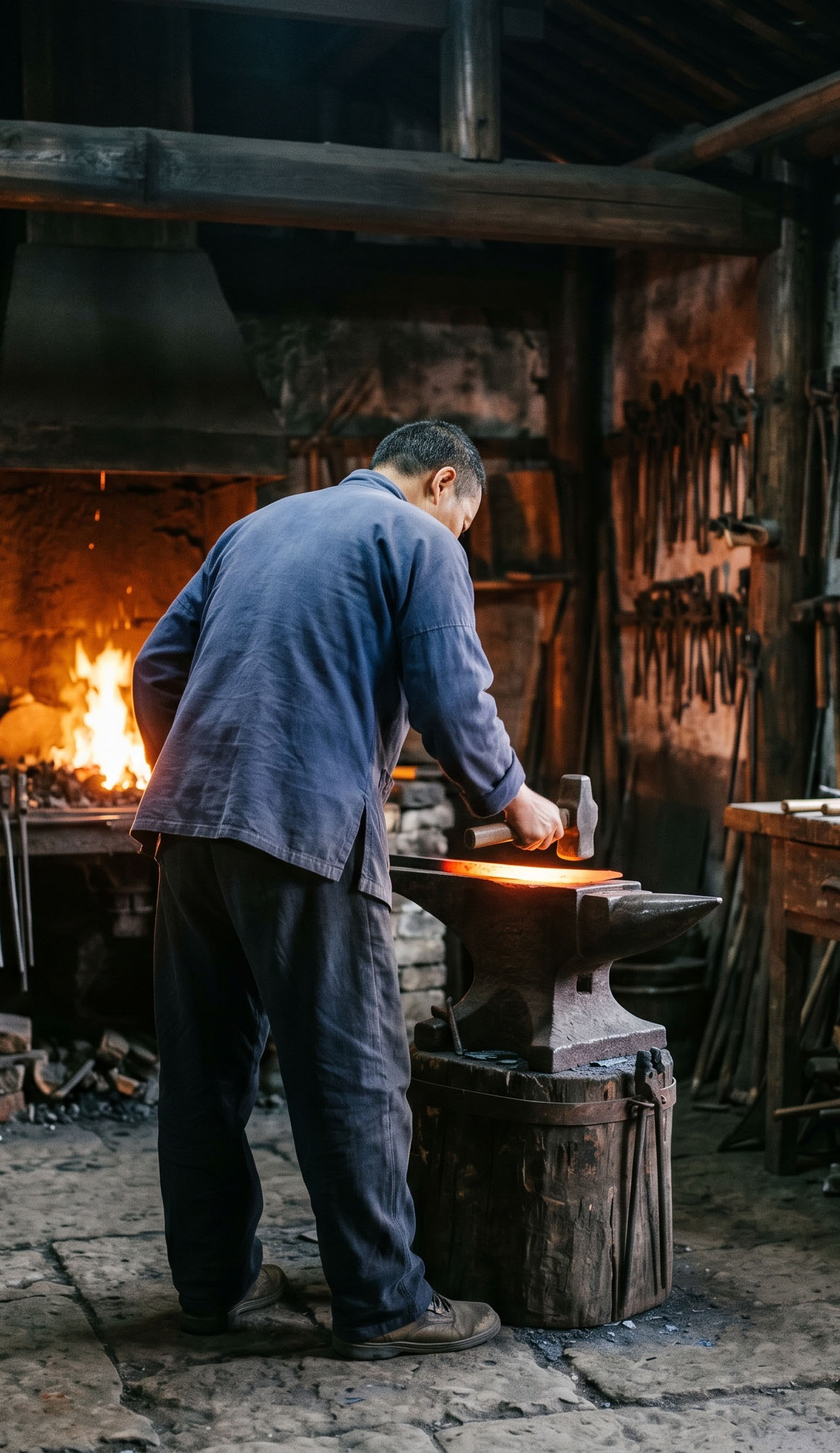
Every blade we sell is full-tang, hand-forged carbon steel. They are functional cutting swords, not decorative wall pieces. We do not carry display-only blades. A few upper-tier Damascus pieces are better suited to collection than regular tameshigiri — we note this where it applies.
[/accordion_item][accordion_item title=”What is the difference between clay-tempered and oil-quench heat treatment?”]Clay-tempering insulates the spine during quenching, producing a harder edge zone (HRC 58–62) and a softer spine (HRC 38–42). The visible boundary between these zones is the hamon. Oil-quench through-hardening produces uniform hardness across the blade — functional, but without differential performance or a visible hamon. Our 1095, T10, and Damascus blades are clay-tempered. 1065 and spring steel are typically oil-quenched.
[/accordion_item][accordion_item title=”How long does shipping take?”]Most orders leave our facility within 3–5 business days. Standard international shipping is 10–20 business days depending on destination and customs processing. Every order ships with tracking. Express shipping (7–10 business days) is available at checkout.
[/accordion_item][accordion_item title=”Is it legal to own and import a sword in my country?”]Legal status varies by country and sometimes by region. In most of the United States, Canada, and most EU countries, owning a katana for martial arts or collection is legal. The UK, Australia, New Zealand, and Japan have stricter import requirements. See our Sword Laws guide for country-specific information. We are not legal advisors — verify with local authorities before ordering.
[/accordion_item][accordion_item title=”Do the blades arrive sharp?”]Yes. Blades are sharpened at the forge before shipment. Edge geometry is correct for the steel grade. Depending on your use case, you may want to refine the edge on a Japanese water stone before the first cutting session — the factory edge is functional but not always at the specific angle you prefer.
[/accordion_item][accordion_item title=”What does the 30-day guarantee cover?”]If a blade does not match its listed specifications, or if a fitting fails under normal use within 30 days of delivery, we replace or refund without argument. Normal use means cutting practice and tameshigiri — not prying, chopping wood, or contact with other blades. We stand behind the specifications we publish because we measure them ourselves before listing.
[/accordion_item][accordion_item title=”How do I sharpen a katana?”]Japanese water stones are the correct tool. Start at 400-grit to correct damage or change the bevel angle. Progress through 1000, 2000, and 4000 grit for a working edge. 6000–12000 grit produces a mirror finish. Maintain the correct bevel angle — work the blade at the geometry the smith established, not freehand at a random angle.
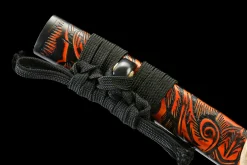
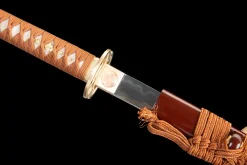
[/accordion_item][accordion_item title=”Can I request a custom blade?”]Limited customization is available on catalog blades — handle wrap color, saya finish, and tsuba style can often be specified at order. Full custom commissions (specific geometry, length, steel, fittings) are available through direct inquiry. Lead time for customs is 8–16 weeks depending on smith availability and specification complexity.
[/accordion_item]