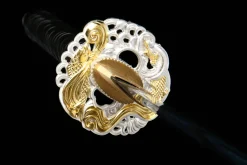
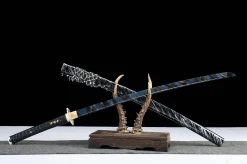
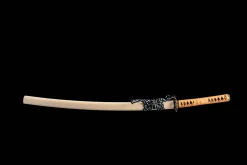


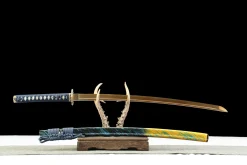
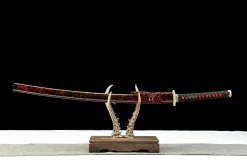

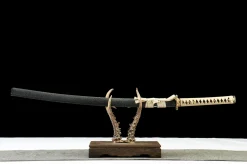


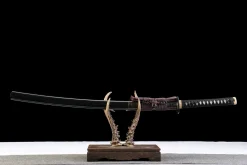

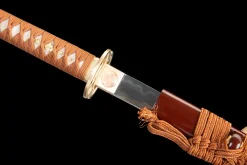

Two steels. Both high-carbon. Both capable of producing a razor edge and a vivid hamon. Both are the kind of material that separates a working sword from a wall decoration. So which one do you pick? This comparison goes beyond surface-level ratings. We forge and finish both steels here in Longquan, and the differences show up not just in the numbers but in how the steel behaves under a hammer, in a quench tank, and on a cutting target. Read through before you decide. For a broader look at how these compare against 1065, spring steel, and Damascus, our full steel comparison guide covers the complete matrix. T10 is a tungsten-alloyed tool steel. The full designation is T10 High Speed Tool Steel, and that last part matters. The tungsten content, typically around 0.9-1.1%, adds wear resistance at the carbide level. You are not just hardening the surface. You are locking fine tungsten carbide particles into the grain structure itself. Carbon content sits at approximately 0.95-1.04%. That puts it firmly in the high-carbon range, with enough carbon to form a hard martensitic edge through clay tempering. Combined with the tungsten, the result is a steel that scores 8 out of 10 on edge retention and 7 out of 10 on toughness. For a tool steel, that toughness rating is the real achievement. Think of it this way: T10 is the tungsten-tipped drill bit. Built to outlast and outperform, with enough toughness to handle real work. It hardens to HRC 60-62 when properly heat treated, but the clay tempering process creates a softer spine alongside that hard edge. That differential hardness is what keeps the blade from shattering on a hard target. One thing you will notice when polishing a T10 blade: the grain is very tight. Finer grain means finer edge geometry is possible. Sharpening scores a 6 out of 10, lower than 1095, because the tungsten carbides resist abrasion from your stones. That same resistance is exactly why the edge lasts longer in use. 1095 is plain high-carbon steel with no alloying additions beyond what is already present in the base material. Carbon content runs between 0.90-1.03%, putting it right alongside T10 on the carbon scale. The difference is everything that is not carbon. Without tungsten, 1095 is more responsive to heat treatment. The steel moves more predictably in the quench, which is partly why it has earned its reputation among smiths who clay-temper for hamon work. Edge retention scores 9 out of 10, the highest in our steel matrix. Toughness, however, drops to 5 out of 10. That toughness gap is real and it matters. A 1095 blade that receives a hard lateral impact, like catching a blade on a poor angle during tameshigiri, is more likely to crack or chip than a T10 blade in the same situation. Think of 1095 as a sports car engine: incredible performance, but it needs more attention and care to keep it running right. Hardness on a well-treated 1095 katana typically lands at HRC 58-60 at the edge. Sharpening scores 7 out of 10 because without the tungsten carbides, your stones cut through the steel more easily. Easier to maintain, but quicker to lose that edge in heavy use. On paper, 1095 scores higher on edge retention: 9 versus T10’s 8. In controlled cutting tests through rolled tatami omote, the gap narrows considerably. Both steels will take a shaving-sharp edge. The difference shows up after the 40th or 50th cut. 1095 edges tend to fold microscopically before T10 edges do. Under magnification after extended cutting, you see a slightly more pronounced wire edge on 1095. T10’s tungsten carbides resist that micro-deformation. The practical result is that T10 holds its working edge longer through sustained practice sessions, even though 1095 can be brought to a slightly finer initial geometry. For a practitioner doing regular tameshigiri, T10’s durability advantage compounds over time. Less time at the sharpening stone means more time cutting. Both steels score higher on edge retention than Damascus steel, which sits at 7 out of 10 due to the variable hardness across the folded layers. This is where T10 separates itself clearly. Toughness scores: T10 at 7, 1095 at 5. That two-point gap is not a rounding error. It reflects a fundamental difference in how these steels handle shock and lateral stress. Drop a 1095 blade tip-first onto a hard surface and you are gambling. The hardened edge zone, without the tungsten to buffer it, has less resistance to brittle fracture. T10 at the same hardness absorbs that shock better. We have seen 1095 blades chip at the kissaki from impacts that left T10 blades with nothing worse than a slight roll that polished out in ten minutes. For martial arts practice involving partner work or any contact scenario, T10’s toughness advantage is the argument that closes the debate. A snapped tip on a 1095 blade mid-session is both expensive and dangerous. The slight premium on T10 is cheap insurance by comparison. Both steels produce excellent hamon through clay tempering. The activity, however, looks different between them. 1095 hamon is vivid and energetic. The activity, meaning the nie and nioi along the temper line, shows sharp contrast. Ashi, the small projections that drop from the hamon toward the edge, tend to be well-defined. Clay-tempered 1095 is one of the most photogenic steels we work with, which is why it remains popular for display-quality builds. T10 hamon is rated stunning in our matrix, and the difference is visible to the naked eye. The tungsten in the steel affects how the crystalline boundary forms during quench. You get more complex activity, including nie that clusters and shifts along the temper line in ways that make each blade unique. The utsuri, a faint secondary reflection visible in direct light above the hamon, appears more reliably on T10 than on 1095. Here is something you only learn by polishing hundreds of blades: T10’s tight grain structure means the polisher can bring out hamon detail that 1095 cannot hold at the same level. The nie particles are smaller and more distinct. Under a jeweler’s loupe, a well-polished T10 hamon looks like a Milky Way photograph. That is not marketing language. That is what the steel does. 1095 is a price index 2 steel. T10 sits at price index 3. In practical terms, you pay more for T10 because the raw material costs more and because the heat treatment is less forgiving. Tungsten-alloyed steels have a narrower quench window. Miss it and you have wasted the steel’s potential entirely. Our Silent Thunder in T10 starts at $280. A comparable 1095 build from our full katana collection typically runs $30-60 less for equivalent construction. The question is whether the toughness improvement and the superior hamon activity justify that gap for your specific use case. For serious practitioners who cut regularly and want the blade to last: T10 is the better value long-term. For someone building their first collection with an eye on aesthetics and occasional light cutting: 1095 delivers vivid hamon character at a lower entry point. Our katana buying guide walks through this decision in more detail if you are still deciding. Both steels are premium choices. Neither is wrong. The head-to-head data shows a tie on cutting performance, T10 ahead on durability, and T10 ahead on overall value for a serious user. For beginners, neither steel is ideal as a first sword. Start with 1065 or spring steel, develop your handling, then come back for one of these. If your priority is the most vivid hamon at the lowest price, 1095 is a legitimate choice. If you cut regularly, train hard, or want a blade that handles unexpected impacts without drama, T10 is the answer. The Dark Ravine at $340 shows exactly what T10 clay-tempered looks like when the heat treatment is done right. Pick it up, draw it slowly from the saya, and look at what the hamon does in natural light. That is the steel making its own argument. For those who want to care for whichever steel they choose, our sword care guide covers oil schedules, storage, and what to do after a cutting session. Both 1095 and T10 score a 2-3 on corrosion resistance, which means neither forgives neglect.
T10 Steel Properties
1095 Steel Properties
Edge Retention Test
Toughness Test
Hamon Quality
Price and Value
Verdict
Frequently Asked Questions
T10 Tool Steel — Browse the Collection.