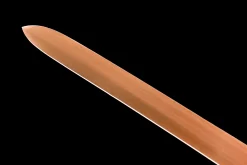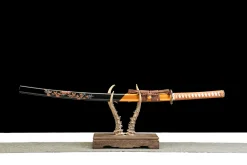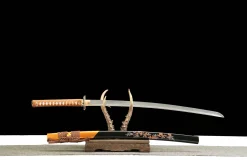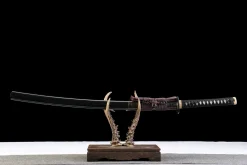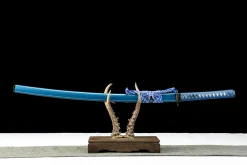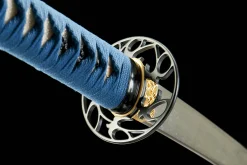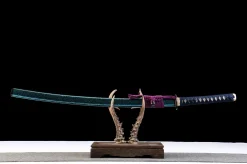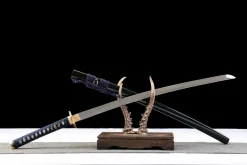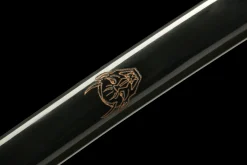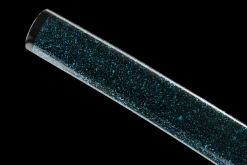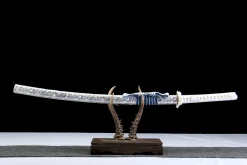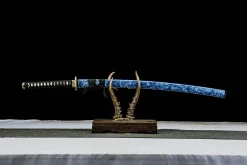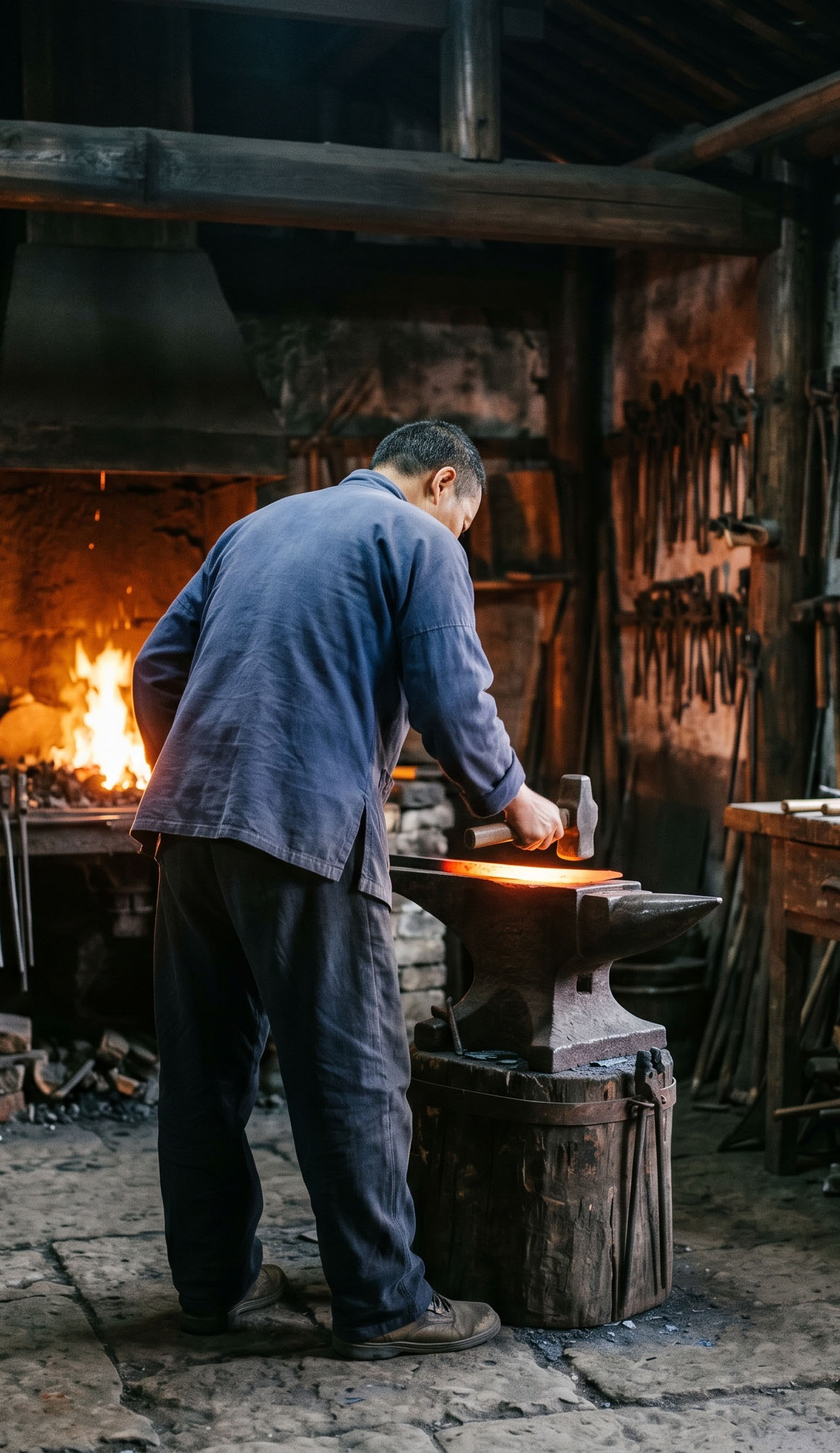

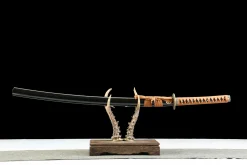


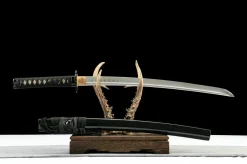
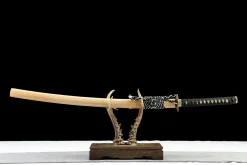


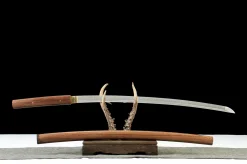
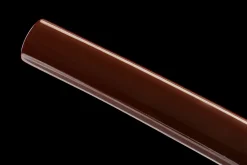
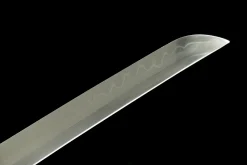
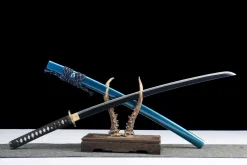
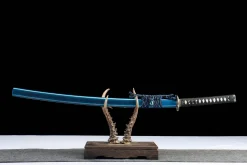
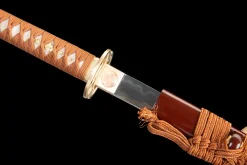
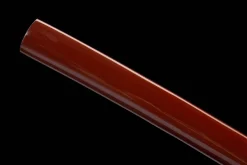
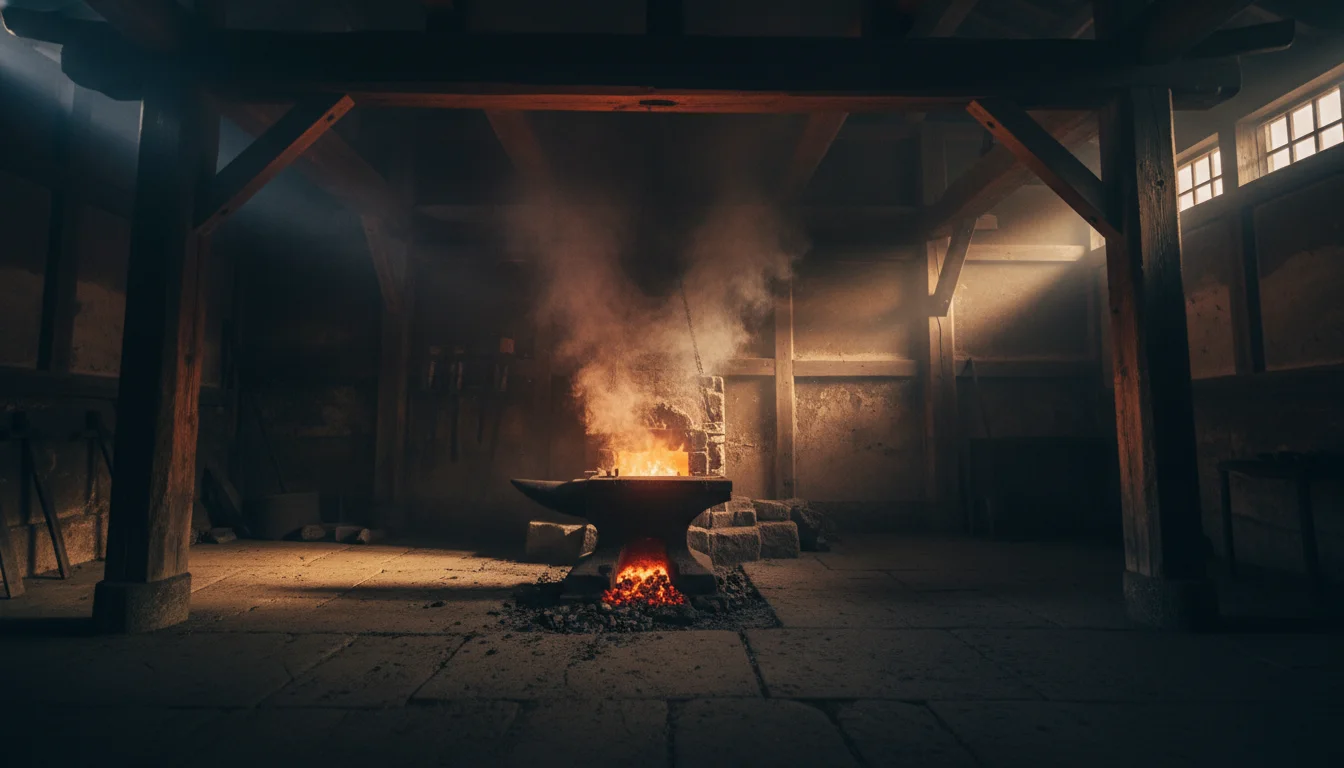
Every katana in this collection is forged in Longquan, the city that has produced blades continuously since the Spring and Autumn period. Steel choices range from clay-tempered T10 tool steel with a real, visible hamon to imported Japanese DC53 die steel at the top of the range. These are functional swords built around the shinogi-zukuri geometry, full tang construction, and genuine rayskin handles that serious buyers expect.
Why Choose Our Katana Swords
The katana’s geometry is not decorative. The shinogi-zukuri cross-section, with its raised ridgeline running the length of the blade, distributes impact stress in a way a flat grind simply cannot. Every blade we ship has that ridgeline ground by hand, checked against a straight-edge before it goes into polish.
Clay tempering is what separates a katana from a regular blade. A layer of refractory clay is applied to the spine before quench, insulating it so it cools slowly and stays relatively soft. The edge cools fast, hardening to HRC 58-62. That differential creates the hamon you see along the edge, and more importantly, a spine that absorbs shock instead of transmitting it to your hands.
Our handles are built on a wooden core, wrapped in genuine same (ray skin), then bound with cotton or silk ito in a tight diagonal pattern. Pull the handle off any blade we sell and you will find a full-length nakago secured with bamboo mekugi pins. No shortcuts at the part you cannot see.
How to Choose the Right Katana
Start with steel, not looks. T10 high-speed tool steel holds a fine edge and responds well to clay tempering, making it a strong choice for anyone who plans to cut with the blade. Our own forge-refined steel (自炼钢) is used in mid-range pieces where we control the carbon content from the start. At the top, the Night Slash uses imported Japanese DC53, a die steel with tighter alloying tolerances than most sword steels on the market.
Check the hamon before you buy. A real clay-tempered blade has a hamon that is uneven, slightly cloudy in places, and different on each side. A hamon that looks identical on both sides and perfectly smooth was either acid-etched or polished in. Honest product photos will show the difference.
Match the blade to your purpose. Functional cutting requires a full tang, properly fitted habaki, and a saya with enough retention to hold the blade securely. Display pieces can carry more elaborate fittings in softer materials. Know which you are buying before you decide on a price point.
Handle wrap tells you a great deal. Tight, even ito with no gaps at the crossings takes time to do correctly. Loose wrapping or uneven spacing is a sign that the rest of the assembly received similar attention. Read our full katana buying guide for a checklist you can use with any seller.
Frequently Asked Questions
What is the difference between T10 steel and DC53 steel in a katana?
T10 is a high-carbon tool steel with roughly 0.95-1.05% carbon and a small tungsten addition that improves wear resistance. It clay-tempers predictably and polishes to a clear hamon, which is why it appears across most of our mid-range katanas. DC53 is a Japanese cold-work die steel developed by Daido Steel. It has a more complex alloy composition including chromium and molybdenum, giving it higher toughness at equivalent hardness compared to most carbon steels. The Night Slash uses DC53 specifically because the steel holds a finer geometry at the kissaki without becoming brittle. It is a more demanding steel to forge and finish, which is reflected in the price.
How do I know if a katana's hamon is real or acid-etched?
A genuine clay-tempered hamon forms during the quench when the clay-insulated spine and the exposed edge cool at different rates. Under good light, it appears as a misty, irregular transition zone called the nie and nioi. The pattern shifts slightly depending on your viewing angle and will look different on each side of the blade. An acid-etched hamon is applied chemically after hardening. It tends to be perfectly consistent from side to side, crisper than a real hamon has any reason to be, and does not shift with the light the same way. All T10 blades in this collection are clay tempered, and we photograph the hamon under natural light so you can judge for yourself.
Can I use these katanas for tameshigiri (test cutting)?
Any katana in this collection marked as clay-tempered T10 or above is suitable for tameshigiri on rolled tatami targets. The full tang construction and bamboo mekugi pins are designed to handle the shock of a proper cut. Before your first cutting session, check that the habaki is seated firmly in the koiguchi, the mekugi pins have no play, and the ito wrap has no loosening at the tsuka. See our sword care guide for a full pre-use checklist. Blades with elaborate lacquer or gilded fittings are better kept as display or iaido practice pieces where cutting is not the primary use.
What blade length should I choose?
Standard katana blades run 70-73cm, which suits most adult practitioners. The measurement that matters more than overall length is the nagasa, the blade length from the habaki collar to the tip, not including the tang. For iaido and iaijutsu practice, your instructor will usually specify a nagasa range based on your height and draw style. A common rule is that the blade should clear the saya completely before your elbow bends past 90 degrees on the draw. If you are buying without an instructor, 72cm nagasa is a safe starting point for adults between 170-185cm tall.
What maintenance does a katana require?
Carbon steel blades will rust if left untreated. After handling, wipe the blade with a soft cloth to remove fingerprint oils, then apply a thin coat of choji oil or mineral oil along the entire surface. A blade stored in its saya for more than two weeks should be re-oiled before storage, since the saya itself can draw moisture against the steel. The edge geometry should be maintained with a whetstone, starting no coarser than 1000 grit to avoid removing too much material. Our sword care guide covers oiling schedule, storage position, and polish maintenance in detail.
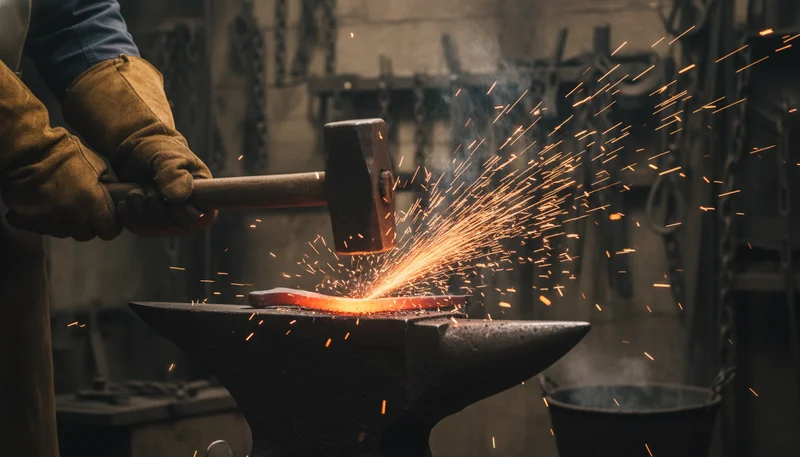
Hand-Forged in Longquan · Five Steel Grades
Katana Swords.
The full collection. Every steel grade we work with, from 1065 entry-level carbon to master-edition Damascus. Each blade is drawn from the saya, inspected at the hamon, and measured before it ships.
Katana Blades.


Clay-Tempered Damascus Steel
Abyss Edge – Hand Forged Clay-Tempered Damascus Steel Katana Sword
$524.99