






History & Culture
Anime Swords: From Screen to Steel

The Most Popular Anime Swords Right Now
Every few years, a new series reshapes what collectors want to see in steel. Right now, two franchises dominate that conversation: Demon Slayer and One Piece. Before either of those, Ghost of Tsushima – technically a video game, but animated in spirit – sent a wave of buyers looking for long, slender tachi geometry with understated fittings.
What these designs share is a basis in real Japanese sword tradition. Tanjiro’s black Nichirin blade follows standard katana proportions. Zoro’s Wado Ichimonji is a straight-gripped katana, nothing exotic about the handle construction. Ghost of Tsushima’s Jin Sakai carries a tachi worn edge-down. Anime exaggerates color and finish, but the underlying geometry is usually legitimate swordsmithing.
That legitimacy is exactly why we take anime-inspired commissions seriously here in Longquan. The source material gives us something real to work from.
Real vs. Fictional: What’s Actually Possible in Steel
Some requests we get are straightforward. A black blade? Achieved through a controlled forge scale finish or a forced oxidation process – no magic required, just time and fire. A blade with a visible hamon in red or blue? The hamon itself is real, a crystalline boundary formed during differential hardening. The color is fiction, but the pattern can be made to mirror what you see on screen remarkably closely.
Other requests push harder against physics. Blades that are six feet long and two inches wide would flex under their own weight in any steel that could hold an edge. Blades that glow are a lighting effect, not a material property. A few design elements – extreme curve radius, paper-thin cross-sections near the kissaki – are real structural weaknesses that would make a sword unsafe to handle.
What we tell every customer: the closer an anime design sits to historical Japanese sword geometry, the better the result in real steel. When the design drifts into pure fantasy – unusual proportions, asymmetric cross-sections, hollow handles for concealing multiple blades – we’ll tell you exactly what we can replicate faithfully and where we’d need to adapt.
Our buying guide walks through these decisions in detail, including how to read a product specification so you know what you’re ordering before the forge gets involved.
Our Anime-Inspired Collection
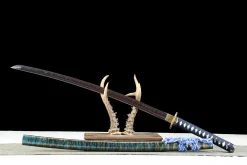
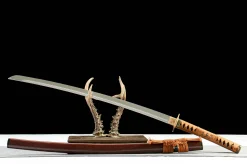
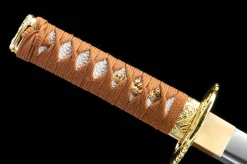
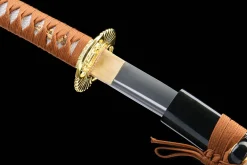
We built this range specifically for collectors who want screen-accurate aesthetics on a blade that is also a genuine cutting instrument. Every sword below is hand-forged in Longquan, heat-treated to functional hardness, and finished with the kind of attention to surface detail that separates a decorative replica from a real sword.
Steel selection matters more here than in a standard katana order. Anime-inspired blades often involve unusual finishes – deep stone-wash patterns, high-contrast hamon lines, or specific tsuba shapes. The steel comparison guide explains how T10, T8, and san-mai construction each respond to different finishing approaches.

Ink Meteor
San-mai (三枚合) construction with a high-carbon core , $775

Silent Thunder
T10 High Speed Tool Steel with a deep stone-wash finish , $280

Dark Ravine
T10 High Speed Tool Steel with aggressive hamon detail , $340
What “Hand-Forged” Means for These Blades
Every blade in this range starts as a steel billet, not a stamped blank. A forged blade has grain flow that follows the profile of the sword. A stamped or ground blade cuts across that grain, which affects how the steel responds under lateral stress. You won’t see that difference in a photograph, but you’ll feel it if you ever put the sword to serious use.
One thing worth knowing about stone-wash finishes on anime-inspired blades: the process involves tumbling the finished blade with abrasive media. This means you’re getting that surface texture on a blade that has already been hardened and tempered. Doing it in the wrong order – tumbling first, then heat treatment – would distort the geometry. We do it correctly. That sounds obvious, but not every workshop does.
Ghost of Tsushima: Jin Sakai’s Tachi in Real Steel
The sword Jin Sakai carries in Ghost of Tsushima is based on a tachi – a longer, more deeply curved predecessor to the katana, traditionally worn suspended from the belt with the edge down. Most katana replicas are designed as katana, worn edge-up through the obi. The difference in curvature, blade length, and sori (curve) geometry is real and visible if you know what to look for.
Our Ink Meteor comes closest to that tachi aesthetic. The san-mai (三枚合) construction gives you a hard high-carbon core for edge retention with a softer wrought-iron cladding on the sides. This is the same structural logic historical Japanese smiths used for tachi intended for mounted combat – you need a blade that can flex slightly without the edge chipping.
The surface finish on the Ink Meteor’s blade shows a visible grain pattern from the san-mai layers. Under certain lighting, that folded texture reads similarly to the worn, weathered sword aesthetic that Sucker Punch built into Jin’s weapon design. It is not accidental on our end. That finish is the result of controlled forge work, not post-production grinding.
Browse our full range of katanas if you want to compare geometry across the whole collection, or look at our Damascus steel category for blades where the surface pattern is even more pronounced.
Demon Slayer Nichirin Blades: The Black Blade Question
Tanjiro’s sword turns black when he first draws it, which is treated in the series as unusual and ominous. Historically, a black blade finish is simply forge scale – iron oxide that forms on the surface during the hardening process and is intentionally preserved rather than polished away. It is not rare. It was common on working swords that didn’t need a mirror finish.
What we do with our Nichirin-inspired blades is use a controlled clay-coat hardening process to produce the hamon, then finish the blade body with a forge scale or forced-oxidation black. The contrast between the dark body and the bright hamon line running along the edge is sharp and clean. The Silent Thunder at $280 uses T10 high-carbon tool steel for this – T10 takes a particularly crisp hamon because of its fine carbide structure.
T10 steel, hardened correctly, runs HRC 58-60 on the Rockwell scale. That is functional hardness for a cutting sword. The Dark Ravine uses the same steel with a different hamon pattern – a wilder, more turbulent activity line that reads closer to the irregular Nichirin hamon you see on Inosuke’s dual blades in the series.
One practical note for new owners: black-finished blades show fingerprints and water spots more readily than polished steel. A light coat of choji oil after every handling session keeps the surface stable. Our sword care guide covers the full maintenance routine.
Frequently Asked Questions
Ready to Find Your Blade?
