






Buying Guides
Best Katana Under $200: 2026 Picks
What to Expect for Under $200
Let’s be straightforward about this price range. Two hundred dollars does not buy you a clay-tempered, hand-polished blade with a hamon that took a smith three days to produce. What it does buy, if you choose carefully, is a functional, properly heat-treated sword that will hold an edge, survive test cutting, and not embarrass you at a dojo.
The honest floor for a sword worth owning is around $80-100. Below that, you are buying wall decoration with a blade-shaped profile. At $150-200, you start finding pieces built from 1045 or 1060 carbon steel, factory-ground to workable geometry, with fittings that won’t rattle apart after six months.
What you should realistically expect in this bracket: a blade hardened to approximately HRC 52-58, a full-tang construction, a functional wooden saya, and fittings that are assembled rather than individually finished. The geometry will be there. The metallurgical soul of the steel, the differential hardening, the hand-polished ji, the fitted habaki that clicks home with exactly the right resistance, those details belong to a different price conversation.
For iaido beginners, tameshigiri practice on rolled mats, or someone who wants to understand how a katana actually feels in hand before investing further, this range is perfectly reasonable. Browse our full katana collection to see where the $200 bracket sits relative to the broader range.
Our Top 5 Picks
None of the five picks below sit at exactly $200. Two of them exceed it modestly. We included them because the jump from $200 to $230 or $280 is meaningful in terms of steel quality, and we would rather show you what that extra money actually buys than pretend the boundary is a hard line.
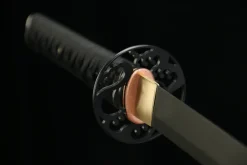
1. Dark Night Slash – $230 (T8 Carbon Steel)
The Dark Night Slash is the closest to the $200 mark and the most honest entry point we carry for a buyer serious about cutting. T8 steel sits at roughly 0.75-0.85% carbon content. It hardens well, typically reaching HRC 56-58 with proper quenching, and it has enough toughness to absorb lateral stress without the brittleness that comes with higher-carbon options.
T8 is not as hard as T10, and it will not hold a fine edge quite as long. For a beginner working through cutting fundamentals on tatami omote, that’s actually an advantage. A slightly softer blade is more forgiving of technique errors that would chip a harder edge. Think of it as a steel that penalizes bad form with a dull edge rather than a cracked blade.
The fittings on the Dark Night Slash are functional and clean. The tsuka wrapping is tight with no gaps at the samekawa underneath. One thing to check when yours arrives: run your thumb along the mune from habaki to nakago. Any rough file marks near the habaki collar indicate the finish was rushed, and the Dark Night Slash has consistently passed this check across our quality control batches.
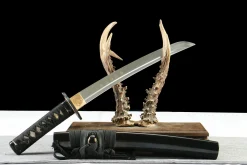
2. Silent Thunder – $280 (T10 High Speed Tool Steel)
The Silent Thunder steps up to T10, which is where the conversation about edge retention actually changes. T10 contains approximately 0.95-1.04% carbon plus trace tungsten, which refines the grain structure and improves wear resistance compared to standard high-carbon steels at similar hardness levels.
At HRC 58-60, a T10 blade will hold a sharpened edge through significantly more cutting volume than a 1060 or T8 blade at the same sharpness. The trade-off is that T10 is less forgiving of lateral flex. You sharpen a T10 blade with the understanding that it rewards clean, committed cuts.
The Silent Thunder’s geometry is worth noting specifically: the blade width at the hamachi runs approximately 3.1cm, tapering to a functional kissaki with a distal taper that keeps the point from feeling club-like. That profile is better thought through than most swords at this price point.
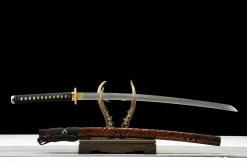
3. Dark Ravine – $340 (T10 High Speed Tool Steel)
The Dark Ravine at $340 is over our stated ceiling, but it earns a spot here because it represents the clearest argument for stretching your budget. Same T10 steel as the Silent Thunder, but the finishing work on the Dark Ravine is a step up. The blade surface shows more care in the hand-polishing stages, and the tsuba fit at the habaki is noticeably tighter.
For anyone who has handled a lot of swords in this range, the difference between a 15-minute machine polish and a hand-polished finish is immediate. The ji on the Dark Ravine catches light differently. It shows the grain of the steel rather than concealing it under a uniform satin sheen.

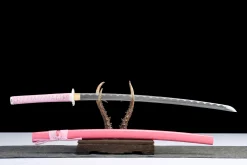
Dark Night Slash
T8 carbon steel entry point – $230

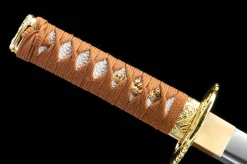
Silent Thunder
T10 tool steel with refined grain – $280

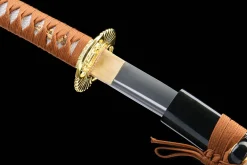
Dark Ravine
T10 with superior finish work – $340
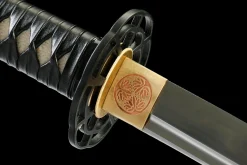
4. Dark Gold – $290 (T10 High Speed Tool Steel)
The Dark Gold at $290 occupies a similar technical specification to the Silent Thunder but with different aesthetic choices in the koshirae. If the fittings matter to your intended use, whether display or dojo training, it’s worth comparing the two side by side on the product pages. Mechanically, both run T10 steel at HRC 58-60 with comparable blade geometry.
5. Brown Gleam – $290 (T10 High Speed Tool Steel)
Same steel, same price bracket as the Dark Gold. The Brown Gleam distinguishes itself through its tsuka construction and the finish on the saya. The lacquer on the saya is applied in more layers than typical in this range, which matters for moisture resistance over time. If you live somewhere humid, that detail is not cosmetic.
Steel Types in This Range
You’ll encounter three steel types most commonly in the sub-$300 bracket: 1045, 1060, and T8/T10. Understanding what those numbers mean helps you evaluate what you’re buying rather than trusting marketing descriptions alone. Our steel comparison guide covers this in full technical detail, but here’s the working version.
1045 carbon steel contains approximately 0.45% carbon. It can be hardened, but the maximum practical hardness sits around HRC 55, and edge retention is modest. This steel is fine for display or very light use. For regular tameshigiri, it will need frequent sharpening.
1060 carbon steel at 0.60% carbon is a meaningful step up. Tougher than 1045, it handles lateral stress better and is often the steel of choice for practitioners who prioritize durability over maximum hardness. Many senior practitioners actually prefer 1060 for heavy cutting sessions precisely because a slightly softer blade is more resilient when technique isn’t perfect.
T8 and T10 are tool steels rather than simple carbon steels. T10 specifically includes trace tungsten, which improves wear resistance at the molecular level. At equivalent hardness, a T10 blade will hold its edge longer than a 1060 blade. The catch is that tool steels are less forgiving of lateral stress and improper sharpening. Use a whetstone at the correct angle, around 10-12 degrees per side, or you’ll roll the edge rather than sharpen it.
Damascus steel options don’t realistically appear in this price range from a reputable source. If someone is selling you “Damascus” for $150, the pattern is either acid-etched onto a single steel or the layering was done so carelessly that it offers no structural benefit. Real pattern-welded Damascus, like our Damascus collection, requires significantly more forge time to produce correctly.
What You’re Sacrificing vs Premium
This is the section most budget guides skip. We’d rather you understand the gaps clearly, because knowing what you’re missing helps you use the blade appropriately and decide when to upgrade.
Clay tempering and hamon. A genuine hamon, the visible line between the hardened edge and the softer spine, requires clay application before quenching. That process takes skill, time, and creates unpredictable, individual results. No two clay-tempered blades come out identical. At under $200-230, you will not find this. The blade is through-hardened, uniform from edge to spine. It functions, but it lacks the differential hardness that makes a clay-tempered blade simultaneously hard at the edge and tough at the spine.
Hand polishing. A full polish by a trained togishi takes 8-20 hours and works through progressively finer stones to reveal the steel’s true surface. Budget blades are machine-polished to a consistent satin finish. The difference is visible and tactile. More importantly, a proper polish reveals flaws in the steel. Machine polishing can obscure them.
Fitted components. On a well-made sword, every component fits with specific intention. The habaki is sized to the individual blade. The tsuka is shaped and wrapped to the tang. Budget swords use standardized components assembled to acceptable tolerances. They work. They just aren’t specific.
Read our full buying guide for a breakdown of every component and what quality looks like at each price tier.
Upgrade Path
If you’re starting with a $200-230 blade, the logical next step is not immediately jumping to a $700 custom order. The upgrade path has clear intermediate stations.
$280-340: T10 steel with better finishing. The Silent Thunder and Dark Ravine represent this tier. You get meaningfully better edge retention and a blade surface that actually shows the steel’s character.
$340-500: Clay tempering becomes available. This is where differential hardness enters the picture and where a real hamon appears. The blade starts behaving differently in the hand because the spine and edge are genuinely different materials joined at the quench line.
$500+: Hand selection of materials, more forge time, individual fitting of components, and longer finishing stages. Our Ink Meteor at $775 uses san-mai construction, three layers of steel with a hard core and softer outer cladding, which represents a genuinely different manufacturing approach rather than an incrementally better version of the same process.
The best way to use a budget blade is to learn what you want from it. After six months of regular cutting practice or daily iaido kata, you’ll know exactly which qualities matter to you. That knowledge makes the upgrade decision easy. For maintenance while you practice, our sword care guide will extend the life of any blade in this range significantly.
Frequently Asked Questions
Ready to Find Your Blade?
