






Buying Guides
Best Katana Under $500: Premium Without the Premium Price
The Sweet Spot: Why $200-500 Is Where Quality Lives
Below $150, you are buying wall art. The steel is usually 420 stainless, the heat treatment is inconsistent, and the handle wrap will loosen inside six months. Nobody in our workshop would put their name on one of those blades.
Above $800, you are paying for heirloom-grade finishing, hand-polished geometry, and materials like san-mai laminate or high-layer Damascus that take three times as long to produce. That price is justified. But not everyone needs that blade on day one.
The $200 to $500 range is where the math finally works in the buyer’s favor. At this price, Longquan smiths can use real high-carbon steel, genuine clay tempering, full-tang construction, and hand-wrapped tsuka with actual samegawa ray skin. The fittings stop being pot metal and start being brass or iron. The hamon is real, not etched on with acid.
If you are choosing your first functional katana, or you cut regularly and want a reliable workhorse, this is where to spend your money. Browse our full katana collection and you will see most of the serious volume sits right here.
Our Top 5 Premium Picks
These five blades are what we actually recommend when customers email asking for a functional katana without going over budget. Each one ships from Longquan, each one is hand-forged, and each one has a documented steel spec, not just a label.

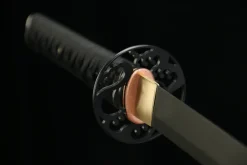
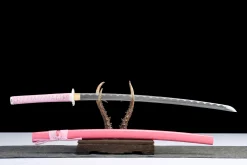
Silent Thunder
T10 tool steel with clay temper, $280. Clean geometry and a genuine hamon.

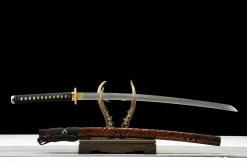
Dark Ravine
T10 tool steel, $340. Fuller-ground blade with a slightly longer nagasa for two-hand cutting work.

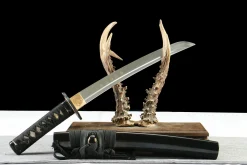
Dark Gold
T10 tool steel, $290. One of our best-selling handles, with a dark-wrap tsuka that holds grip in wet conditions.
Silent Thunder – $280
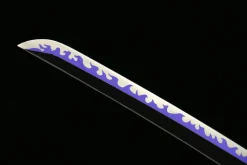
The Silent Thunder runs on T10 high speed tool steel with a clay temper that produces a distinct, irregular hamon line. T10 sits at roughly 1.0% carbon content with trace tungsten, which gives it better wear resistance than most 1060 or 1075 blades in this price class. Hardness at the edge lands between HRC 58 and 60 after differential hardening. The spine stays softer, around HRC 40, so the blade absorbs impact rather than cracking.
One thing you notice immediately when handling this one: the kissaki geometry is properly maintained. A lot of budget blades let the tip get fat and blunt during grinding because it takes time to shape. This one doesn’t cut corners there.
Dark Ravine – $340
At $340, the Dark Ravine is the blade we recommend when someone wants to do actual cutting practice, not just display. Same T10 steel as the Silent Thunder, but the profile is ground with a fuller that reduces cross-section weight without sacrificing rigidity. The result is a blade that swings faster through a downstroke than its 28-inch nagasa suggests it should.
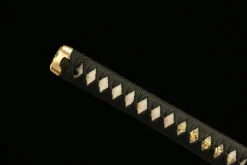
The tsuka on this model uses a tighter cotton ito wrap over genuine ray skin. Handle wraps on entry-level swords often use synthetic leather, which compresses and slips after repeated grip-intensive sessions. Ray skin doesn’t compress.
Dark Gold – $290
The Dark Gold’s strongest feature is practical: the dark-wrap tsuka hides wear better than light-colored wraps, and the fuchi and kashira fittings are iron rather than painted zinc alloy. You can tell the difference by weight. Iron fittings add a small but noticeable mass to the handle assembly, which helps balance the blade’s forward bias.
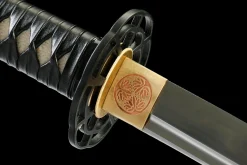
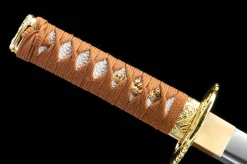
Brown Gleam – $290
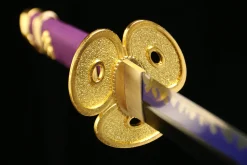
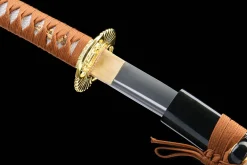
The Brown Gleam uses the same T10 steel specification but pairs it with a tsuka wrapped in brown ito over a natural ray skin panel. The tsuba on this model is a round iron guard with a minimal finish, which keeps the overall aesthetic clean. For practitioners who train in a traditional school and care about visual authenticity, this one sits closest to classical shinogi-zukuri proportions.
Dark Night Slash – $230
At $230, the Dark Night Slash is the most accessible blade on this list. It uses T8 steel rather than T10, which means slightly lower carbon content and a bit less wear resistance at the edge. That is a real difference, not a marketing footnote. T8 is still a legitimate high-carbon steel that responds well to heat treatment, and for someone who is cutting occasionally rather than drilling through fifty mats a week, it performs perfectly well. This is the honest entry point into functional swords from Longquan.

Brown Gleam – $290
T10 steel, classical proportions, round iron tsuba.

Dark Night Slash – $230
T8 steel, functional cutter, the most accessible blade on this list.
T10 vs Damascus at This Price Point
Customers ask this question constantly: should I go T10 or Damascus? The short answer is that under $500, T10 is almost always the better cutting tool. Here is why.
Damascus steel in this price range is typically pattern-welded from two alloys, usually a high-carbon steel folded against a lower-carbon steel to create the visible grain pattern. The visual result is striking. Functionally, the edge is only as hard as the high-carbon component in the weld, and at lower price points, the layer count tends to be 64 to 128 rather than the 300-plus layers you see in higher-end work. See our steel comparison guide for the full breakdown of how layer count affects performance.
T10, by contrast, is a uniform steel throughout. The carbon distribution is consistent, so the heat treatment is predictable, the edge geometry holds up, and if you chip the blade, a competent smith can re-profile and re-temper without worrying about what alloy is at which depth. For daily use, that matters.
That said, Damascus in this range is not a bad choice if you understand what you are buying. The Damascus katanas in our collection are built with cutting use in mind, not just display. The pattern-welding is structural, not cosmetic. If the visual is important to you and you are not planning to cut five days a week, a mid-range Damascus sword is a legitimate option.
The honest truth from the forge floor: T10 blades are easier to maintain, easier to sharpen, and more forgiving of improper storage. If you are newer to sword ownership, our sword care guide covers the basics, and a T10 blade will give you more margin for error on all of it.
What $500 Gets You That $200 Doesn’t
Spending $500 versus $200 on a katana is not about prestige. It is about specific, measurable differences in materials and labor time.
Steel and Heat Treatment
At $200, you are working with T8 or occasionally a lower-grade 1075. Both are functional. At $400 to $500, the blades consistently use T10 or equivalent high-speed tool steels. The extra 0.2% carbon at the top of the range affects edge retention in ways you will feel after a dozen cuts rather than right away. The differential hardening at the higher price point is also done with more care: the clay application is thicker at the spine, the quench timing is tighter, and the resulting hamon is more defined.
Fittings and Furniture
Handle fittings on $200 blades are often zinc alloy with a painted finish. At $350 and above, you start seeing iron, brass, or copper tsuba, fuchi, and kashira. Iron fittings corrode differently than zinc. They develop a patina rather than flaking, and they can be cleaned and maintained for decades. Zinc fittings cannot.
The habaki, that collar piece that fits tight against the saya opening, is another tell. A well-fitted habaki on a $400 blade holds the sword snug in the scabbard without rattling. On a cheaper blade, you sometimes feel play in the fit. That gap lets moisture in, which starts the clock on rust inside the saya where you cannot see it.
Polish and Edge Geometry
Longquan smiths spend a significant portion of a blade’s production cost on the polishing and edge-setting stages. A $200 blade might have four to six hours of finishing work. A $450 blade can have ten to fourteen. You see this in how the shinogi line sits relative to the edge bevel, in the consistency of the ha thickness from machi to kissaki, and in whether the tip geometry holds its proper angle or drifts.
If you are serious about making an informed purchase, read through our full buying guide before deciding. We cover everything from measuring nagasa to matching blade geometry to your cutting style.
The top end of this budget, around $450 to $500, also begins to approach san-mai territory. The Ink Meteor at $775 uses a full san-mai laminate construction, three layers with a high-carbon core, and represents the next step up from this budget range. Worth knowing what you are working toward.
Frequently Asked Questions
Ready to Find Your Blade?
