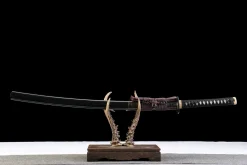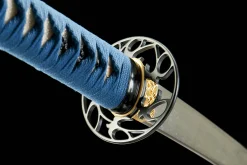


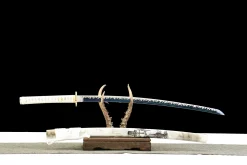
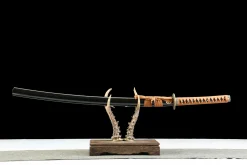


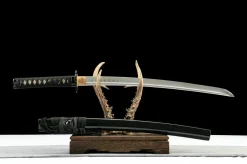
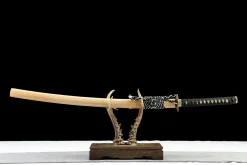


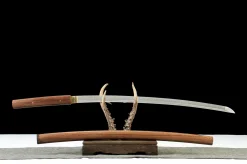
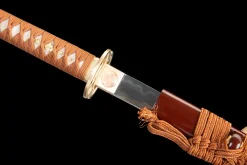

A katana left unattended for six weeks in a humid room will show surface rust. Six months without re-oiling in a wooden saya, and the wood will have pulled every drop of protection from the blade. We have seen it happen to swords that took forty hours to forge and grind. Proper katana care is not complicated, but it is non-negotiable. This guide covers the full maintenance cycle for carbon steel and Damascus blades, the products that actually work, and the mistakes that quietly destroy a polish. If you want the short version of our core care instructions, our sword care reference guide has a quick-reference checklist. This post goes deeper. Every time you handle a bare blade, you deposit oil and salt from your skin onto the steel. On a 1095 or T10 blade, fingerprints can begin oxidizing within a few hours in warm, humid conditions. The daily routine takes under five minutes and should happen without exception. Step 1. Draw the blade slowly from the saya by holding the handle, never the blade itself. Grip the tsuka, not the steel. Step 2. Take a soft, lint-free cloth and wipe from the habaki toward the kissaki in a single, controlled stroke. Always wipe away from your body, always in one direction. This removes old oil, dust, and any fingerprints from previous handling. Step 3. Apply 2-3 drops of choji oil to a clean cloth and spread a thin, even coat across both flat faces and the mune. Choji oil is camellia-based and does not go rancid the way cooking oils do. Mineral oil works as a practical substitute. Do not use WD-40. It leaves a sticky residue that traps dust and eventually traps moisture underneath it. Step 4. Return the blade to the saya with the cutting edge facing upward. Edge-down storage will cause the ha to cut into the wooden liner over time, damaging both the polish and the saya itself. One detail most guides skip: when you slide the blade back into the saya, you should feel a slight snug resistance at the habaki collar. That friction is intentional. A well-fitted habaki creates a near-seal that slows the exchange of humid air around the blade. If the fit feels loose, the saya may have warped or dried out. Even a stored, unhandled blade needs attention once a month. Wood is hygroscopic. The saya will slowly absorb the oil from your blade surface, leaving sections of bare steel exposed. A monthly inspection catches this before rust takes hold. Once a month, use an uchiko powder ball to lightly tap polishing powder along the flat of the blade. Then buff it off with a soft cloth, using the same base-to-tip motion. Uchiko contains fine stone powder that removes minor surface oxidation and residue without abrading the polish. Follow immediately with a fresh coat of choji oil. Do not skip the re-oiling after uchiko. The powder removes the old oil layer entirely. A blade left dry after an uchiko application is more vulnerable than one that was never cleaned at all. While the blade is clean and lit well, examine the hamon line on your clay-tempered swords. The hamon should appear as a distinct, misty transition zone between the hard edge and the softer spine. If you see small dark spots anywhere on the blade, particularly near the shinogi ridge where water tends to collect, address them immediately with uchiko and oil before they develop further. Twice a year, spring and autumn, give every blade in your collection a full inspection. These are the seasons when humidity swings most dramatically, and stored swords take the most stress from those changes. Pull each blade fully from its saya and let it sit at room temperature for fifteen minutes before applying oil. A cold blade brought into a warm room will develop condensation on the surface, and oiling over condensation traps moisture against the steel. Let the temperature equalize first. Inspect the saya as well. Check the interior for any wood debris, dried lacquer flakes, or grit that could scratch the blade during drawing and sheathing. A saya that rattles or has developed cracks should be replaced or repaired before it damages the blade. This is also the right time to check the tsuka wrap and the mekugi. The bamboo pin that secures the blade to the handle can dry out and shrink over time. A loose mekugi is a safety issue, not a cosmetic one. If it moves when you push it, replace it. You do not need an expensive kit. You need the right four items, used correctly. Mineral oil is an acceptable substitute for choji oil if you are maintaining a practice blade or want a lower-cost option. Use food-grade mineral oil. Do not use motor oil, vegetable oil, olive oil, or any oil with organic compounds that will eventually break down and become acidic against your steel. Most blade damage we see comes from a short list of repeated errors. These are the ones worth knowing before they cost you a polish or a blade. You clean the blade, you oil it, you admire your work, and then you grab the flat of the blade with your palm to check the reflection. Now you have left a fresh set of fingerprints on a freshly cleaned surface. Skin oils work fast on carbon steel. Handle by the handle, always. If you need to examine the blade under light, hold it by the tsuka and rotate. Wood draws moisture from its environment, and it will pull oil from your blade surface given enough time. A sword stored in its saya for three months without inspection will often show dry patches on the blade where the wood has absorbed the protective layer. Monthly re-oiling is not optional for stored blades. WD-40 is a water displacer, not a protectant. The carrier solvent evaporates and leaves a light petroleum residue that attracts airborne dust. That dust then holds moisture against the steel. People reach for it because it is familiar, but on a polished blade it creates more problems than it solves. Basements, garages, and bathrooms are the three worst environments for stored swords. Humidity above 60% will overwhelm a thin oil coat, particularly on 1095 and 1065 carbon steels, which are reactive. Store blades horizontally in a low-humidity room, ideally with a silica gel packet in the storage bag or display case. Target relative humidity between 40% and 55%. A paper towel is abrasive enough to scratch a polished blade surface under pressure. Steel wool, rough cloth, or any scouring material will destroy the polish and obscure the hamon. If you have surface rust that a soft cloth and uchiko cannot remove, consult a professional polisher. Aggressive home remedies do permanent damage. Not every blade follows the same protocol. The steel type matters, and so does the construction method. Our steel comparison guide covers the metallurgical differences in detail, but here are the care implications. These are the most reactive steels we work with. T10, with its tungsten content, holds an edge longer than 1095 but is no more rust-resistant. After every handling, every time, oil the blade. The Silent Thunder and Dark Ravine are both T10, clay-tempered with a differential hardness between HRC 58-62 at the edge and HRC 40-42 at the spine. That softer spine is actually more prone to oxidation than the hard edge. Do not neglect the mune when oiling. Damascus blades from our Damascus steel collection require extra attention because the layered construction creates micro-channels between the folded layers. Moisture can settle into those fine boundaries and cause hidden corrosion that is not visible on the surface until it has already progressed. Apply choji oil slightly more generously than you would on a mono-steel blade, working the oil into the pattern with a soft cloth rather than wiping it across quickly. If the pattern looks dull or flat, use uchiko powder followed by a fresh oil coat. The powder gently restores contrast in the surface without removing material. Never use chemical etching agents, acidic cleaners, or abrasive pastes to “restore” a Damascus pattern at home. You will damage the surface layer and the pattern below it. The Ink Meteor uses San Mai construction, with three distinct layers rather than hundreds of folded ones. The same principles apply, but pay particular attention to the junction lines where the outer cladding meets the core steel. Those transitions are where dissimilar metals meet, and moisture at those seams causes galvanic corrosion faster than on a single-material blade. Stainless steel blades are often marketed as low-maintenance, and they are, in the sense that they resist rust. But they also cannot be differentially tempered, cannot produce a true hamon, and the hardness ceiling is lower than what we achieve with T10 or folded steel. If you are looking at our full katana range and considering stainless for ease of care, read the buying guide first. Most buyers who start with stainless end up wanting a carbon steel blade within a year.
Daily Care After Handling
Monthly Maintenance Routine
The Uchiko Step
Inspect the Hamon
Seasonal Deep Care
Swords Worth Maintaining
Products You Need
Common Mistakes That Damage Swords
Touching the Blade After Cleaning
Storing Without Re-Oiling
Using WD-40
Humidity and Improper Storage
Abrasive Cleaning
Steel-Specific Care Tips
Carbon Steel: 1045, 1065, 1095, T10
Damascus and Pattern-Welded Steel
Stainless Steel: What We Do Not Recommend for Serious Collectors
Frequently Asked Questions
Hand-Forged Katana — Browse the Collection.
Clay-Tempered Damascus Steel Abyss Edge – Hand Forged Clay-Tempered Damascus Steel Katana Sword