
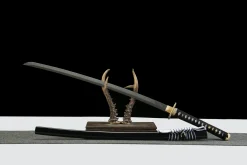
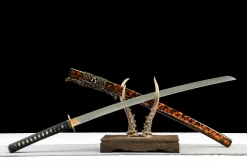
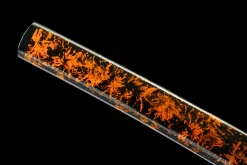
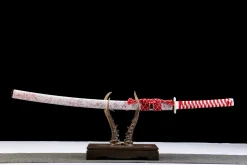
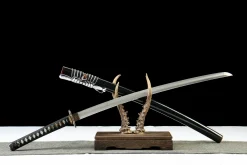
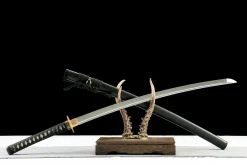
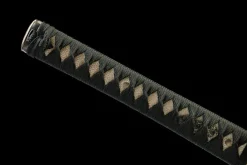
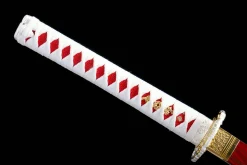
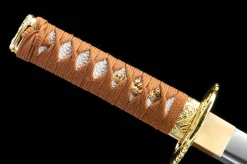
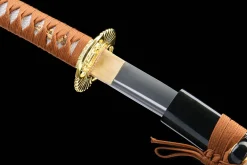
Every sword in this collection is a fully functional, hand-forged blade that also happens to demand a wall mount or a display stand. These are not decorative replicas. From the DC53 tool steel of the Night Slash to the ladder-pattern Damascus of the Damascus Blade Tang Dao, each piece is built in Longquan by smiths who treat the geometry of a grind line the same way a carpenter treats a dovetail joint , nothing is approximate. If you are building a collection around provenance, process, and verifiable materials, this is the category to start in.

Why Choose Display & Collection

A display sword earns its place on the wall by being worth looking at up close. That means the hamon line on a clay-tempered blade like the Silent Orchid Wakizashi needs to be consistent and clearly defined , not a smear left by rushed polishing. Our smiths use traditional tsuchioki clay application before the quench, which produces a hamon with the activity and nie crystals that collectors actually inspect with a loupe.

The same principle applies to our Damascus pieces. The Damascus Iron Tang Dao and the Damascus Blade Tang Dao both use a tiantimosaic ladder pattern , 天梯纹 , which requires precise layering and acid etching to reveal the grain. Get the fold count wrong, or rush the etch, and the pattern turns muddy. Ours does not.

Steel selection is where most buyers stop asking questions. We do not let you. The Night Slash uses Japanese-import DC53 tool steel, a cold-work die steel that holds an edge at HRC 60-62 and polishes to a mirror finish without the orange-peel texture you sometimes see on cheaper tool steels. For our self-smelted steel blades , 自炼钢 , our smiths control the carbon content from the melt, which is why the Azure Void and Crane Shadow have grain consistency that factory bar stock simply cannot match.

How to Choose a Display & Collection Sword

1. Decide what the blade will tell visitors about itself. A clay-tempered blade like the Golden Kirin Wakizashi shows its hamon clearly even across a room. A Damascus piece like the Damascus Tang Dao rewards closer inspection. Both are valid choices , but they are different conversations.

2. Match steel to your environment. High-carbon self-smelted steel requires more maintenance than stainless alternatives. If the blade is going on a wall in a humid room without climate control, factor that into your choice and read our sword care guide before you commit.

3. Check the polish grade. The Ink Scale Flowing Light is listed as polished with a yokote line , that detail matters. A proper yokote means the smith cut the geometry of the point with enough precision to define the boundary between shinogi-ji and fukura. That is not cosmetic. It is a measurement of how well the blade was ground.

4. Consider blade geometry alongside material. The Celestial Jade uses a sanmai sandwich construction , 自炼钢夹钢 , where a hard high-carbon core is wrapped in softer iron. Under display lighting, the boundary between the two layers is visible along the shinogi. That structural detail becomes part of how the sword looks on a stand. If you want to understand construction types before buying, our buying guide covers this in depth.

Frequently Asked Questions

Every blade in this category is fully functional. The Ink Scale Flowing Light uses T10 high-speed tool steel with differential hardening , that is an iaido-grade construction, not a wall-hanger setup. Display swords from Longquan are built on the same forging process as our cutting swords. The distinction is that these pieces prioritize visual detail , hamon clarity, surface polish, pattern work , alongside performance rather than instead of it. We do not produce blades that are purely ornamental.
Quite a lot. When the smith applies tsuchioki clay to the blade before quenching , leaving the edge exposed and the spine insulated , the edge cools faster and hardens to roughly HRC 58-60 while the spine stays softer at HRC 40 or below. The boundary between those two hardness zones is the hamon. On a polished blade like the Golden Kirin, that boundary appears as a visible misty line running along the blade’s length, often with nie (fine martensite crystals) and nioi (a softer cloudy activity) that shift under different lighting angles. No two hamon are identical , the clay application is done by hand, so the activity patterns are unrepeatable. That is what makes a clay-tempered display blade worth examining closely.
The main risks are humidity, fingerprints, and dust. Skin oils are acidic enough to etch bare high-carbon steel within a few days, so handle the blade only with cotton gloves or a clean cloth. Wipe the blade down with a light coat of choji oil , about 1-2 drops on a flannel cloth, wiped along the flat from habaki to kissaki , every 4 to 6 weeks if the room is climate-controlled, more often in humid conditions. Remove dust with a soft brush before oiling so you are not dragging abrasive particles across the polish. Our sword care guide covers the full maintenance schedule, including what to do if you spot early surface rust.
Self-smelted steel means our smiths start with raw iron and control the smelting process themselves, adjusting carbon content and removing impurities before the steel is ever hammered. The result is a blade with a grain
[/accordion-item] [/accordion]