
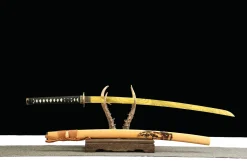
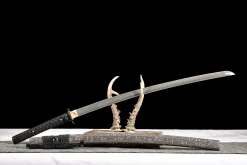
The Katana Buying Guide: What Actually Matters Before You Spend a Dollar

Most people get this wrong. They search for a katana, find something that looks right, and order based on photos. Then the blade arrives, they hold it for thirty seconds, and something feels off. The geometry is wrong. The handle wobbles. The edge rolls on the first cut. That is a disappointing way to spend two or three hundred dollars.

This guide exists so that does not happen to you.

We are based in Longquan, which has produced swords continuously for over 2,600 years. Our forge team handles blades every day, and we have seen what separates a sword that performs from one that disappoints. Steel type, heat treatment, handle construction, hardware fit – each decision compounds. Get three of them right and you have a good blade. Get all of them right and you have something worth passing on.

Read this before you buy. It will save you money, and it will get you the right blade the first time.

, –

Steel Types Explained

Carbon content determines how a blade behaves. Get above roughly 0.6% carbon and steel holds an edge. Get to 0.95% and you are in high-performance territory. Add tungsten, manganese, or silicon and you start changing specific properties. None of this is magic – it is metallurgy, and it has measurable consequences.

Here is what each steel type actually delivers, rated on a 1-10 scale with real tradeoffs. For a deeper technical breakdown, see our steel comparison guide.

1065 Carbon Steel

  • Edge retention: 6/10
  • Toughness: 8/10
  • Ease of sharpening: 9/10
  • Corrosion resistance: 3/10
  • Hamon potential: Faint
  • Price index: Budget-friendly

Think of 1065 as the Honda Civic of sword steels. Reliable, affordable, does everything you need without drama. It is forgiving on the edge, which means a beginner practitioner who lands a bad cut angle is less likely to roll or chip the blade. The tradeoff is that 1065 does not hold a razor edge as long as higher-carbon alternatives.

For tameshigiri training or regular dojo practice, this is a sensible starting point. Oil it after every session – at 3/10 corrosion resistance, it will rust if you ignore it.

1095 Carbon Steel

  • Edge retention: 9/10
  • Toughness: 5/10
  • Ease of sharpening: 7/10
  • Corrosion resistance: 2/10
  • Hamon potential: Vivid
  • Price index: Mid-range

A sports car engine. Incredible performance, but needs more attention and care to keep it running right. At 0.95% carbon, 1095 takes and holds an edge that 1065 simply cannot match. Clay-tempered 1095 produces some of the most vivid hamon visible on any production blade.

The toughness score of 5/10 is the honest number that budget sellers do not want to print. Lateral stress and hard contact cuts are more likely to cause micro-chipping. This steel rewards proper technique and punishes sloppy cuts. Start with 1065. Graduate to 1095 when your cutting mechanics are solid.

T10 Tool Steel

  • Edge retention: 8/10
  • Toughness: 7/10
  • Ease of sharpening: 6/10
  • Corrosion resistance: 3/10
  • Hamon potential: Stunning
  • Price index: Premium

Think of the tungsten-tipped drill bit – built to outlast and outperform, with enough toughness to handle real work. T10 is a high-speed tool steel with roughly 0.9-1.0% carbon and small tungsten additions that increase wear resistance without sacrificing the flexibility you need in a sword blade.

Combined with clay tempering, T10 produces a hamon that is genuinely difficult to look away from. The nie and nioi activity in a well-done T10 hamon is comparable to blades that cost multiples more. Sharpening is harder – rated 6/10 – so budget time for proper whetstone work, not quick passes on a pull-through sharpener.

Damascus Steel

  • Edge retention: 7/10
  • Toughness: 7/10
  • Ease of sharpening: 5/10
  • Corrosion resistance: 3/10
  • Hamon potential: N/A – visible folded layers instead
  • Price index: Premium to high

Forty layers of folded steel, four hours at the forge, one blade with a grain pattern that will never repeat. Fine wood grain on a guitar – no two are alike, and the visual beauty is part of what you are buying. Our Longquan Damascus uses alternating high and low carbon layers, folded and forge-welded until the grain flows from spine to edge.

Functional? Absolutely. But if your primary purpose is hard cutting practice, 1065 outperforms Damascus at a fraction of the price. Damascus is for the collector who also wants a fully usable blade. Browse our Damascus steel katanas if that describes you.

Spring Steel (65Mn / 9260)

  • Edge retention: 5/10
  • Toughness: 10/10
  • Ease of sharpening: 8/10
  • Corrosion resistance: 4/10
  • Hamon potential: None
  • Price index: Budget-friendly

A truck leaf spring. You can bend it nearly flat and it springs right back. Unkillable. The manganese and silicon additions in 65Mn and 9260 give these steels a flex tolerance that no high-carbon blade can match. If you are doing contact sparring, heavy dojo work, or you simply cannot afford to chip a blade, spring steel is the practical choice.

Edge retention at 5/10 is the honest limitation. You will be sharpening more frequently. The payoff is a blade that absorbs impacts that would fracture a brittle high-carbon edge.

Bottom line on steel selection: 1065 forgives mistakes and 1095 rewards precision – start with 1065, graduate to 1095. T10 clay-tempered outperforms Damascus in every functional category, but Damascus produces visual beauty that T10 cannot replicate. Spring steel is the toughness champion when edge retention is a secondary concern.

, –

Functional vs Display: Set Expectations First

Functional (Sword-Ready) Blades

A functional katana is heat-treated to HRC 58-62 along the edge and HRC 40-45 at the spine. Those are not arbitrary numbers – that differential means the edge holds a cut while the spine absorbs shock without snapping. The blade should pass the flex test: 30mm of deflection at the kissaki with hand pressure, returning perfectly straight.

Full tang construction is non-negotiable in a functional blade. The tang should run the full length of the handle with a snug fit at the habaki. Our smiths test habaki fit by hand – it should seat with light thumb pressure and resist pull without the mekugi peg engaged. A rattling habaki means the blade geometry was not finished correctly.

Expect to pay $300 minimum for a genuinely functional blade. Below that, corners were cut somewhere – usually in the heat treatment, the grind geometry, or both.

Display Blades

Display-grade blades are finished for appearance, not cutting performance. The steel is typically 420 stainless or mild carbon at lower hardness – around HRC 45-50. The edge may be sharpened to look right in photos but cannot hold a cut under real load. Fittings are often cast zinc alloy rather than machined iron or copper.

There is nothing wrong with a display blade if you know what you are buying. They serve a purpose: wall mounting, costume use, decorative collection. The problem is when a display blade is marketed with ambiguous language that implies functional use. If a product listing does not state the steel grade, the HRC rating, and whether the tang is full or rat-tail, treat it as display grade until proven otherwise.

Display blades under $100 are legitimate products. Display blades sold as “battle-ready” at $150 with no specifications are not.

, –

Heat Treatment: What You Get for the Extra Cost

Oil Quench

Oil quenching is the standard process for most production blades. The heated blade goes into oil, which cools it at a controlled rate. The result is a blade hardened along its full length at a relatively consistent HRC – typically 58-60. It works, it is reliable, and it produces a functional edge. Most katanas under $400 use this method.

What you do not get is a hamon. Oil-quenched blades are uniform in hardness, so there is no visible transition between hard edge and soft spine. Some sellers etch a fake hamon pattern into oil-quenched blades. It looks decorative but tells you nothing about the actual metallurgy beneath.

Clay Tempering (Differential Hardening)

Clay tempering is the process behind the hamon – the visible activity line running along the edge of traditionally made Japanese swords. The smith applies heat-resistant clay paste to the spine before quenching in water. The clay insulates the spine during quench, leaving it at roughly HRC 40-45 while the exposed edge hardens to HRC 58-62 or higher.

That differential does two things. First, it creates the hamon you can see – the misty, crystalline transition line that varies based on steel type, clay composition, and quench temperature. Second, it genuinely improves the blade’s mechanical behavior. A hard edge backed by a soft, flexible spine is more resistant to catastrophic fracture than a uniformly hard blade.

The process is more demanding, more variable, and produces more rejects. A smith cannot perfectly control where the hamon forms – which is why every clay-tempered blade has a unique hamon, and why this process adds real cost. Expect to pay $400-600 more for genuine clay tempering versus oil quench at the same steel grade. For our full care guide on maintaining clay-tempered blades, including how to oil and store them correctly, follow that link.

, –

Handle and Fittings: Where Cheap Blades Show Themselves

Tsuka (Handle)

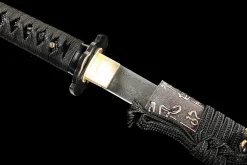
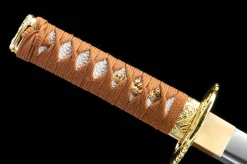
The tsuka core should be solid hardwood – ho wood is traditional, oak is common in production blades. Tap it against your palm. A hollow sound means it was built light to save cost. The ray skin (same) wrapping should be actual ray skin, not embossed leather or vinyl. Run your finger across the nodes: real ray skin has a hard, calcified texture that cannot be faked convincingly up close.

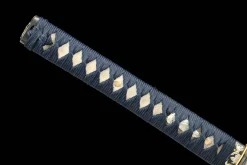
Tsuka-ito wrapping should be tight with no gaps at the diamonds. Loose wrapping moves during use, which creates hot spots that blister your palm on extended sessions. We re-wrap handles that do not meet tension standards before they leave Longquan.

Tsuba (Guard) and Fittings

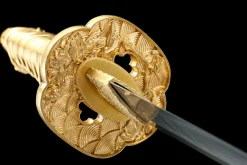
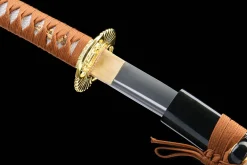
Iron or copper tsuba: this is the standard for functional blades. Zinc alloy tsuba is noticeably lighter and has a slightly chalky surface texture when you look at it in raking light. It will not stop a slide from a practice partner’s blade the way iron will. Decorative carving on a zinc tsuba is cast-in rather than hand-chased, so the detail tends to be soft and rounded at the edges.

The seppa (collar washers) above and below the tsuba should fit snugly with no lateral play. Wobble here means the entire fitting assembly can shift under load. A correctly fitted tsuba assembly on a quality blade takes two hands and deliberate effort to disassemble. On a cheap blade, it comes apart by accident.

Saya (Scabbard)

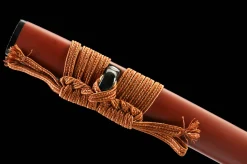
Lacquered wood is correct. Plastic saya exists, and it tells you everything about what the seller prioritized. Draw the blade from the saya slowly – you should feel a slight, consistent resistance as the habaki clears the koiguchi (mouth of the saya). That resistance is the fit doing its job, keeping the blade seated against humidity and preventing rattling during carry.

If the blade drops out of the saya when you tilt it downward, the koiguchi fit is wrong. If it takes significant force to draw, the saya may be swelling from moisture, or the fit was cut too tight from the start. Either problem needs correction before regular use.

The sageo (cord) should be silk or quality cotton, tied in a proper knot rather than glued in place. Pull it – it should hold. On display-grade saya, the sageo is often glued or fused to the saya body and tears away cleanly. That is a fast quality indicator when you are examining a new blade.

, –

Recommendations by Budget

$100 – $200: Understand What You Are Buying

At this price, functional and fully finished katanas

[/row] [/col]