






Dragon Blade Forge · Buyer’s Guide
How to Choose the Right Katana.
Steel grade, heat treatment, construction, and price. The four decisions that determine whether a sword is worth owning. This guide covers each one without padding.
Choose your steel first.
Steel grade determines hardness, toughness, and maintenance requirements. Every other decision follows from this one.
1065 Carbon Steel · HRC 54–58
Tough, forgiving, easy to maintain. Resharpens in minutes on a 1000-grit stone. The correct choice for high-volume tameshigiri training and blades that take hard contact. If this is your first real sword, start here.
Shop 1065 →1095 High Carbon · HRC 58–62
Clay-tempered. The visible hamon marks the actual hardness boundary. Edge retention is measurably better than 1065. The right choice when you want a functional, high-performance cutter with a traditional Japanese differential heat treatment.
Shop 1095 →T10 Tool Steel · HRC 60–62
Tungsten-alloyed. The carbide structure holds the edge longer than 1095 at the same hardness. More brittle than 1065 or spring steel. Choose T10 if edge retention is your priority and you will maintain the blade correctly.
Shop T10 →Damascus Pattern-Welded · HRC 58–60
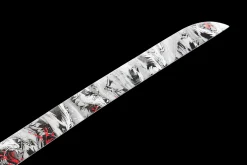
Alternating high and low carbon layers, forge-welded and acid-etched. Performance comparable to 1095. Every blade is visually unique — the pattern is permanent and unrepeatable. Functional, not just decorative.
Shop Damascus →65Mn Spring Steel · HRC 50–55
Silicon-manganese alloy engineered for flexibility. Flexes under heavy contact and returns to true geometry. Highest toughness in our lineup. Choose spring steel for high-impact training or any scenario where a blade that does not chip matters more than one that holds an acute edge.
Shop Spring Steel →Steel at a Glance
| Steel | HRC | Toughness | Best for |
|---|---|---|---|
| 1065 | 54–58 | High | Training |
| 1095 | 58–62 | Medium | Performance |
| T10 | 60–62 | Medium | Edge retention |
| Damascus | 58–60 | Medium | Collector + cutter |
| 65Mn | 50–55 | Highest | Heavy contact |
Decision 02 · Construction
Full tang is non-negotiable.
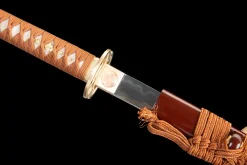
A full-tang blade runs the complete length of the handle, pegged through with a bamboo mekugi pin. Under cutting load, the steel absorbs the impact across the entire handle — not at a single weld point or thread.
A rat-tail tang threads a thin rod through the handle and bolts it in place. It works fine for display. It is a safety failure under cutting load. Every blade we sell is full-tang. We do not carry rat-tail or threaded-bolt construction.
100%
Full tang
Mekugi
Bamboo pin
0
Rat-tail tangs
Decision 03 · Heat Treatment
Clay tempered means differential hardness.
Clay-tempering insulates the spine during the quench, producing a harder edge (HRC 58–62) and a softer, tougher spine (HRC 38–42). The boundary between these zones is the hamon.
Oil-quench through-hardening produces uniform hardness across the blade. Functional, but more likely to break where a clay-tempered blade would flex.
Clay tempering is a single-chance process. It cannot be undone or repeated on the same blank. Our smiths do not rush this step.
What you get at each level.
Under $200
Entry Level
1065 or 1045 carbon steel. Full-tang. Genuine ray skin. Oil-quench heat treatment. Functional cutter, not a wall hanger. Expect to sharpen it before the first session.
Shop Under $200 →$200–$500
Performance Tier
Clay-tempered 1095. Visible hamon. Hand-polished blade. Real hardwood saya. The minimum tier for a blade you will pass on. Most buyers land here for a first serious sword.
Shop $200–$500 →$500 and Above
Master Grade
Clay-tempered T10, Damascus, or self-smelted steel. Seven-stage hand polish. Collector documentation on master editions. The difference between $500 and $2,500 is measurable under magnification at the hamon.
Shop Premium →