










Crimson Gale – Hand Forged Damascus Steel Katana Sword
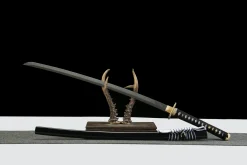
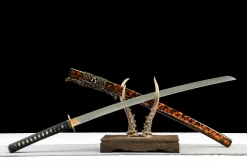
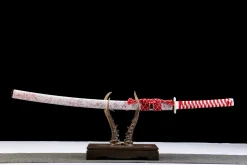
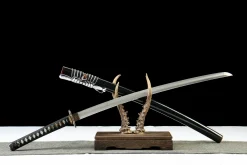
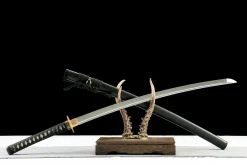
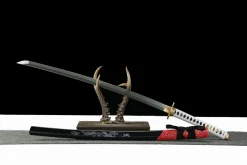
The Crimson Gale (猩红疾风) is a handmade full-length katana forged from three-panel composite Damascus steel (三枚合) — a construction method in which three distinct steel billets are forge-welded side by side to create a blade with structural integrity layered into its very architecture. Fast as its name implies and bold as its crimson character, the Crimson Gale pairs copper fittings with a green bark wood saya for a premium katana experience at $300. This is the blade for the collector who understands that how a sword is built matters as much as how it looks.
Specifications
| Blade Steel | Damascus Steel (三枚合 — Three-Panel Composite) |
| Total Length | 103.0 cm / 40.6 inches |
| Blade Length | 72.0 cm / 28.3 inches |
| Blade Width | 3.2 cm |
| Weight | 950 g / 33.5 oz (net) |
| Heat Treatment | Oil Quench & Temper |
| Fittings | Copper (装) |
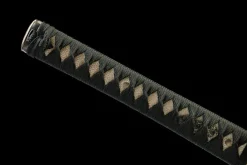
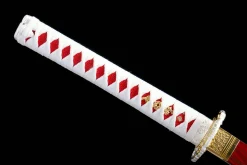
| Handle | Cotton Ito Wrap |
| Sheath | Green Bark Wood (Aohada) |
Craftsmanship & Materials
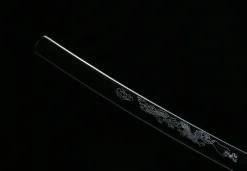
The 三枚合 (san-mai awase) construction method used in the Crimson Gale is a time-honored approach to composite blade-making: a high-carbon steel core is sandwiched between two outer panels of contrasting steel, all three forge-welded into a unified billet before the blade is shaped. The result is a katana whose cutting edge benefits from the hardness of the high-carbon core, while the outer panels contribute toughness and resistance to lateral stress — a structural logic that mirrors the traditional Japanese practice of combining jigane and hagane in a single blade. The three-panel weld lines, visible along the blade’s flat when properly polished, give the Crimson Gale a layered depth that single-steel blades simply cannot replicate.
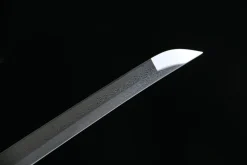
The oil quench and temper process applied to the finished blade produces a distinct hamon along the cutting edge — a temper line that in 三枚合 construction tends to run cleanly and consistently, owing to the uniformity of the hardened core strip. This is a blade with both visual character and technical intentionality: the crimson of the name refers not just to the sword’s fierce energy, but to the warm, reddish surface tones that emerge along the blade’s pattern after acid etching.
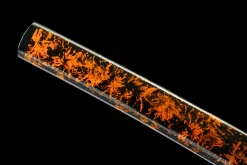
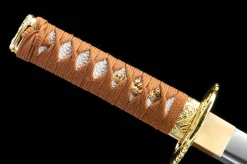
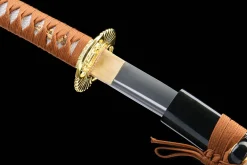
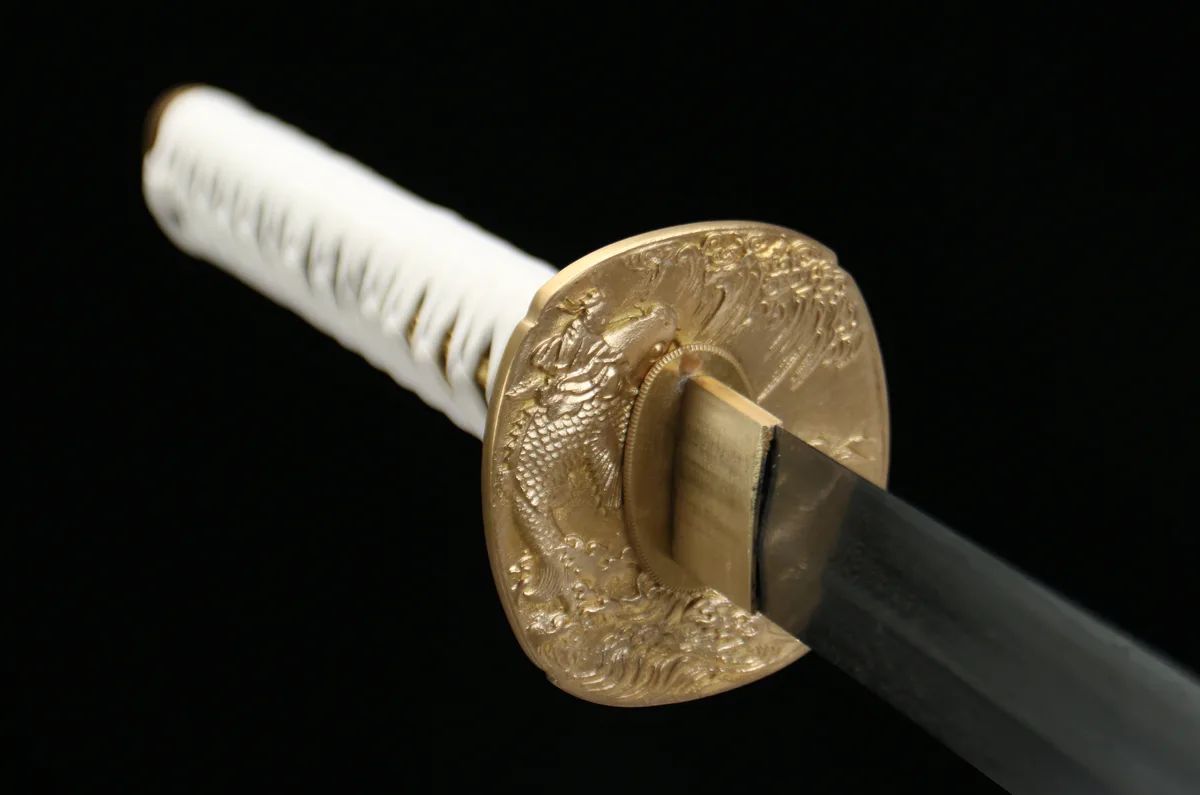
Copper fittings on the tsuba, fuchi, and kashira give the Crimson Gale a warm metallic presence that pairs naturally with the organic, bark-textured surface of the Aohada saya. Unlike lacquered sheaths, the green bark wood saya develops its own character with handling — subtle variations in tone and texture that make each sword’s housing as individual as its blade. Cotton ito wrapping completes the tsuka with a firm, traditional feel.
Perfect For
- Structural construction enthusiasts — collectors who appreciate the 三枚合 composite method and want a blade whose internal architecture reflects genuine sword-making knowledge.
- Handmade sword collections — tagged as handmade, the Crimson Gale is produced in limited quantities and carries the subtle variations of individual craft rather than factory uniformity.
- Tameshigiri practitioners — the san-mai construction’s tough outer panels and hard cutting core make this katana well-suited for supervised cutting practice on rolled tatami targets.
Care & Maintenance
The three-panel composite construction of the Crimson Gale means the blade has forge-welded boundaries that must be kept clean and protected from moisture ingress. Oil the blade thoroughly after any handling session using choji or high-grade mineral oil, paying particular attention to the edge and the panel junction lines visible along the flat. Store in the Aohada saya away from humid environments, and inspect the weld lines periodically — any discoloration along these boundaries is an early warning sign of moisture and should be addressed immediately with cleaning and re-oiling.
Frequently Asked Questions
What is Sanmai (三枚合) Damascus construction on the Crimson Gale katana?
Sanmai (三枚合) is a traditional Japanese blade construction method meaning ‘three-piece assembly.’ In the Crimson Gale (LQS-0088), a hard high-carbon steel cutting core is sandwiched between two outer layers of tougher, more flexible steel. This replicates the logic of classical Japanese sword-making: a hard edge for sharpness combined with a resilient body to resist breaking. The result is a Damascus-patterned blade with superior structural integrity compared to single-layer monosteel construction.
Is the Crimson Gale handmade, and what does that mean for quality?
Yes, the Crimson Gale (LQS-0088) is tagged as handmade, indicating that skilled smiths perform the folding, shaping, and finishing processes by hand rather than relying purely on automated production. Handmade swords typically feature more consistent heat treatment, hand-filed edges, and individually fitted components. For a $300 Damascus katana, this human craftsmanship contributes to subtle variations in the blade pattern that make each Crimson Gale visually unique — a quality appreciated by serious collectors.
How sharp is the Crimson Gale out of the box?
The Crimson Gale (LQS-0088) arrives with a functional working edge suitable for cutting practice and tameshigiri on tatami mats and similar soft targets. Sanmai Damascus construction gives the hard core steel excellent edge-holding capability. As with most production katanas, some buyers choose to perform a final stropping or light hand-sharpening to bring the edge to their preferred sharpness level. It is not a razor-sharp kitchen knife but is meaningfully sharp for a functional sword.
What is the green Aohada bark wood sheath on the Crimson Gale?
Aohada (青肌, ‘green bark’) refers to a natural wood used in traditional Japanese sword scabbard (saya) construction, prized for its distinctive mottled green-grey bark texture. On the Crimson Gale (LQS-0088), the Aohada sheath provides both protection for the Damascus blade and an aesthetically striking natural finish that pairs beautifully with the copper fittings. Unlike painted or lacquered sheaths, Aohada’s natural texture gives each saya a one-of-a-kind appearance.
How does the Crimson Gale compare to the Flame Edge at a similar price?
The Crimson Gale (LQS-0088, $300) and Flame Edge (LQS-0087, $320) are closely matched siblings. Both feature Damascus blades, copper fittings, Aohada sheaths, and oil quench heat treatment. The key difference is construction method: the Crimson Gale uses Sanmai (three-layer composite) Damascus for superior structural integrity, while the Flame Edge features feather-pattern Damascus for a more visually dramatic blade. The Crimson Gale’s handmade tag also suggests additional hand-finishing. Choose Crimson Gale for performance focus; Flame Edge for visual impact.
| Weight | 1.2 lbs |
|---|---|
| Dimensions | 103.0 × 3.2 × 0.7 in |
| Sword Type | Katana |
| Blade Steel | Damascus Steel |
| Total Length | 103.0 cm |
| Blade Length | 72.0 cm |
| Heat Treatment | Oil Quench & Temper |
| Handle Wrap | Cotton Ito Wrap |
| Sheath Material | Green Bark Wood (Aohada) |
| Fittings | Copper, (装) |
| Forging Style | Folded Steel (Pattern Welded) |
Related products


1065 Carbon Steel

High Carbon Steel
1065 Carbon Steel

1045 Carbon Steel
1065 Carbon Steel
1045 Carbon Steel

1045 Carbon Steel

1045 Carbon Steel
Black Heaven Feather – Hand Forged 1045 Carbon Steel Katana Sword