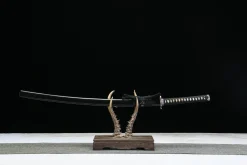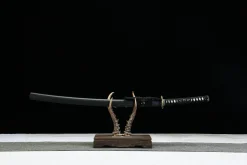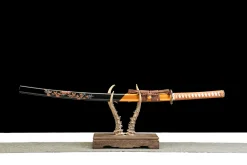










Dark Night Slash – Hand Forged Carbon Steel Katana Sword
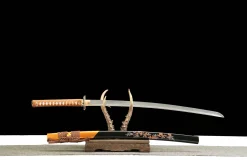
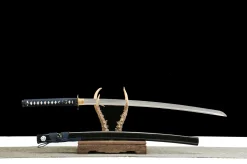
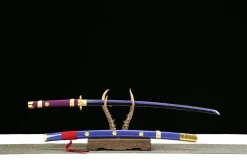
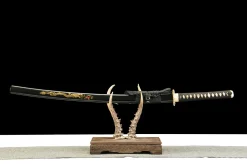
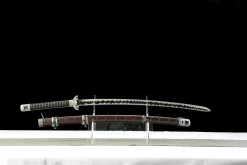
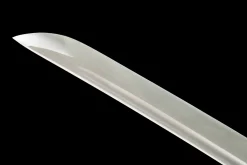
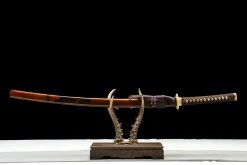
Hand-forged Carbon Steel katana (102cm total / 72cm blade), crafted in Longquan. Clay-tempered blade with a genuine hamon line — visible contrast between hardened edge and soft spine.
$339.99
Dark Night Slash – Hand Forged Carbon Steel Katana Sword
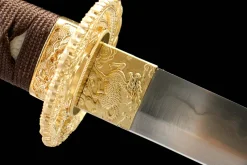
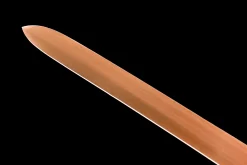
The hamon on a clay-tempered T8 blade does not announce itself – it earns your attention. Run your eye along the Dark Night Slash from kissaki (tip) to habaki (blade collar) and the temper line resolves out of the steel like a coastline seen from altitude: irregular, geologically honest, impossible to fake. This is a blade forged in shinogi-zukuri (ridgeline) geometry with a dragon-carved hardwood saya finished in high-gloss black lacquer, and every element of its construction is oriented toward one thing – a blade that performs with authority and ages with dignity.
Specifications
| Blade Steel | T8 Carbon Steel |
| Total Length | 102.0 cm / 40.2 in |
| Blade Length | 72.0 cm / 28.3 in |
| Blade Width | 3.2 cm |
| Blade Thickness | 0.7 cm |
| Weight | 1040 g / 36.7 oz |
| Heat Treatment | Clay Tempering (Differential Hardening) |
| Fittings | Zinc Alloy |
| Handle | Cotton Ito wrap over Genuine Rayskin (Same) |
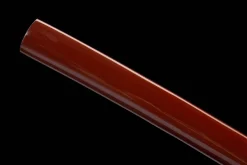
| Sheath | Hardwood, High-Gloss Lacquer, Dragon Carving |
The Steel
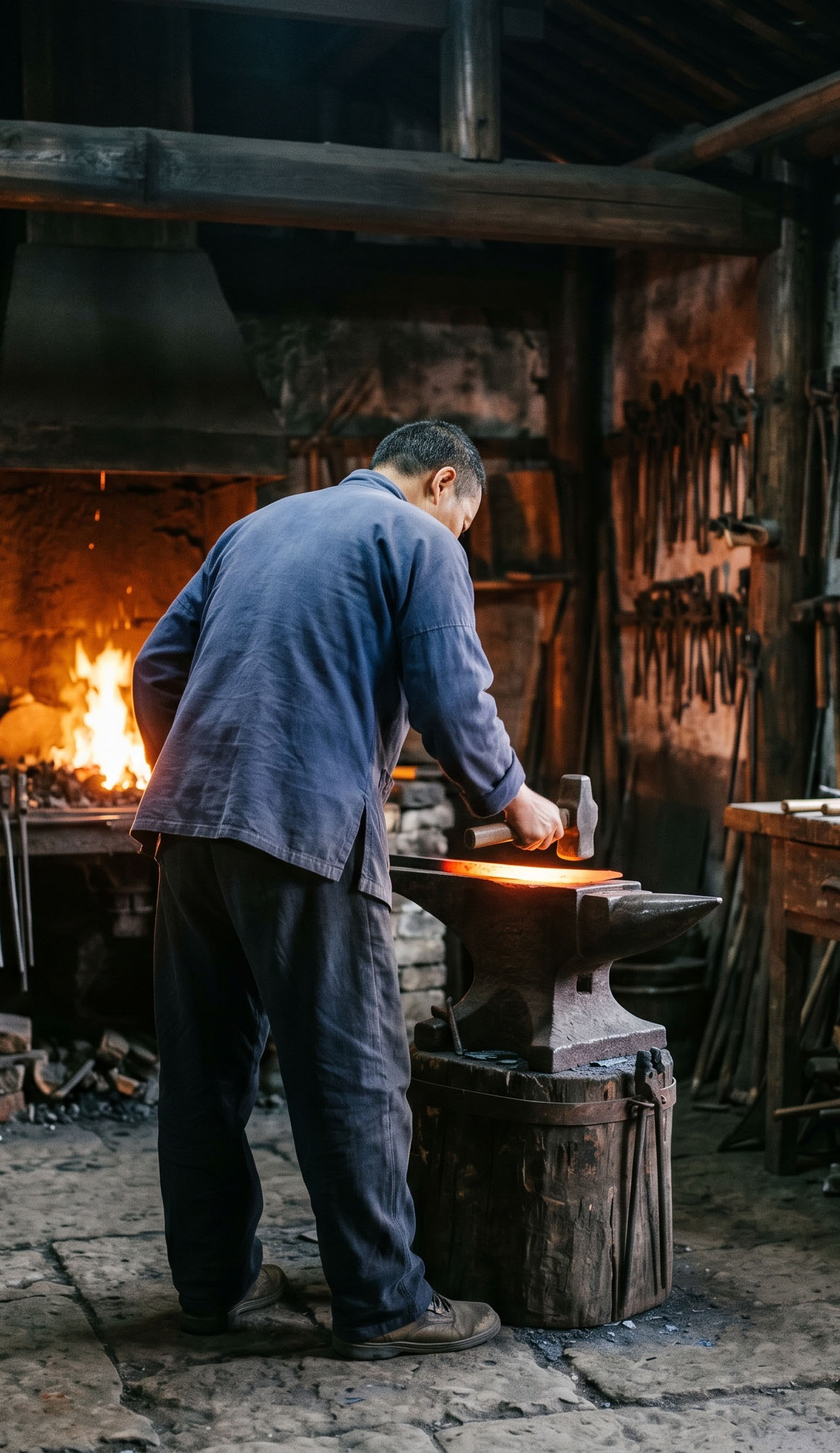
T8 sits in a specific and deliberate position in the carbon steel family – higher carbon content than the general-purpose 1060 and 1065 grades, tightly controlled in its alloy profile, and responsive to differential hardening in a way that rewards the experienced smith. When clay is packed along the spine before the quench, the cooled blade emerges with a hard ha (cutting edge) typically reaching into the upper HRC 58-60 range and a tough, shock-absorbing mune (spine) that retains the elasticity to absorb lateral stress without catastrophic failure. The transition between these two zones is the hamon – and on T8, the habuchi (the boundary line itself) tends toward a soft, billowing character rather than a sharp mechanical edge. What you see is nie: tiny crystalline martensitic particles suspended at the transition, visible as a faint luminous scatter under directional light. No two clay-tempered blades produce the same hamon. This one is the only one.
The shinogi-zukuri forging profile – the classic ridgeline geometry used by Japanese smiths for centuries – gives the blade a defined shinogi-ji (the flat between the ridge and the spine) and a hamaguri-ba (clamshell-curved) grind toward the edge that distributes cutting stress efficiently across the geometry. The 3.2 cm width and 0.7 cm spine thickness are proportions that have been validated across centuries of practical use: substantial enough to carry authority, tapered enough to move without drag.
In Your Hands
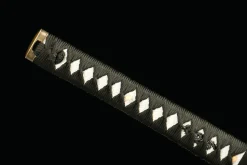
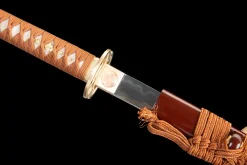
The tsuka (handle) runs 26.0 cm – a full, two-handed grip that places both hands clear of each other with room to spare. The cotton ito is wrapped in the traditional diamond (hishi) pattern over genuine same (rayskin), and the texture under your palm is immediate and purposeful: the raised nodules of the rayskin telegraph through the wrap and lock the grip without abrasion. The draw from the high-gloss lacquered hardwood saya is clean and consistent – the koiguchi (mouth of the sheath) is fitted precisely, with a resistance that releases the blade deliberately rather than accidentally. At 72.0 cm of blade extending from a 26.0 cm handle, the geometry places the cutting vector well forward of the hands – a proportion that rewards committed, full-extension technique.
Care
After any use, wipe the blade down with a soft cloth and apply a thin film of choji oil (clove-infused mineral oil) along the entire surface, including the habaki area where moisture collects first. The lacquered saya should be kept dry – prolonged contact with a damp blade will lift the lacquer from the inside. Inspect the mekugi (handle pin) periodically and replace if any lateral play develops in the tsuka.
| Weight | 1.32 lbs |
|---|---|
| Dimensions | 102.0 × 3.2 × 0.7 in |
| Hamon | Real Hamon (Clay Tempered) |
| Blade Steel | Carbon Steel |
| Total Length | 102.0 cm |
| Blade Length | 72.0 cm |
| Heat Treatment | Clay Tempering (Differential Hardening) |
| Handle Wrap | Cotton Ito + Genuine Rayskin |
| Sheath Material | Hardwood (High-Gloss Lacquer) |
| Fittings | Zinc Alloy |
| Forging Style | 鎬造 |
Related products