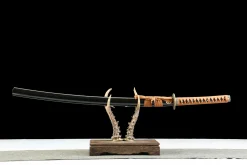


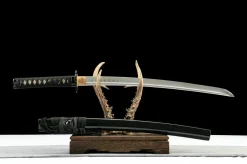
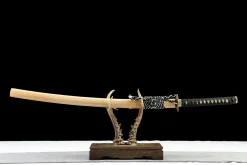


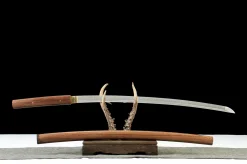





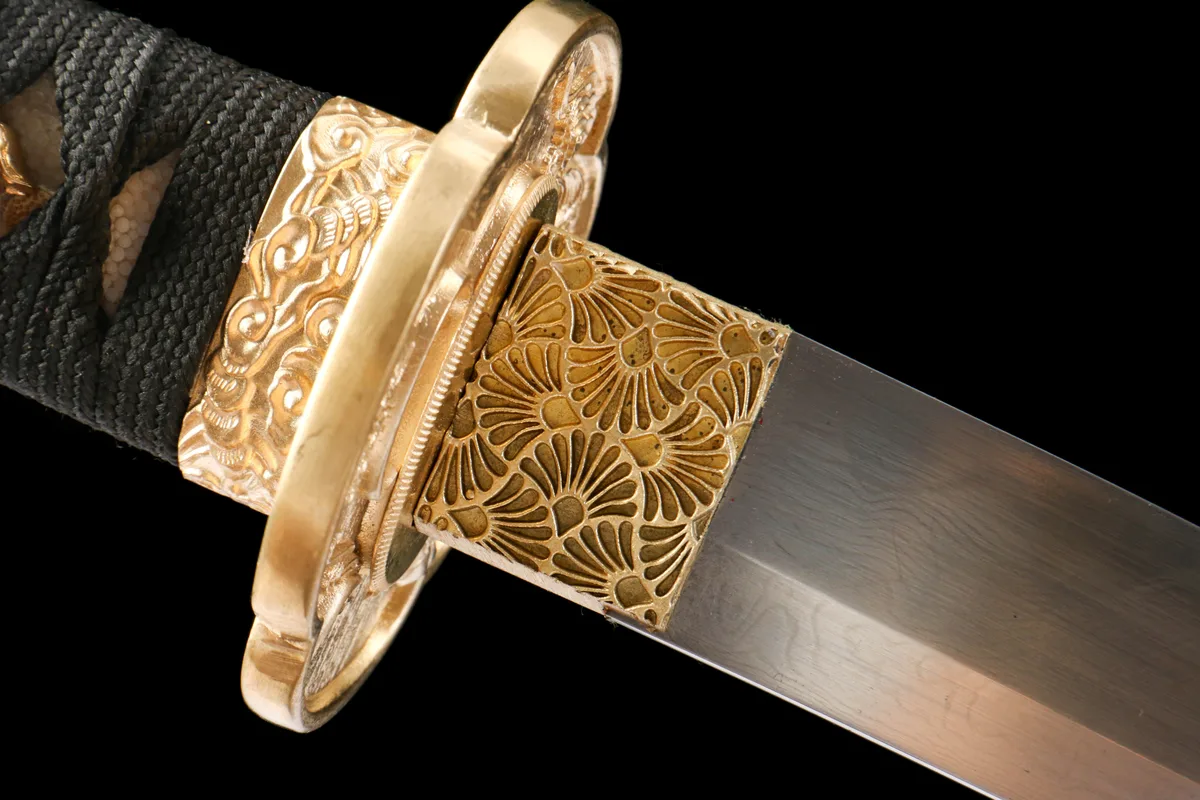
Ink Jade – Hand Forged Clay-Tempered Damascus Steel Tanto Sword
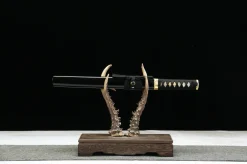
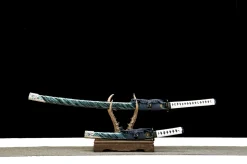
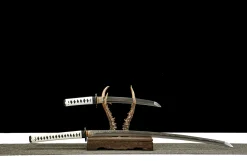
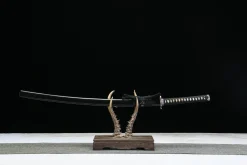
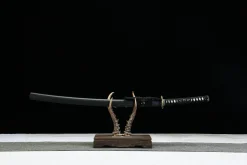
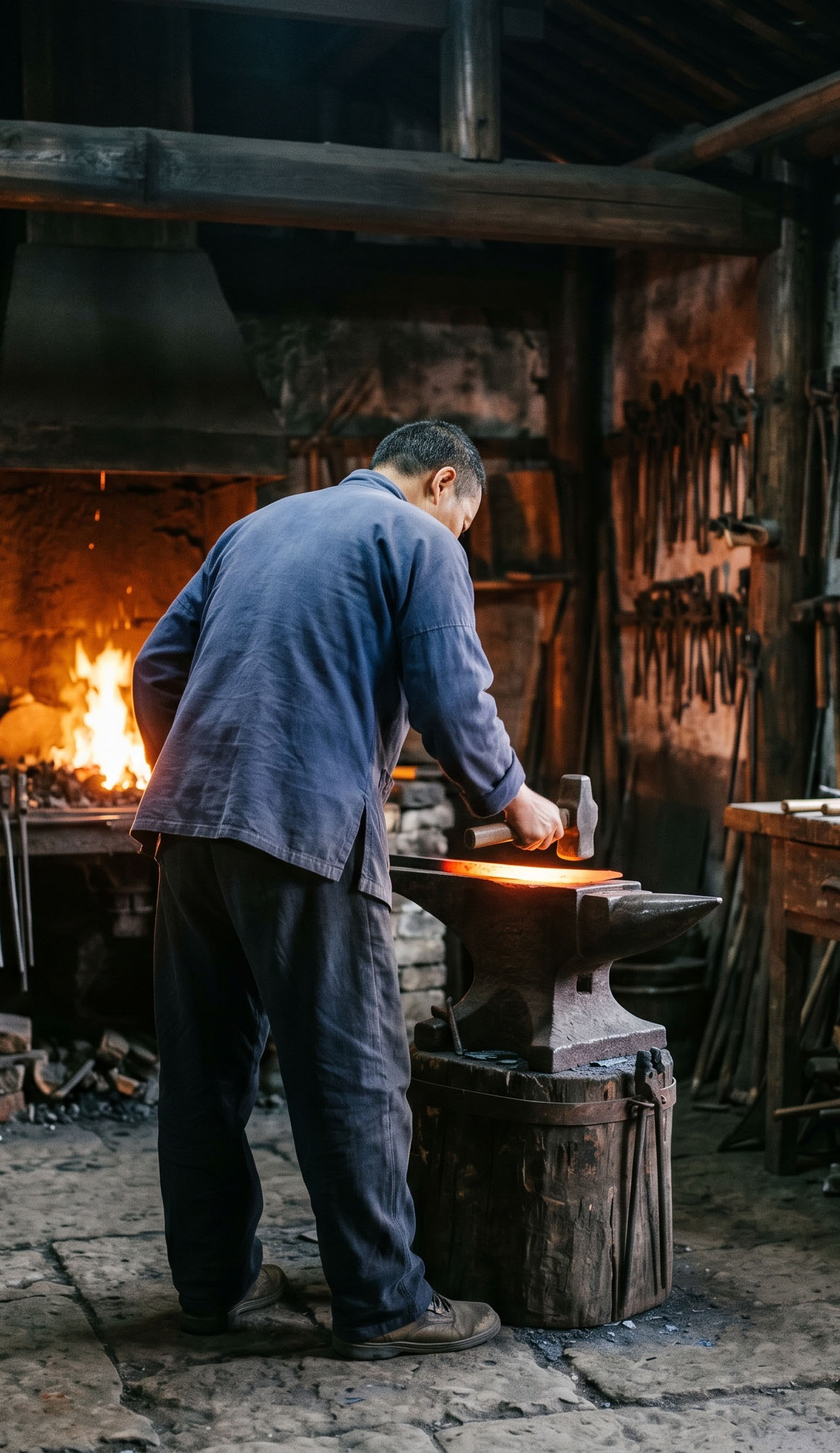
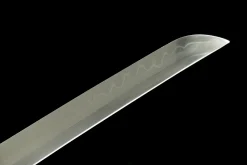
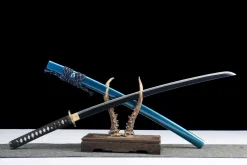
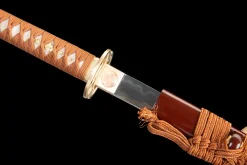
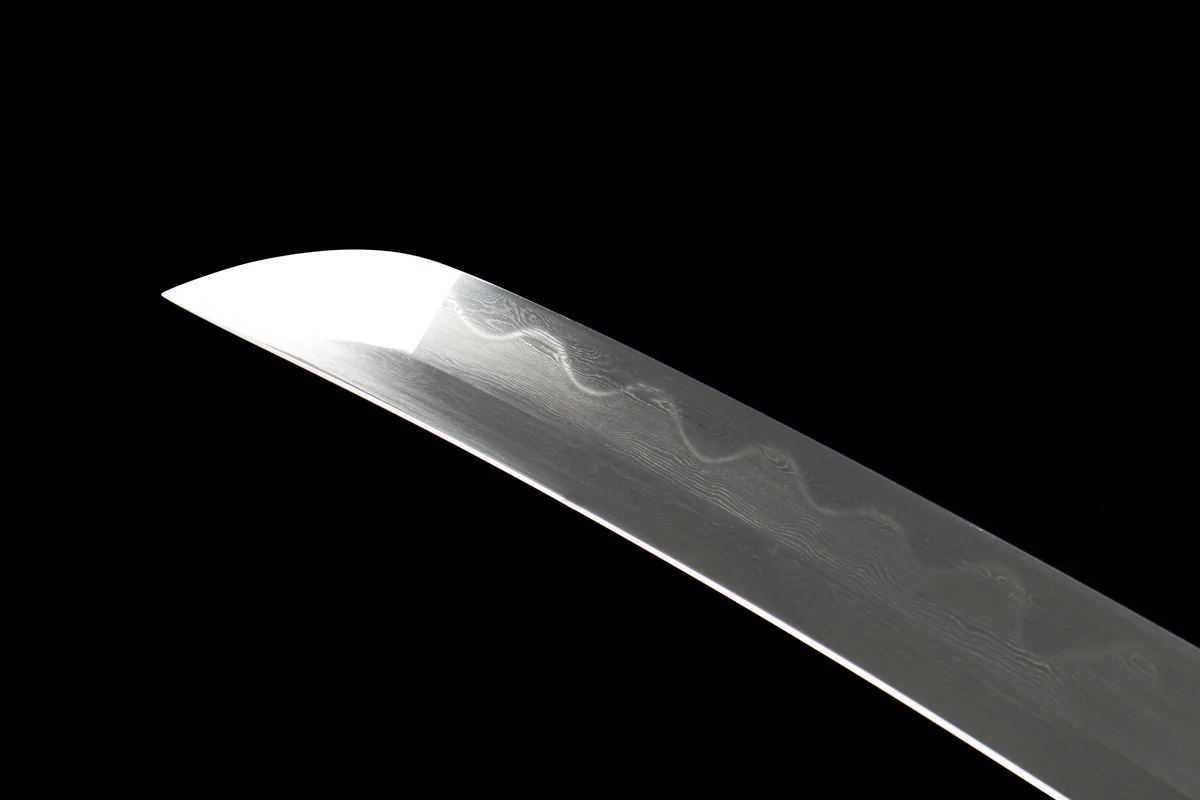
Hand-forged Clay-Tempered Damascus Steel tanto (52cm total / 30cm blade), crafted in Longquan. Clay-tempered blade with a genuine hamon line — visible contrast between hardened edge and soft spine.
$549.99
Ink Jade – Hand Forged Clay-Tempered Damascus Steel Tanto Sword
A tanto that carries two distinct processes simultaneously – pattern-welded Damascus and clay tempering – sits in a narrow category, and the Ink Jade occupies that category with specificity. The grain of the folded steel runs along the blade’s length, and the hamon (the temper line produced by differential hardening) cuts across it. These two visual systems operate independently, intersect unpredictably, and the result at the intersection is something that cannot be designed in advance – only revealed in the finishing.
Specifications
| Blade Steel | Damascus / Pattern-Welded Steel |
| Total Length | 52.0 cm / 20.5 in |
| Blade Length | 30.0 cm / 11.8 in |
| Blade Width | 3.2 cm |
| Blade Thickness | 0.7 cm |
| Heat Treatment | Clay Tempering (Differential Hardening) |
| Fittings | Copper (铜装) |
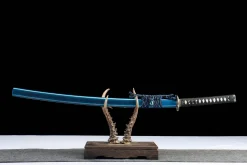
| Handle | Cotton Ito + Genuine Rayskin |
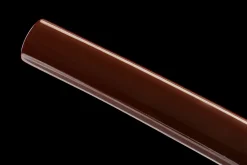
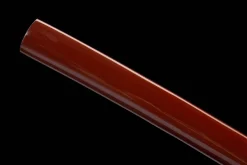
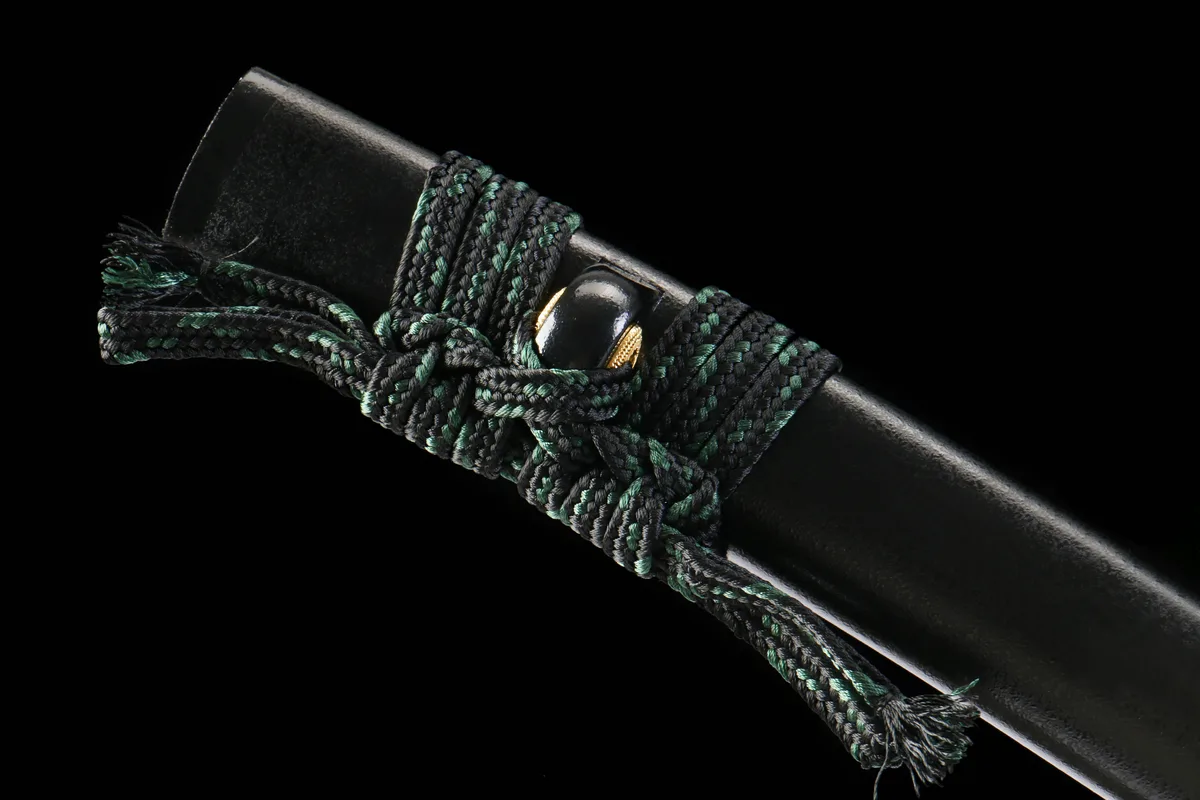
| Sheath | Hardwood (High-Gloss Lacquer) |
Steel & Construction
Pattern-welded Damascus is produced by forge-welding multiple steel billets of differing carbon content, then folding, drawing, and folding again until the layers are too numerous to count individually but still distinct enough to etch into visibility. The acid etch after grinding and polishing reacts differentially to the high- and low-carbon layers, pulling the grain pattern forward as alternating light and dark bands. On the Ink Jade, the grain is brought to the surface of a shinogi-zukuri (ridgeline) blade profile – the same classical cross-section used on full-length katana, here compressed into the tanto (short blade) format. The folded grain reads differently on the flat than it does on the beveled area near the edge, because the cross-section of each folded layer changes as the geometry changes. Tilt the blade and those relationships shift again.
Clay tempering on pattern-welded steel is technically demanding because the layered structure responds to the quench with more variability than a homogeneous alloy. The clay is applied to the spine (mune) to create differential cooling – the edge (ha) hardens, the spine stays tough, and the habuchi (boundary between the two zones) forms across whatever the grain is doing at that point on the blade. The hamon that results is not a smooth line. It is interrupted by the Damascus pattern, pulled by the underlying layer structure into irregular shapes that a single-alloy blade cannot produce. The copper fittings (铜装 – copper-mounted fittings) are chosen for their warm coloration, which reads against the etched Damascus pattern without competing with it.
Handling
The 17 cm tsuka (handle) on a 30 cm blade is proportioned for single-handed use, though the genuine rayskin (same) beneath the cotton ito wrap and the diamond-lozenge binding pattern give enough surface friction to support a two-handed grip when needed. The handle sits compact in the hand – there is no excess beyond the grip. The draw from the high-gloss lacquered hardwood saya is short and direct; at this blade length, the tanto clears the scabbard quickly, and the close-fitting koiguchi (sheath mouth) retains the blade firmly until the draw is intentional. The copper fittings at the habaki (blade collar) and tsuba (hand guard) are warm to the touch in a way that zinc alloy is not, and they add a tactile quality to the piece beyond what the ito and same provide.
Care Instructions
Pattern-welded Damascus requires more attentive maintenance than monosteel, as the differential between layers can create micro-galvanic activity in humid environments – oil the blade thoroughly after handling, paying particular attention to the etched surface where moisture can settle in the grain texture. Use a light, non-reactive oil such as choji or camellia oil, applied with a soft cloth. The copper fittings will develop a natural patina over time; this can be left to develop naturally or maintained with a copper-appropriate polish, according to preference.
| Weight | 0.0 lbs |
|---|---|
| Dimensions | 52.0 × 3.2 × 0.7 in |
| Hamon | Real Hamon (Clay Tempered) |
| Blade Steel | Clay-Tempered Damascus Steel |
| Total Length | 52.0 cm |
| Blade Length | 30.0 cm |
| Heat Treatment | Clay Tempering (Differential Hardening) |
| Handle Wrap | Cotton Ito + Genuine Rayskin |
| Sheath Material | Hardwood (High-Gloss Lacquer) |
| Fittings | 铜装 |
| Forging Style | 鎬造 |
Related products