







Buying Guides
Sword Gift Guide: Best Katanas for Every Budget

Most people buying a sword as a gift have no idea what separates a $90 wall-hanger from a $400 blade that will still be sharp in twenty years. That gap is not marketing. It is steel grade, heat treatment, geometry, and the hours a smith spends on the handle wrap. This guide walks through real options at real price points, so you can match the right blade to your budget and to the person receiving it.
If you want to go deeper on materials before you decide, our katana buying guide covers the full selection process from steel to saya. For now, let us get practical.
Gifts Under $150
At this price point, you are buying a functional decorative piece. That is not a criticism. A well-made entry-level katana with a proper carbon steel blade and a tight handle wrap is a genuinely good gift for someone curious about Japanese swords, a martial arts student who needs a practice reference, or a teenager who will hang it on the wall and care about it for years.
What to avoid at this tier: stainless steel. Anything marketed as “stainless” is decoration only. Stainless is too brittle for a sword geometry and cannot be properly heat treated to functional hardness. Look instead for 1045 or 1060 carbon steel with a stated HRC rating. Even at $100-150, those steels can be hardened to HRC 50-54, which holds an edge under light use.
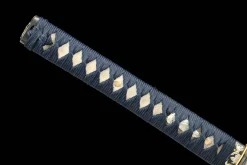
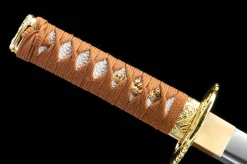
Also check the handle construction. A tsuka that rattles or shifts on the tang is a safety issue, not just a quality complaint. Peg it with a real mekugi pin and make sure the menuki are secured, not glued. At this budget, you are buying carefully, not buying anything that catches your eye.
Gifts $150-300
This is where the options start to get genuinely interesting. Around $230, you can get into T8 tool steel with proper differential hardening, which means a hard edge and a softer spine. That combination is what gives a katana its characteristic flex-without-snapping behavior. It is not cosmetic. It is functional metallurgy.
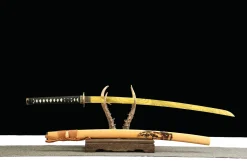
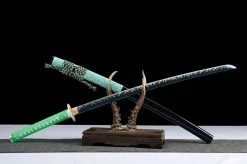
The Dark Night Slash sits at $230 and uses T8 high carbon steel with clay tempering. The hamon on a clay-tempered blade forms at the boundary between the hardened edge and the softer body. No two are identical, because the clay application is done by hand. That detail alone makes it worth more than its price suggests.

Dark Night Slash
T8 clay-tempered steel with natural hamon. $230.
One thing worth knowing about T8 at this price: the steel responds well to differential hardening but has less carbon than T10, so the edge retention is slightly lower under sustained cutting. For a gift recipient who will do occasional tameshigiri or display work, that is irrelevant. For someone cutting twice a week, step up to T10.
Gifts $280-350
T10 high speed tool steel is a meaningful upgrade. The carbon content sits around 1.0%, and T10 also contains a small amount of silicon, which improves wear resistance at the edge. Heat treated correctly to HRC 58-62, a T10 blade holds a working edge through serious cutting practice without needing constant resharpening.
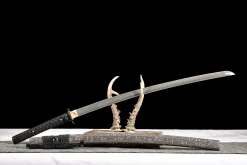
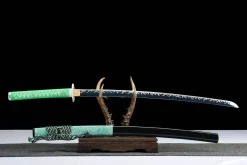
The Silent Thunder at $280 and the Dark Ravine at $340 both use T10 with clay tempering and water quenching. Water quenching produces a more dramatic hamon than oil quenching, with a more turbulent activity line. The tradeoff is slightly higher risk during the quench process. When it works, the hamon has a presence that oil-quenched blades rarely match.

Silent Thunder
T10 tool steel, water quenched, visible hamon. $280.

Dark Ravine
T10 tool steel with full clay tempering and bo-hi. $340.
At this price range, also check whether the blade has a bo-hi, the fuller channel running parallel to the spine. A bo-hi reduces weight by roughly 100-150 grams without sacrificing structural rigidity, and it changes the blade’s sound during a cut. Experienced cutters call it the “whisper.” It is a real acoustic phenomenon caused by air displacement through the groove.
Our steel comparison guide breaks down T8 versus T10 versus Damascus with side-by-side hardness and edge retention data if you want the full technical picture before choosing.
Premium Gifts $500+
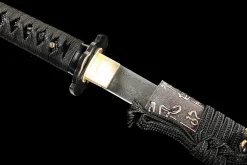
Above $500, you are buying construction methods that take significantly more forge time. The Ink Meteor at $775 uses sanmai construction, which translates literally as “three-layer.” A hard high-carbon steel core is sandwiched between softer outer steel on the spine side. The core takes and holds the edge. The outer layers absorb impact and prevent the spine from cracking under lateral stress.
Sanmai is not decorative lamination. It is a structural solution to a real engineering problem: how do you make a blade hard enough to cut cleanly but tough enough not to snap under lateral force? The answer is not one steel. It is two, bonded at temperature and forge-welded into a single piece.

Ink Meteor – Sanmai Construction
Three-layer laminated blade with high-carbon core. $775. For the collector or serious practitioner who understands what they are holding.
The grain pattern on a sanmai blade at the shinogi line, where the two steels meet, is visible under the right light. You will see a subtle boundary running the length of the blade. That line is the junction between the core and the jacket steel. No two are identical, because forge welding at temperature is not a machine process. A smith’s hands and judgement determine where that boundary sits.
Browse our full Damascus and laminated steel category for more options at this tier.
What to Look for in a Gift Sword
Steel First, Aesthetics Second
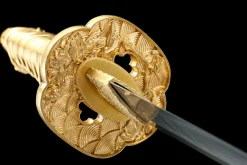
The tsuba design and handle wrap color are easy to see in a photo. The steel grade is not. Always confirm the steel specification before price becomes the deciding factor. A blade listed only as “carbon steel” with no grade number is a red flag. T10, 1075, 1095, sanmai, and Damascus are all specific enough to evaluate. “Carbon steel” tells you almost nothing.
Full Tang, No Exceptions
A full tang extends the entire length of the handle and is the single most important structural feature on a functional sword. Rat-tail tangs, which narrow dramatically behind the blade, can fail under cutting stress. If the product listing does not confirm full tang construction, ask before buying.
Fit and Finish Details
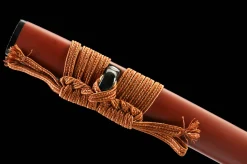
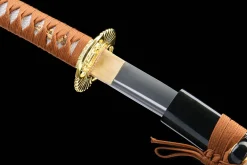
Check whether the habaki, the metal collar at the base of the blade, fits snugly into the koiguchi of the saya. A loose habaki is not just sloppy work. It allows moisture to contact the bare steel. On a carbon steel blade, that means rust in weeks, not years. Tight habaki fit is a sign that the smith treated the assembly as a complete system, not just the blade.
See our sword care guide for how to maintain a carbon steel blade after gifting, including the correct uchiko powder application technique that most beginners skip.
Presentation Tips
A katana delivered in a cardboard shipping box is still a katana, but the first impression matters for a gift. Most of our blades ship with a wooden display stand. If yours does not include one, a simple two-peg horizontal stand costs under $20 and transforms the presentation completely.
Include a care card. Carbon steel needs light oil on the blade after handling, every time. New owners who do not know this will find surface rust within a month in a humid climate. A handwritten note explaining the basics, or a printed copy of our care guide, is a practical addition that protects the gift long-term.
For display, horizontal orientation with the edge facing up is traditional and keeps stress off the saya’s throat. Direct sunlight fades the ito wrap over time, so a shaded position is better for the handle. These are small details that a gift recipient will appreciate once they learn them.
Browse our full katana collection to compare the complete range before deciding.
Frequently Asked Questions
Ready to Find Your Blade?
