
Sword Sizing Guide: Find the Right Blade for Your Build

Most buyers come to us knowing what they want but not knowing what they need. There is a difference. A blade that looks right on a shelf will feel wrong in your hand if the proportions do not match your reach, your stance, or your intended use. This guide will walk you through the measurements that actually matter.

, –

How Sword Length Is Measured

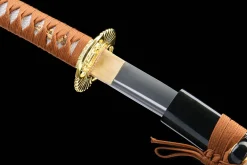
Two numbers define every sword we ship from Longquan: total length (nagasa plus tsuka plus habaki) and blade length (nagasa only, measured from the back of the habaki to the kissaki tip). When a customer asks for a “72cm katana,” they almost always mean the blade, not the full sword. We always confirm before we cut.

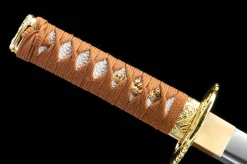
The tsuka typically adds 25-28cm on a standard katana. Factor that in when you are thinking about draw clearance or display space. A sword listed at “102cm total” is carrying roughly 73-76cm of sharpened steel, depending on the build.

Blade length is measured along the back edge (mune), not the curve. Because of the sori, a curved blade with a 73cm mune measurement will span slightly less than 73cm in a straight line. This is not an error. It is geometry. Keep that in mind if you are sizing for iaido practice, where draw angle and arc distance both matter.

, –

Katana Sizing

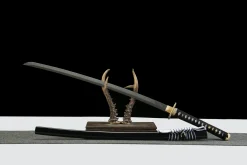
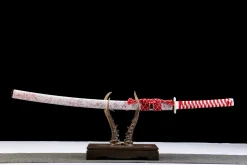
Our standard katana runs 102-103cm total, with a nagasa of 72-73cm. This is not an arbitrary number. Traditional blade classification sets anything over 60cm nagasa as a katana, and 72-73cm has been the functional sweet spot for mounted and ground combat geometry for centuries. It is also the legal limit for carrying in a saya under Japanese convention, though local laws vary and are your responsibility to check.

This length fits most adults between 165cm and 185cm comfortably. At that height range, the draw clears the hip without catching the saya tip on the ground, and the blade length gives enough reach for two-handed cutting without over-extending the shoulders. Buyers under 165cm often find a 70cm nagasa more manageable, particularly for iaido kata where the draw must be clean and controlled.

One thing most guides skip: if you have a shorter arm span but still want a full-length blade for tameshigiri, a longer tsuka (28cm instead of the standard 25cm) can compensate. It shifts the grip position and changes where the sweet spot lands on the cut. We can build to that specification on request.

Browse Katana Collection
, –

Wakizashi Sizing

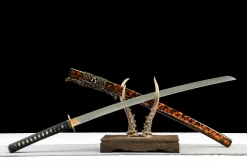
The wakizashi occupies the 30-60cm nagasa range by definition. Our production models run 78-82cm total, with a 52-57cm nagasa. Historically this was the blade a samurai kept when the katana had to be left at the door. Practically speaking, it is the more versatile of the two for indoor use, close-quarters cutting practice, or carry situations where a full katana is impractical.

Because the wakizashi is lighter, typically 650-750g versus 950-1100g for a full katana, it responds faster in the wrist. New practitioners sometimes start here before moving to a katana, which is a reasonable approach. The cutting mechanics are identical; only the reach changes.

Paired as a daisho with a matching katana, the wakizashi should share the same steel type, heat treatment, and hamon style. A mismatched pair is a collector’s compromise. If you are ordering both, order them together so the geometry and finish come from the same production run.

View Wakizashi
, –

Tanto Sizing

Tanto blades run under 30cm nagasa. Our standard model comes in at 30cm nagasa, 52cm total. Below that threshold, you are holding a knife by classification, not a sword, regardless of what the product listing calls it.

The tanto is a specialist tool. Its geometry is built for thrust and close control, not for swinging cuts. The blade stock is often thicker relative to length than a katana, giving it rigidity where the katana has flex and taper. Collectors appreciate this because tanto can carry complex hamon work and detailed hada in a compact format that displays well.

For buyers interested in tanto as a functional blade rather than display, check the tanto geometry guide on blade grind and point type. Shinogi-zukuri tanto and hira-zukuri tanto perform differently under pressure, and the difference is not subtle.

View Tanto
, –

Choosing by Your Height

Height is a starting point, not a final answer. Arm span, wrist strength, and intended use all influence the right fit. That said, here is a straightforward reference built from what we see working in the workshop and in customer feedback.

  • Under 160cm: 68-70cm nagasa katana, or consider starting with a wakizashi at 52-55cm nagasa
  • 160-170cm: 70-72cm nagasa, standard 25cm tsuka
  • 170-185cm: 72-73cm nagasa, standard 25-26cm tsuka
  • Over 185cm: 73-75cm nagasa, 27-28cm tsuka to keep the balance point correct

The balance point on a correctly proportioned katana sits roughly 15-18cm from the tsuba. Stretch the blade without adjusting the tsuka, and that point migrates forward. The sword feels tip-heavy, the draw slows down, and your cuts lose precision. Proportions matter more than raw length.

If you are unsure, our team can help you size correctly before an order is placed. Send your height, arm span (fingertip to fingertip), and intended use, whether that is display, iaido, or tameshigiri. We will come back with a specific recommendation, not a guess.

Contact Us for Sizing Help
, –

Frequently Asked Questions

Yes. Custom nagasa lengths are available on most of our hand-forged models. The minimum order lead time for a non-standard build is 6-8 weeks from Longquan. Note that changing the nagasa without adjusting the tsuka and habaki proportionally will shift the balance point, and not always in the direction you want. We will flag any proportion issues before production begins.

It does, slightly. A blade with 2cm of sori will have a straight-line span roughly 1-2cm shorter than its mune measurement. For most cutting applications this is irrelevant. For iaido practitioners where draw arc precision matters at competition level, it is worth accounting for. We measure and list nagasa along the mune on all product pages, which is the accepted standard.

Most iaido schools standardize on 72-73cm nagasa for adults. Some styles specify 71cm for smaller practitioners. Check with your sensei before ordering, because some schools are strict about this and will ask you to re-order if the length is off. A well-fitted iaito or shinken makes technique easier to develop; a poorly fitted one builds compensations into your form that take years to correct.