









Care & Maintenance
Sword Storage: How to Display and Store Your Katana Safely
A blade can survive the forge, survive the grinder, survive final polish, and then rust in a collector’s spare room inside six months. Poor storage is one of the most common ways a good katana gets ruined, and most of the damage is invisible until it is too late. This guide covers what actually works, from orientation on a stand to long-term humidity control, based on how we store swords here in Longquan before they ship.
Horizontal vs. Vertical Display
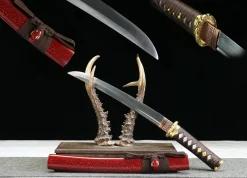
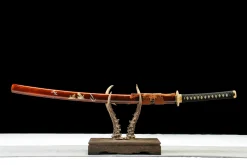
The orientation question comes up constantly, and the answer depends on whether you care more about aesthetics or preservation. Horizontal display, with the blade resting in a wall-mounted or tabletop stand, is the traditional Japanese approach and the more practical one. When the katana sits horizontally with the edge facing upward, gravity works in your favor: any residual choji oil distributes evenly along the blade surface rather than pooling at the tip or running toward the habaki.
Vertical storage is popular because it looks dramatic and takes less horizontal wall space. The problem is that oil migrates downward over time. Store a blade tip-down for several months and you will find the upper portion of the blade drier than the tip, which means the section nearest the habaki, where moisture enters first, is the least protected section.
If you display vertically, edge-forward is the correct orientation. This is not just tradition. Edge-forward places the cutting side away from the wooden stand contact points, reducing the chance of micro-nicks from vibration or accidental contact. Whatever orientation you choose, the blade must never rest with bare steel touching bare metal or unfinished wood. More on that in the next section.
Sword Stands: Types and Materials
Tabletop Stands (Katana-Kake)
A single-tier or two-tier wooden katana-kake is the most common display option, and for good reason. The padded arms, typically wrapped in silk, faux leather, or felt, protect the saya lacquer and prevent contact between metal fittings and the stand surface. When you buy a stand, press your fingernail into the padding. If it compresses easily and springs back, it has enough give to protect the saya during vibration, such as from footsteps or doors closing nearby.
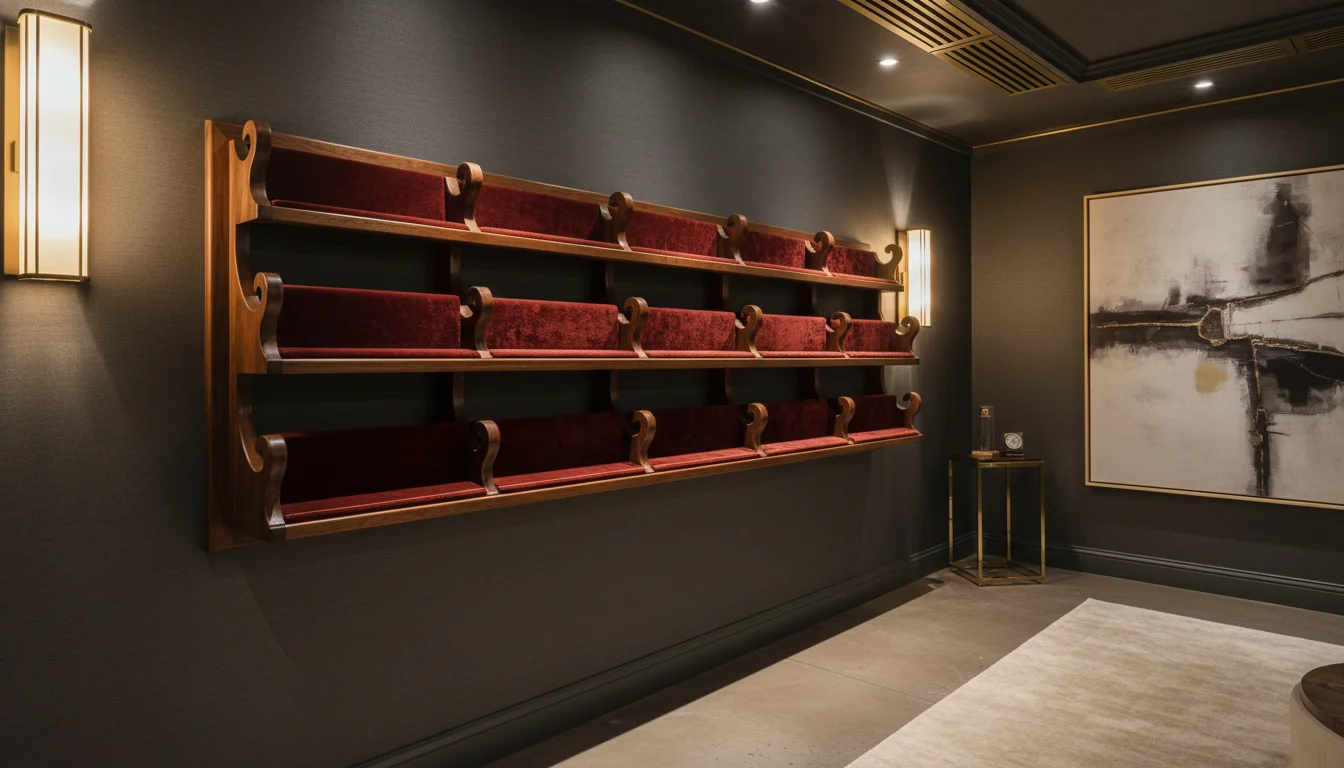
Avoid stands with velvet padding. Velvet holds moisture against the saya, and over time that moisture works its way to the blade through the koiguchi opening. A tightly woven, smooth fabric or genuine leather is the better choice.
Wall Mounts
Wall-mounted brackets work well for display pieces but require more thought about placement. The bracket hardware should never contact the saya directly. Good wall mounts have individual padded cradles for each resting point. Check that the mounting surface is interior drywall, not an exterior-facing wall, since exterior walls carry more temperature fluctuation and moisture transfer.
Material Quality
Hardwood stands, oak, walnut, and paulownia, are better than MDF or softwood. MDF absorbs and releases humidity unpredictably and can off-gas compounds that accelerate metal oxidation over years. Paulownia is the traditional choice in Japan specifically because it is light, stable, and low in tannins that would react with bare steel if contact ever occurred.

Ink Meteor
San-mai construction, $775. A display-worthy blade that rewards careful storage.

Silent Thunder
T10 high-speed tool steel, $280. Clay-tempered with a visible hamon worth protecting.

Dark Ravine
T10 high-speed tool steel, $340. The polished ji benefits from consistent humidity control.
Climate Control
Carbon steels, including the T10 used in our Silent Thunder and Dark Ravine, begin oxidizing at relative humidity above 60%. The ideal storage range is 40-55% RH at a stable temperature between 15-22°C. Fluctuation is more damaging than a consistently moderate humidity level, because expansion and contraction cycles drive moisture through the habaki gap and into the saya where the blade sits.
A basic digital hygrometer costs under $15 and tells you immediately whether your display room is within safe parameters. Basements, garages, and bathrooms are all disqualified without active climate control. A spare bedroom on an upper floor with central heating and a small dehumidifier is a more realistic setup than a temperature-controlled safe for most collectors.
Damascus and pattern-welded blades need particular attention here. Our Damascus steel katanas are built from layers of folded steel with micro-channels between them. Moisture can settle in those channels and cause hidden corrosion that shows up on the surface pattern weeks later. If you own a Damascus piece, err toward the drier end of the acceptable range, around 40-45% RH.
Silica gel packets inside a display case are a practical, low-cost solution. Use indicating silica gel that changes color when saturated, and replace or recharge the packets every three to four months. One 50-gram packet per 30 liters of enclosed cabinet space is a reasonable starting point.
Protecting the Edge
The cutting edge of a katana is typically ground to between 0.5mm and 1mm at the shinogi before final polish. At that thickness, a minor impact from another hard surface creates a visible flat spot that requires professional re-polishing to correct. The goal of storage is to ensure the edge never touches anything harder than the wood or padding of the saya.
Always store the blade inside the saya, with the cutting edge facing upward. Edge-up prevents the ha from pressing into the wooden scabbard under its own weight. A blade left edge-down in the saya for months will develop shallow pressure marks on the cutting surface, especially on softer carbon steels like 1065 or 1075.
When drawing the blade for cleaning or inspection, pull slowly and stop before the kissaki fully clears the koiguchi. Rotate the blade slightly to confirm it is not binding, then complete the draw. Forcing a blade that is binding slightly is how tsukamaki gets damaged and how fittings loosen. If you notice increasing resistance when drawing, the saya has likely absorbed moisture and swollen slightly. Remove the blade, let the saya dry for 24-48 hours, then re-fit.
For maintenance after each handling session, follow the five-step oiling process we outline in our complete sword care guide. The short version: two to three drops of choji oil on a microfiber cloth, thin even coat from habaki to kissaki, return to saya edge-up. Never use WD-40. It leaves a residue that attracts dust and holds moisture against the steel.
Long-Term Storage
If you are storing a katana for six months or longer without regular handling, the process differs from routine display maintenance. First, apply a heavier coat of choji oil than you would for a displayed blade. The saya wood will absorb oil over time, and what was a thorough coating in month one will be a thin, incomplete coating by month three.
Wrap the oiled blade in acid-free rice paper before placing it in the saya. The rice paper acts as a secondary oil reservoir and protects against wood tannins in older saya. This is a practice used by Japanese sword polishers when storing blades awaiting polish, and it works equally well for long-term collector storage.
Store the sword horizontally, inside a wooden case or a cloth bag, never in a sealed plastic bag or airtight case. Plastic traps humidity rather than managing it. A breathable cotton bag allows minor humidity fluctuation while keeping dust off the saya and fittings.
Inspect the blade every 90 days, minimum. Remove the blade from the saya, wipe it down, examine the surface under good lighting at a low angle. Early-stage rust appears as a faint orange or brown haze before individual rust spots form. Caught at that stage, it can be removed with an uchiko powder application and re-oiling. Left for another 90 days, it requires professional attention. Check our steel comparison guide to understand how your specific steel type responds to long-term storage conditions, as T10 and 1095 behave differently from higher-alloy options.
For collectors building out a collection, our full range of katanas includes detailed steel specifications on every product page, so you know exactly what care schedule each blade requires before it arrives.
Frequently Asked Questions
Ready to Find Your Blade?
