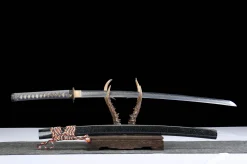
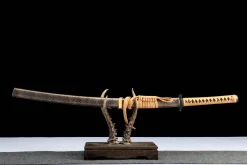
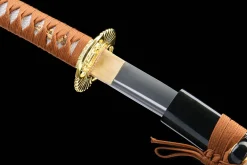
Katana Swords Shop was built on a simple idea: you should not have to spend a fortune to own a hand-forged sword made by a real blacksmith. Every blade leaves our Longquan workshop hand-ground, tempered, and inspected.
Hand-forged steel from Longquan , real blades, real materials, no compromises on craft.
Every sword in this category is forged from either 1065 high carbon steel or multi-layer Damascus, ground to a proper edge, and finished by hand in Longquan , the city that has been producing blades since the 6th century. At under $200, you are not buying a wall piece. You are buying a functional cutting sword with a full tang, a heat-treated blade, and the kind of fit-and-finish that most buyers do not expect at this price point. Browse the full selection below, or check our sword buying guide if you are still deciding which type of blade suits you.
Why Choose Swords Under $200
The question we hear most from first-time buyers is whether a $200 sword is worth buying or whether it will feel cheap in hand. Here is the honest answer: material cost and forge labor in Longquan make it possible to produce a blade with a 60-70cm cutting edge, a full-tang construction, and real heat treatment at this price. What you give up at this tier is not structural quality , it is extended finishing time. The hand-polishing on a $200 blade takes two to three hours. On a $500 blade, it takes eight. You will see the difference under magnification. You will not feel it when you cut.
Six of the ten blades in this category use Damascus steel , specifically pattern-welded steel made by folding and forge-welding two or more alloys together. The grain patterns you see on the Dark Empyrean and the Night Ember Star Fall are not etched or printed. They come from the steel itself, revealed by acid wash after grinding. No two billets produce the same pattern, which means the blade you receive will never be identical to any other.
The 1065 high carbon steel options , the Azure Storm, the Pure Heart, and the Steel Shadow , run slightly simpler in appearance but hold an edge well. At HRC 58-60, the steel is hard enough for serious cutting practice but not so brittle that a lateral force will crack the blade. If you are buying your first sword for tameshigiri or dojo use, 1065 is a sensible starting point. Read our sword care guide to understand how to oil, store, and maintain whichever blade you choose.
Four Things to Check Before You Buy
1. Steel type matches your intent. Damascus blades in this category are built for display and moderate cutting. If you train three times a week with heavy targets, a mono-steel 1065 blade is more forgiving of repeated lateral stress. Damascus shows its patterning best when kept clean and dry , it takes more maintenance in a training environment.
2. Blade length fits your draw. The Shadow Phantom is a wakizashi, meaning the blade runs roughly 45-60cm. Every other sword in this category is a katana, with blades in the 68-73cm range. Your height and arm length determine which length handles comfortably. A blade that is too long will drag on the saya lip during iaido practice.
3. Check the habaki fit before your first draw. A properly seated habaki , the metal collar at the blade’s base , should grip the saya mouth with light friction. Too loose and moisture enters. Too tight and you will stress the lacquer on the draw. On every blade we ship, we test this fit manually before packing.
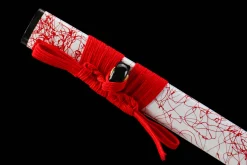
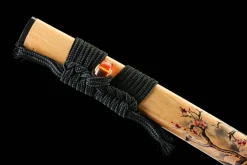
4.烤红 finish requires extra care. The Brocade Sun and the Tsukuyomi both carry a 烤红 (baked red) heat-coloring treatment on the fittings. This finish is stable under normal handling but will fade with prolonged exposure to moisture or abrasive contact. Keep those blades oiled and stored in their saya when not in use.
Every sword in this category is functional. The blades are ground to a working edge, heat treated to HRC 58-60, and constructed with a full tang that runs the length of the handle. They are not sharpened to shaving-sharp by default , that is a shipping safety measure , but they arrive ready for light cutting practice and can be sharpened further by anyone with basic whetstone skills. They are not wall hangers. If you want a display-only piece, you would actually be overpaying here, because most of what you are paying for is structural integrity in the blade.
Damascus steel in this context means pattern-welded steel, produced by forge-welding two or more alloys , typically a high carbon steel and a softer iron , and folding the billet repeatedly before grinding. The result is a blade with visible grain patterning and, depending on the alloy combination, a modest differential in hardness between layers. The 1065 mono-steel blades are made from a single homogeneous alloy with 0.65% carbon content. They are straightforward to sharpen, highly predictable under load, and slightly more tolerant of hard cuts than a Damascus billet of equivalent thickness. Damascus blades require more attention to prevent surface rust on the exposed softer iron layers. For a first cutting sword, 1065 is simpler to maintain. For someone who wants a blade that looks different every time they wipe it down, Damascus is the choice.
We ship from Longquan, China. Standard international shipping runs 12-20 business days depending on destination and customs processing. Expedited options are available at checkout and typically arrive in 7-10 business days. All blades are individually wrapped, edge-protected, and packed in a double-wall box with the saya secured separately from the blade. Customs regulations vary by country , some import restrictions apply to swords in Canada, Australia, and parts of the EU. We recommend checking your local import rules before ordering. We declare all shipments accurately and do not mark them as gifts to reduce declared value.
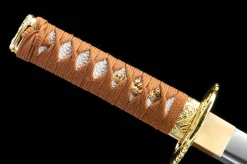
Yes. The handles on all katana in this category follow standard Japanese fittings sizing, which means the tsuba, fuchi, kashira, and menuki can be replaced with aftermarket or custom components. The handle itself , the tsuka , is wrapped in traditional ito cord over a same (