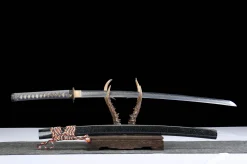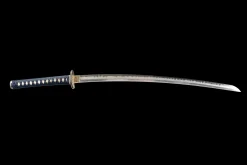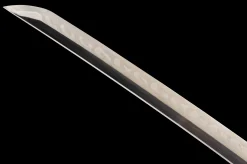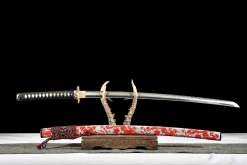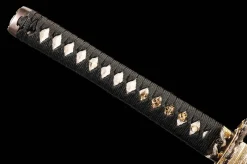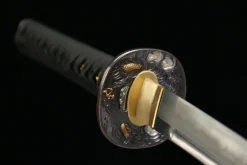
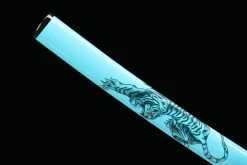
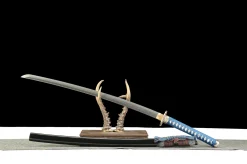
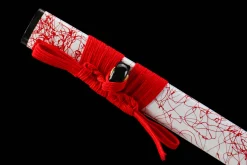
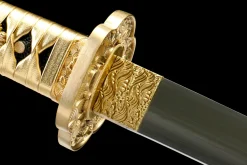
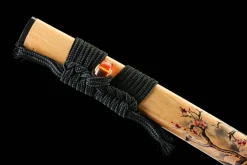
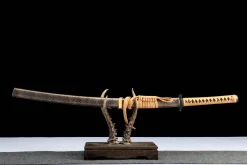
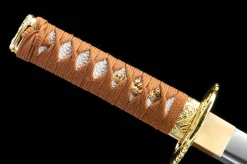
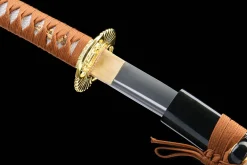
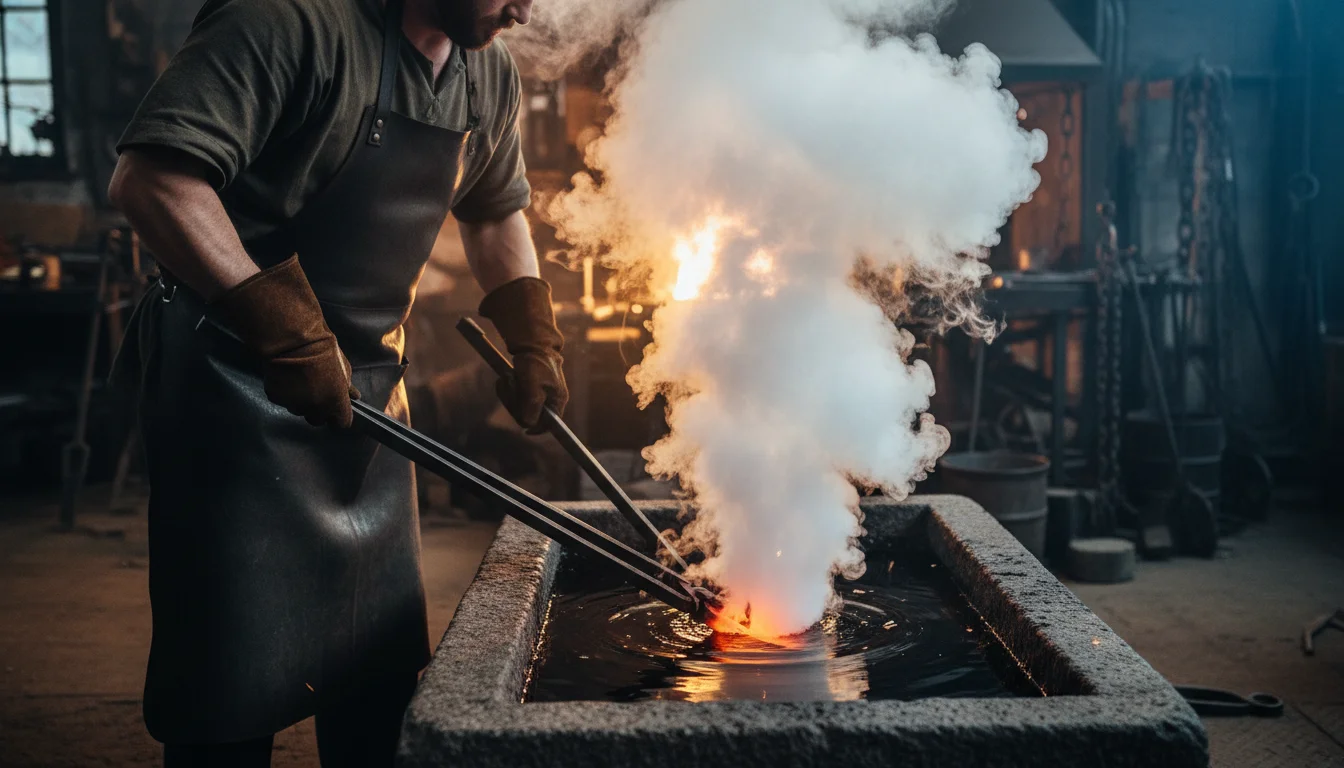
T10 tool steel sits at the serious end of the functional sword spectrum. The tungsten content – absent in most high-carbon alternatives – tightens the grain structure and slows edge wear in a way that 1095 simply cannot match. Every T10 katana and wakizashi in this category is clay tempered, which means each blade carries a hamon that formed under real differential hardening, not acid etching.
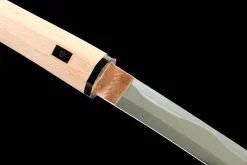
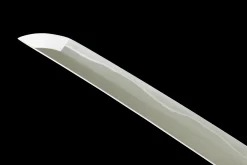
Why Choose T10 Tool Steel

T10 is a tool steel, not a sword steel by original design. That matters. It was engineered to hold a cutting edge under sustained mechanical stress – think dies, punches, and cutting tools. When Longquan smiths adopted it for katana production, they inherited those material properties and added clay tempering on top. The result is a blade hardened to HRC 60-63 at the ha, with a softer spine that absorbs impact instead of transmitting it to your hands as a crack.

The tungsten is what separates T10 from 1095 or 1060 in real use. At 0.95-1.05% carbon plus tungsten alloying, T10 resists micro-chipping along the edge far better than plain high-carbon steels at equivalent hardness. A cutting edge at HRC 62 in 1095 becomes brittle. In T10, the tungsten carbides distributed through the matrix give that hardness something to lean on.

Clay tempering T10 produces some of the most active hamon patterns we see from any steel. The transition zone between the hard edge and the soft spine is wide and turbulent – nie and nioi form densely, and activities like chikei and inazuma show up without any encouragement. Every blade in this category was tempered individually by hand. No two hamon are identical, and that is not a sales line. It is physics.

Choosing the Right T10 Blade

Check the polish grade first. T10’s hamon only becomes fully visible under a proper hand polish. A machine-buffed blade will hide most of the activity in the transition zone. Look for descriptions like “hand polished,” “hazuya finish,” or “丁字烧一级研” – that last one means the blade received a first-grade clove-pattern temper polish, which is the most labor-intensive finish we offer.

Confirm the yokote line if you care about geometry. Several blades in this category are explicitly listed with a yokote line. That small ridge separating the kissaki from the main blade body is ground in by hand and reflects how much time the polisher spent on the tip geometry. Blades without a stated yokote line are still properly formed, but the detail work at the point is less pronounced.

Match the blade length to your use. We carry both katana (typically 70-73cm blade) and wakizashi formats in T10. If you train in iaido or tameshigiri, the katana lengths in this category will suit you. The T10 wakizashi – particularly the Starlight Radiance and Dragon Ascendant – are better suited to paired practice or collection alongside a katana.

Plan for maintenance. T10 at HRC 60-63 requires oiling after every handling session. Fingerprints alone will start surface oxidation within days in humid conditions. Choji oil or a light mineral oil, applied with a nuguigami, is sufficient. Our sword care guide covers the full maintenance routine in detail.

Frequently Asked Questions

Both steels sit in a similar carbon range – around 0.95-1.05% – but T10 includes tungsten as an alloying element. That tungsten forms carbides within the steel matrix that resist wear and micro-chipping at the edge. In practical terms, a T10 katana will hold its edge longer under repeated cutting than a 1095 blade hardened to the same HRC. The tradeoff is that T10 requires more skill at the forge and responds poorly to overheating during grinding, which is why skilled production matters more with this steel than with simpler high-carbon alloys. You can read a full side-by-side breakdown in our steel comparison guide.
Every T10 blade in this category carries a genuine clay-tempered hamon formed through differential hardening, not acid etching. The process involves applying a clay coating to the spine before quenching, so the edge cools rapidly and hardens to HRC 60-63 while the spine cools slowly and stays at roughly HRC 40-42. That temperature gradient is what creates the hamon. An acid-etched hamon is a surface stain that polishes away. A genuine hamon is a structural boundary that runs through the steel and remains visible under any polish level.
Yes, with appropriate targets and technique. T10 at HRC 60-63 is hard enough to take and hold a fine edge, but that hardness means the blade does not flex through a cut the way a softer steel would. Cutting dry, dense material – like thick bamboo or tightly wound tatami without prior soaking – puts lateral stress on a hard edge and risks chipping. Properly soaked tatami omote, soft bamboo, and pool noodles are all suitable. For regular, high-volume tameshigiri training, the buying guide walks through which blade characteristics matter most for cutting performance. If your primary use is kata rather than cutting, any blade in this category will perform well.
T10 is not stainless. After any handling session, wipe the blade with a clean cloth to remove fingerprints and moisture, then apply a thin, even coat of choji oil or mineral oil using a soft cloth or nuguigami. Store the blade in its saya in a dry environment – not in a sealed display case where humidity concentrates. If you live in a coastal or high-humidity climate, check the blade monthly and re-oil as needed. Surface rust caught early can be removed with uchiko powder and light polishing. Deep rust that has pitted the surface requires professional polishing. Our sword care guide covers each step in the full maintenance routine.
[accordion-item title=”
[/accordion-item] [/accordion]