







Sword Education
Understanding Hamon: What the Temper Line Reveals About Your Blade
What Is Hamon?
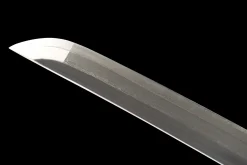
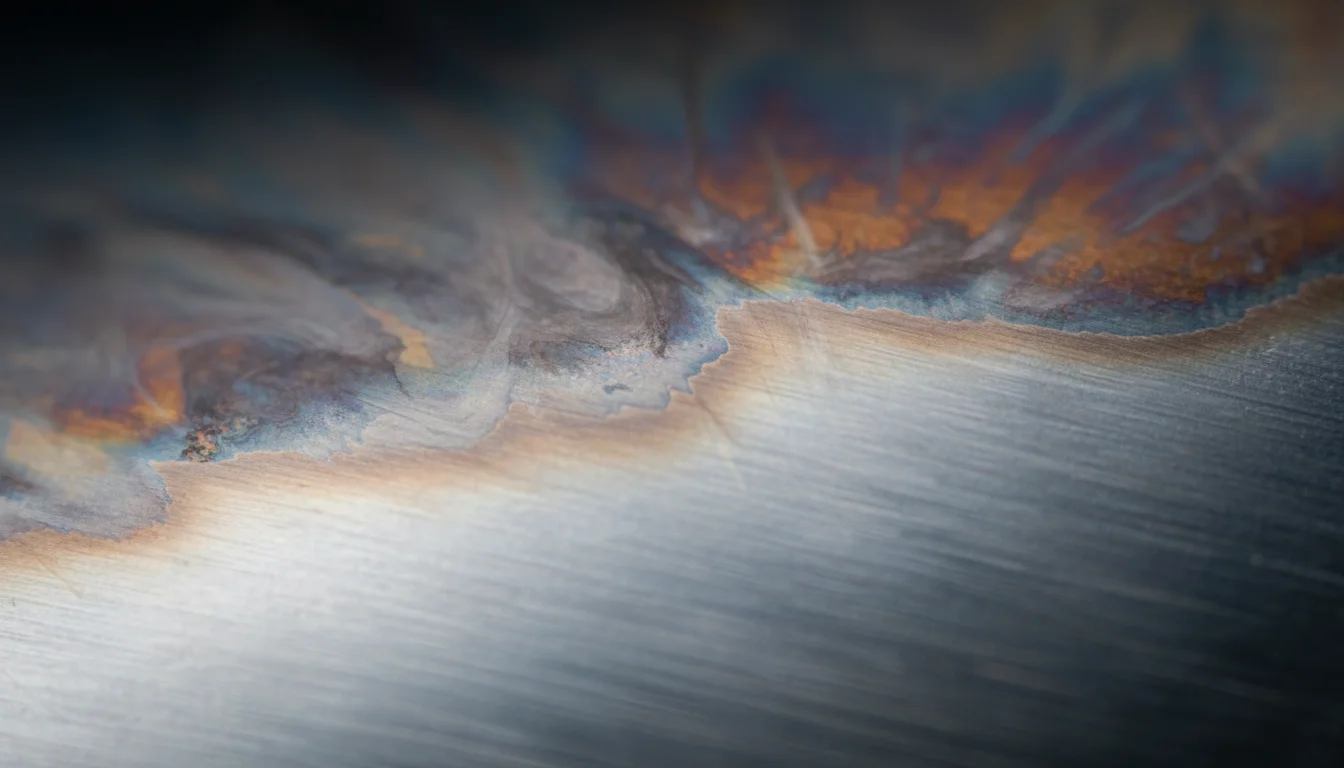
Run your eye along the flat of a properly polished katana and you will see it: a line of mist sitting between the edge and the spine, sometimes straight, sometimes rolling like a wave, sometimes erupting into jagged peaks. That line is the hamon. It is not decoration applied after the fact. It is a boundary, drawn in steel, between two fundamentally different metallurgical zones.
On one side of the hamon sits the ha, the cutting edge. This zone is hard, typically HRC 58-62 on a well-made clay-tempered blade. On the other side sits the mune, the spine, which stays softer, around HRC 40-45. A blade that is uniformly hard shatters. A blade that is uniformly soft bends and will not hold an edge. The hamon is where those two zones meet, and it tells you exactly how the maker handled that balance.
When buyers ask us “what is hamon,” the shortest accurate answer is this: it is proof that differential hardening occurred. Everything else about it, the shape, the activity, the brightness, is a consequence of the steel and the process that created that boundary.
How Hamon Is Created
The process starts before the blade ever sees a quench tank. After the blade is forged and ground to its final geometry, a mixture of clay, ash, and charcoal is applied to the spine and sides. The edge is left bare, or covered with only a very thin layer. This is called tsuchioki, the clay application, and how it is applied determines the shape of the hamon before the steel even gets hot.
The blade then goes back into the forge, heated to critical temperature, somewhere between 780 and 820 degrees Celsius for most high-carbon steels. Pull it too early and the transformation is incomplete. Push it too far and you risk grain growth that weakens the steel permanently. At the correct temperature, the blade is quenched in oil or water.
Here is where the physics take over. The bare edge, uninsulated by clay, sheds heat fast. Fast cooling drives the carbon-rich austenite into martensite, the hard crystalline structure responsible for a sharp, wear-resistant edge. The clay-covered spine cools slowly, transforming into softer pearlite instead. Where those two cooling rates meet, the hamon forms. The activity you see inside it, the small cloud-like structures called nie and nioi, are individual martensite crystals and clusters of crystals visible under polishing and light.
After quenching, the blade is tempered at 150-200°C to reduce brittleness without giving back significant hardness. Skip that step and you have a blade that will perform beautifully until it does not, usually at the worst possible moment.
Common Hamon Patterns
Suguha
Suguha is a straight hamon running parallel to the edge from base to tip. It looks simple. Achieving it consistently is not, because any variation in clay thickness or temperature during the quench shows up immediately as deviation. Schools like the Yamato tradition and many Shinto-period smiths favored suguha precisely because there is nowhere to hide imprecision.
Notare
Notare is a gently undulating hamon, long and slow waves with no sharp transitions. It has a calm quality that suits blades with refined geometry. The wave corresponds to where the clay line was feathered out during application, creating a gradual rather than abrupt boundary between hard and soft zones.
Gunome
Gunome shows a repetitive, rounded-tooth pattern along the hamon. The regularity is intentional and requires careful clay application to produce each tooth at a consistent height and spacing. Many Bizen-tradition blades show gunome, sometimes combined with other elements into what is called gunome-midare.
Midare
Midare is intentionally irregular. The clay is applied with deliberate variation in thickness and boundary shape, so the resulting hamon has no repeating unit. Achieved well, midare looks wild but controlled, energetic without being chaotic. It is the hardest pattern to replicate convincingly on a fake, which is one reason it is a useful diagnostic when examining authenticity.

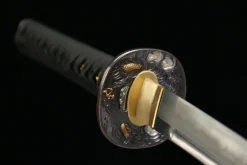
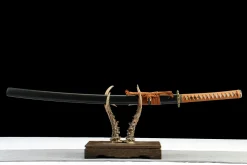
Ink Meteor – LQS-0125
San-mai construction, visible active hamon, $775
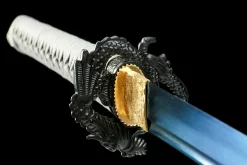
Silent Thunder – LQS-0126
T10 tool steel, clay-tempered hamon, $280
Dark Ravine – LQS-0127
T10 tool steel, clay-tempered hamon, $340
Real vs Fake Hamon
This is where it gets practical. A genuine hamon is a product of metallurgical transformation. A fake hamon is acid-etched or mechanically scratched into the surface of a uniformly hardened, or worse, uniformly soft blade. The visual difference is obvious once you know what to look for, but many buyers never get the chance to learn before they purchase the wrong blade.
On a real hamon, the boundary has depth. Hold the blade under a single-point light source and rotate it slowly. The hamon moves, shifts, and reveals internal activity. Nie crystals catch the light at different angles than the surrounding steel. The boundary between hard and soft is never perfectly sharp because steel does not transform that cleanly. There is always a transition zone called the habuchi, where hamon patterns like ashi (leg-like projections toward the edge) and yo (isolated islands of activity) appear in genuine differential hardening.
A fake hamon looks flat. The contrast between the bright line and the rest of the blade is consistent regardless of viewing angle because it is a surface treatment, not a structural one. It also tends to run in patterns that are a little too clean, too symmetrical, and without internal activity. Acid etching leaves a matte texture in the etched zone that feels different from polished steel. Run a fingertip across it and you will notice it immediately.
The performance test is more definitive but more destructive. A blade with no real differential hardening will either be uniformly hard and brittle, or uniformly soft and unable to hold an edge. If the spine flexes under load and springs back cleanly, and the edge holds after cutting, the hardening is real. Our blade buying guide walks through how to evaluate these characteristics before you commit to a purchase.
One thing worth knowing: stainless steel cannot produce a genuine hamon. Stainless does not respond to clay tempering the way high-carbon steels do. If you see a blade marketed as stainless with a hamon, that pattern is decorative. For a full comparison of how different steels respond to heat treatment, see our steel comparison guide.
Why Hamon Matters for Performance
Collectors care about hamon aesthetics. Cutters care about what the hamon represents functionally. The two interests are not in conflict, because a well-formed hamon on a properly tempered blade means the edge and spine are doing exactly what they are supposed to do.
An edge at HRC 58-62 will take and hold a fine edge through repeated cuts. The same hardness at the spine would make the blade prone to catastrophic failure on lateral stress. Keeping the spine softer, at HRC 40-45, lets it absorb shock and flex without cracking. A katana with no differential hardening is either a wall hanger that will chip on contact, or a practice prop that cannot cut cleanly. Neither is useful.
T10 high-carbon tool steel, the material we use in blades like the Silent Thunder and the Dark Ravine, responds exceptionally well to clay tempering. Its tungsten content improves wear resistance at the edge without making the steel difficult to work. The resulting hamon on T10 tends to show clear activity and a well-defined habuchi, which is one reason we use it across a significant portion of our production line.
For our Ink Meteor, the san-mai construction adds another dimension. The hard high-carbon core carries the hamon and edge, while the softer outer steel wraps the spine and sides. The boundary between core and jacket is visible along the shinogi, and the hamon itself forms only in the core steel. Hold one under light at the right angle and you can see both boundaries at once.
After you acquire a clay-tempered blade, maintenance becomes part of the conversation. The differential hardness that produces the hamon also means the edge is more susceptible to corrosion if left untreated, because the martensitic structure at the edge is slightly more reactive than the softer spine. Regular light oiling keeps that in check. Our sword care guide covers the specific oils and application intervals we recommend for long-term preservation.
Browse our full selection of katanas with genuine clay-tempered hamon, including several options in Damascus steel where the hamon interacts with the folded grain pattern in ways that are genuinely difficult to put into words until you see them in person.
Frequently Asked Questions
Ready to Find Your Blade?
