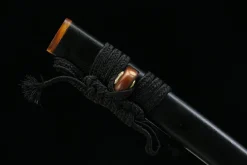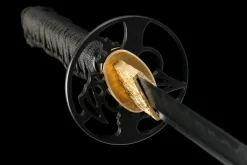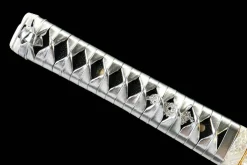
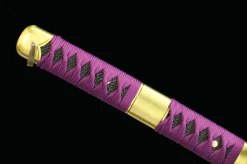
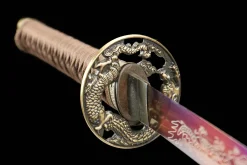
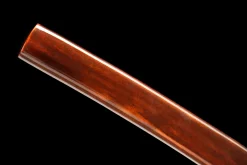
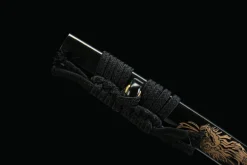
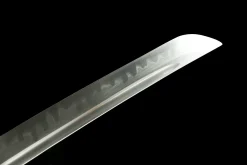
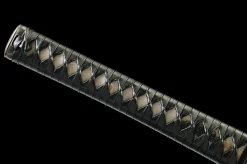
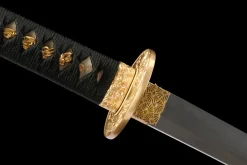
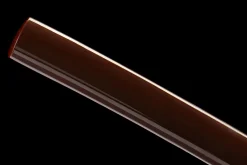
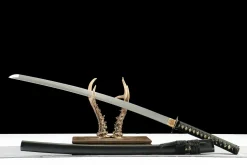
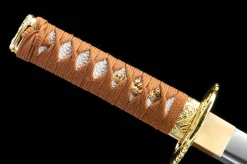
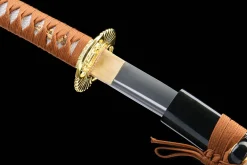
The wakizashi was never a lesser sword. Worn indoors where a full katana could not clear the ceiling, used for close-quarters work where a longer blade became a liability, and carried by merchants and craftsmen who had no right to bear a katana at all , this short sword did serious work in feudal Japan. Every blade in this collection is forged in Longquan using the same construction methods we apply to our full-length katana: curved single-edge geometry, proper heat treatment, and fittings that will last. Steel options run from 1045 carbon for beginners to hand-refined self-smelted steel (自炼钢 上研) for collectors who want the best we can produce.
Why Choose a Wakizashi Short Sword

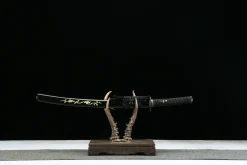
A wakizashi blade runs between 30 and 60cm , one to two shaku in traditional measurement. That compact length is not a compromise. It is a design decision made by smiths who understood indoor combat, tight spaces, and the situations where drawing a full katana is simply not practical. The curved, single-edge geometry is identical to the katana in principle, just scaled down. The steel behaves the same way under differential hardening. The hamon forms the same way along the clay-coated edge. Nothing is watered down in the process.

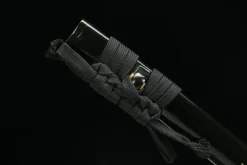
Paired with a matching katana, the wakizashi forms the daisho , the two-sword combination that defined samurai status for centuries. Several of our wakizashi share fittings families with our katana line, so a matched set is achievable. If you are building a daisho display or looking for a sword with genuine display impact in a smaller footprint, the wakizashi is the right choice. One practical note: a 45cm wakizashi fits on a standard wall mount that a 73cm katana simply will not.

Our clay-tempered wakizashi , particularly the Starlight Radiance with its 丁字烧 (choji) hamon and the Golden Kirin ground to 上研 (premium polish) , carry the same differential hardening process we use on our full-length blades. The edge hardens to HRC 58-60 while the spine stays at HRC 40-42. That is not a marketing claim; it is the measurable result of applying and firing the clay correctly, then quenching at the right moment.

How to Choose the Right Wakizashi

Start with steel grade, not price. The gap between 1045 carbon and T10 high-carbon tool steel is real and measurable. T10 holds an edge at HRC 60 and takes a sharper initial grind. If you are buying for display only, 1045 is honest and capable. If the blade will be handled regularly, step up to T10 or clay-tempered T10 at minimum.

Decide whether you need differential hardening. Clay tempering produces the visible hamon line along the edge , the wavy or irregular boundary between the hardened edge zone and the softer spine. It also produces a blade that behaves differently under flex: the spine absorbs, the edge holds. Our Dragon Ascendant uses T10 with 独家钉子烧 (nail-pattern) clay tempering , a specific hamon style that requires precise clay placement before quench. That detail matters to collectors who understand what they are looking at.

Consider the polish grade if you care about grain visibility. A 上研 (premium polish) finish on the Golden Kirin brings the jihada , the surface grain pattern of the steel , into full visibility. A standard polish on a lower-tier blade will show you the hamon but not much else. If the steel’s internal structure is part of what you are paying for, the polish grade determines whether you can actually see it.

Check our full buying guide for steel comparison charts, or read our sword care guide before your first purchase. A clay-tempered blade needs light oil on the surface every few months. That is a five-minute task, not a burden , but it is worth knowing going in.

Frequently Asked Questions

By definition, a wakizashi blade measures between 30cm and 60cm , one to two shaku in the traditional Japanese measurement system. Below 30cm, a blade is classified as a tanto. Above 60cm, it becomes a katana. Our wakizashi range sits within this window. The shorter end of the range, around 35-40cm, was historically preferred for indoor use and close work. The longer end, approaching 55-60cm, gives you something closer to a katana in handling feel, which some practitioners prefer for forms practice.
Yes, and several of our customers build matched sets this way. A true daisho pairs a katana and wakizashi with matching or coordinated fittings , tsuba, menuki, fuchi, and kashira in the same style or material. We carry katana with fittings that complement specific wakizashi in this collection. Contact us before ordering if you want a matched pair, and we will confirm which combinations share fitting families. One thing worth knowing: in the daisho tradition, the tsuba design on the wakizashi was often slightly simpler than the katana’s, not identical , so a close match, not a clone, is historically accurate.
For a display piece, the hamon line alone justifies it for most collectors , the visible boundary between hard edge and soft spine is the most distinctive visual feature a Japanese-style blade can have. For a blade you will handle, the functional argument is just as strong. A differentially hardened blade has a spine that flexes and absorbs impact while the edge stays hard enough to hold a working sharpness. The tradeoff is that the hardened zone is more brittle if you strike hard objects at the wrong angle. That is not a flaw in the process , it is physics. Our clay-tempered wakizashi are heat treated to HRC 58-60 at the edge and HRC 40-42 at the spine. If those numbers matter to you, the upgrade is worth it.
For a first wakizashi, T10 high-carbon tool steel is the practical entry point into serious quality without the price of self-smelted steel. The