







Sword Education
5 Steel Types for Katanas Explained: 1065, 1095, T10, Damascus, Spring

Every customer who walks through our door in Longquan eventually asks the same question: “Which steel is best?” The honest answer is that there is no single best steel. There is only the right steel for what you plan to do with the blade. A tameshigiri practitioner needs something different from a collector who wants a vivid hamon. A beginner running their first cutting sessions needs something different from an advanced practitioner who understands exactly how to maintain a high-carbon edge.
This guide breaks down the five steel types we work with most in our forge: 1065, 1095, T10, Damascus, and spring steel. For each one, we cover the actual numbers, the real-world behavior at the cutting mat, and the maintenance habits you will need to build. Read the full katana buying guide if you want the wider context. Here, we go deep on the steel itself.
Carbon Content and What It Means
The number in a steel designation tells you its approximate carbon content by weight. 1065 steel contains roughly 0.65% carbon. 1095 contains roughly 0.95%. That fraction of a percentage point changes how a blade behaves at the forge, in the quench tank, and on the cutting mat.
Higher carbon generally means harder potential edge retention, but also more brittleness if the heat treatment is careless. Lower carbon means more forgiveness under impact, but the edge rolls off faster. The steel’s other alloying elements, tungsten in T10, silicon and manganese in spring steels, shift those curves in specific directions.
Heat treatment matters as much as raw composition. A well-heat-treated 1065 blade outperforms a poorly heat-treated 1095 blade every single time. That is why we do not just talk about alloy numbers in isolation. The forge process, the clay application, the quench speed, the tempering temperature: these are what turn a bar of steel into a blade worth carrying.
1065 High Carbon Steel
Think of 1065 as the baseline. It hardens to HRC 54-58 with a proper heat treatment, sits at a carbon level that forgives aggressive quenches, and takes an edge that holds up through sustained cutting practice. Our internal rating: edge retention 6/10, toughness 8/10, ease of sharpening 9/10.
The toughness score is where 1065 earns its reputation. At 8/10, it absorbs lateral shock far better than the higher-carbon steels. If you are new to tameshigiri and your angle is occasionally off, a 1065 blade handles that stress without complaining. A 1095 blade in the same situation starts to show micro-chipping along the ha.
Hamon on 1065 is possible but faint. The lower carbon content means the differential hardening between the clay-coated spine and the exposed edge does not produce the same dramatic activity you see in higher-carbon steels. If you want a vivid hamon, 1065 is not your steel. If you want a reliable cutting tool at a price index of 1, lowest in our range, it is the most sensible starting point.
One practical note: 1065 sharpens fast. A few passes on a 1000-grit whetstone bring the edge back cleanly. Beginners learning to maintain their own blades appreciate that. Refer to our sword care guide for the full maintenance sequence we recommend.
1095 High Carbon Steel
Step up to 0.95% carbon and the blade’s character changes noticeably. Edge retention climbs to 9/10. Toughness drops to 5/10. Those two numbers are the whole story of 1095: it holds a finer, longer-lasting edge, but it asks more of the person holding it.
The hamon on a clay-tempered 1095 blade is the reason collectors seek it out. The high carbon content reacts dramatically to differential hardening. You get a bright, active nie and nioi line with complex activity in the hamon that moves and changes under different lighting. We have pulled blades from the quench tank and spent twenty minutes studying the hamon before even starting the polishing process. It is genuinely remarkable steel to work with.
Corrosion resistance scores 2/10, the lowest in this group. High carbon, low chromium: 1095 rusts fast if you ignore it. One practice session with sweaty hands and no post-use oiling can put a rust bloom on the blade within 24 hours. If you are not ready to oil the blade after every use and wipe it before every draw, 1095 will punish you for it.
The analogy we use internally: a sports car engine. Incredible performance in the right hands, but it needs consistent attention to stay in top condition. Our steel comparison guide goes deeper on 1095 versus T10 if you want a full head-to-head breakdown.
T10 Tool Steel
T10 is where high-carbon performance meets practical toughness. The tungsten content, around 1.4-1.8% in most T10 formulations, is what separates it from standard high-carbon steels. Tungsten forms hard carbides within the steel matrix, which resist wear and hold an edge even after repeated cuts through dense targets. Edge retention sits at 8/10. Toughness sits at 7/10. That combination is unusual. Most steels trade one for the other.
Clay tempering T10 produces a hamon we rate as stunning. The tungsten carbides create complex, textured activity in the transition zone between hard edge and softer spine. Our smiths in Longquan consider T10 the most visually rewarding steel to clay temper. The hamon patterns are varied, dramatic, and structurally meaningful, not decorative.
Hardness after heat treatment typically reaches HRC 60-62 at the edge, with the clay-protected spine sitting softer at HRC 40-42. That differential is what gives a clay-tempered T10 blade its dual character: hard enough to hold a fine edge, flexible enough in the spine to absorb impact without cracking.
Sharpening T10 scores 6/10. The tungsten carbides that make it tough also make it slower to rework on a stone. You need a quality 1000-grit water stone and patience. Rush it and you will produce a ragged edge instead of a clean one.

Silent Thunder
T10 tool steel, clay-tempered hamon, $280 – serious cutting performance at an accessible entry point.

Dark Ravine
T10 tool steel with a distinctive hamon pattern, $340 – for the practitioner who wants both function and character.

Ink Meteor
San Mai construction (三枚合), $775 – T10 core sandwiched in softer steel for the most demanding use.
Damascus / Pattern-Welded Steel
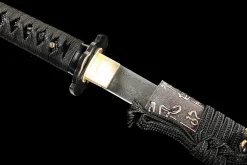
The blades in our Damascus steel collection are built by folding and forge-welding two or more steel types together, typically a high-carbon steel for edge performance and a lower-carbon steel for toughness and flexibility. The folding process can run from 32 layers up to several hundred, with each fold doubling the layer count. Forty layers. Eighty. One hundred sixty. The grain pattern that emerges during acid etching is a direct record of how many times the steel was folded and in what direction.
Edge retention on Damascus rates at 7/10 in our data, toughness at 7/10. Both numbers sit in the middle of the range because Damascus is inherently a composite: you get the averaged performance of the steels used, not the peak performance of either one. The folding process also eliminates the possibility of a clay-tempered hamon in the traditional sense. The visible layer pattern is the aesthetic element here, not a hamon line.
Here is something most buyers do not know: the layer count in Damascus affects how the blade feels during the finish grind, not just how it looks. Very high layer counts, above 200, can produce a surface that polishes to a near-mirror finish with the pattern barely visible. Lower layer counts, 32-64, produce bolder, more visible patterns. Our smiths generally prefer 64-128 layers for blades intended for display or occasional cutting use.
Ease of sharpening sits at 5/10. The alternating hard and soft layers create inconsistent resistance across the edge bevel. A skilled sharpener works with that. A beginner can inadvertently create a wavy edge by pressing too hard through the softer zones. Damascus rewards experienced maintenance habits.
Spring Steel: 65Mn and 9260
Spring steels are the outliers in this list. Neither 65Mn nor 9260 is optimized for maximum edge retention or aesthetic hamon production. Both are optimized for one thing: not breaking.
65Mn is a manganese-alloyed spring steel that hardens to HRC 50-55. It bends under stress and returns to true. Our toughness rating for spring steels is 10/10, the highest in any category we test. Flex a 65Mn blade to a 45-degree angle and release it. It springs back. Do that with a clay-tempered 1095 blade and you will be looking at two pieces of steel on the floor.
9260 adds silicon to the spring steel formula, pushing the flexibility and shock-absorption even further. It is the preferred spring steel for practitioners who do heavy contact training or test cutting through hard materials like green bamboo and thick tatami rolls. Corrosion resistance scores 4/10, the best in our comparison group, because the manganese and silicon content provides modest oxidation resistance that pure high-carbon steels lack.
No hamon is possible on spring steels. The alloying elements that provide flexibility also prevent the differential hardening response that creates a hamon line. If the hamon matters to you, spring steel is not your steel. If you want a blade that survives years of hard training without demanding careful coddling, spring steel is hard to argue against at a price index of 1, equal to 1065.
Comparison Table
All scores are out of 10 unless noted. Price index runs 1 (most affordable) to 4 (most expensive).
| Steel | Edge Retention | Toughness | Ease of Sharpening | Corrosion Resistance | Hamon Potential | Price Index |
|---|---|---|---|---|---|---|
| 1065 | 6 | 8 | 9 | 3 | Faint | 1 |
| 1095 | 9 | 5 | 7 | 2 | Vivid | 2 |
| T10 | 8 | 7 | 6 | 3 | Stunning | 3 |
| Damascus | 7 | 7 | 5 | 3 | N/A – visible layers | 4 |
| Spring (65Mn/9260) | 5 | 10 | 8 | 4 | None | 1 |
Which Steel for Which Purpose
New to Cutting Practice
Start with 1065. The toughness margin it provides, 8/10, means your form errors are less likely to damage the blade. Sharpening is fast and forgiving at 9/10 ease. The price index of 1 means if you decide katana practice is not for you, the investment was modest. When your mechanics are clean and consistent, move to 1095 or T10.
Intermediate Practitioner Focused on Performance
1095 or T10, and the choice between them depends on what you prioritize. 1095 takes a sharper initial edge and produces the most vivid hamon of any steel in this list. T10 holds that edge longer under sustained use and handles diagonal cuts through dense targets more reliably, thanks to the tungsten toughness. Both require careful maintenance. If the hamon is the draw for you, 1095 delivers the most spectacular one. If you want the hamon plus better durability, T10 is the correct call.
The Silent Thunder at $280 is where most of our intermediate customers land when they want their first serious T10 blade. The Dark Ravine at $340 steps up the fittings and hamon complexity for buyers who want more visible character in the blade.
Display Collector or Occasional Light Cutting
Damascus is the obvious answer for wall display or occasional cutting of light targets. The pattern-welded surface, revealed by acid etching, makes each blade genuinely unique. No two Damascus blades from our forge share the same pattern. For heavy cutting work, a solid T10 blade outperforms Damascus in every functional metric. For the collector who wants a blade that is visually distinct and still functional, Damascus at price index 4 is the premium choice.
Browse the full Damascus steel collection to see the current layer patterns available. Each product listing notes the layer count and the steels used in the weld.
Hard Training, Contact Drills, High-Impact Use
Spring steel. 9260 specifically. The 10/10 toughness rating is not theoretical. Our testers have run 9260 blades through cutting sessions that would chip a clay-tempered 1095 in the first twenty minutes. If you are doing contact partner drills, large-volume tameshigiri sessions, or cutting through hard green bamboo regularly, spring steel’s near-unkillable flexibility is worth accepting the lower edge retention score of 5/10.
The Collector Who Wants One Blade to Do Everything
T10, clay-tempered, at whatever budget you can reach. The Ink Meteor at $775 takes that concept further with San Mai construction, a T10 core clad in softer steel on both sides. You get the hard cutting edge, the beautiful clay-tempered hamon, and a spine that is significantly more impact-resistant than a mono-steel T10 blade. The 三枚合 (san-mai) lamination is one of the older structural solutions in sword-making, and it remains one of the most effective ones for a blade that needs to perform and look exceptional.
See the full katana collection sorted by steel type to compare specific blades side by side.
Frequently Asked Questions
Ready to Find Your Blade?
