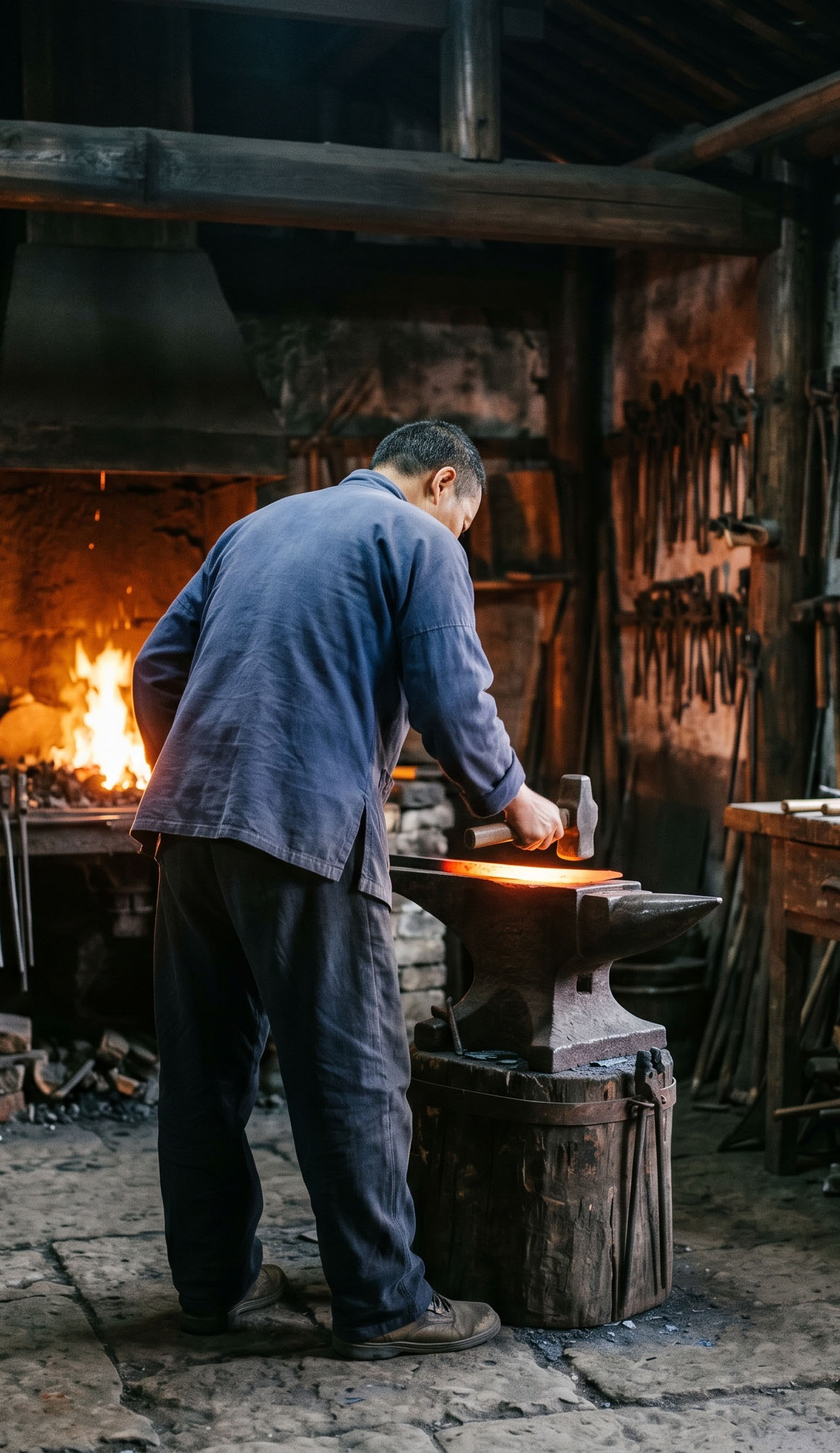


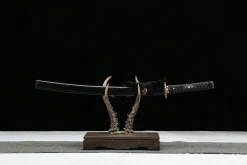

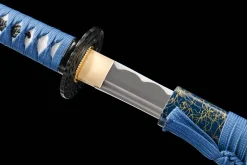
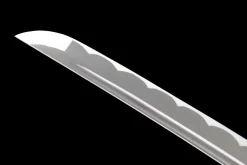
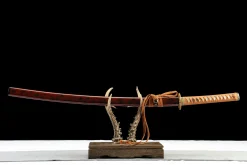

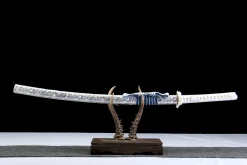



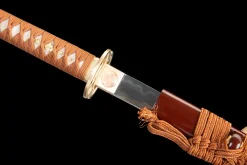

Two katanas sit on the bench. Both are high-carbon steel, both hand-forged, both have a visible hamon line running along the blade. The price difference is $300. Most buyers stare at them for a minute and pick the cheaper one, because from a distance, they look identical. They are not identical. The process that produced that hamon line changes the blade’s hardness profile, its flexibility under stress, and how it will perform five years from now. This guide breaks down what actually happens during each process, so you can make the decision based on metallurgy rather than marketing. Clay tempering, called tsuchioki in Japanese, is a differential hardening technique. Before quenching, the smith applies a layer of refractory clay paste along the spine and sides of the blade, leaving the cutting edge mostly exposed. The clay acts as an insulator. When the blade goes into the water quench, the exposed edge cools in milliseconds. The clay-covered spine cools much more slowly. That difference in cooling rate is everything. The fast-cooling edge transforms into martensite, the hardest possible crystalline structure in high-carbon steel. The slow-cooling spine stays in a softer, tougher phase called pearlite. One blade, two hardness zones, no compromise between them. The result is a blade that typically measures HRC 60-62 at the edge and HRC 40-42 at the spine. You get a cutting edge that holds sharp and a spine that bends rather than snapping under lateral stress. That gradient is the same reason traditional Japanese swords survived centuries of battlefield use. One thing worth knowing from handling these daily: the clay application is never perfectly uniform. Each smith develops their own paste formula and application method. That slight inconsistency is actually what makes every clay-tempered hamon look different. No two are the same, which is a feature, not a flaw. Oil quenching skips the clay entirely. The entire blade, heated to critical temperature, goes straight into quenching oil. The whole blade cools at roughly the same rate, producing a more uniform hardness from edge to spine. That uniformity lands somewhere around HRC 58-60 across the full blade. The edge is hard enough for real cutting work, and the spine is harder than a clay-tempered spine would be. Whether that is a benefit depends on how you intend to use the blade. Oil cools more slowly than water, which reduces the thermal shock the steel experiences during quench. That lower shock rate means fewer stress fractures and warps, which is why oil quenching produces a higher yield rate in production. For the smith, it is a more controllable process. For the buyer, it means more consistent geometry across a production run. The tradeoff is that you lose the differential hardness. The spine is harder than ideal for flex, and the edge is slightly softer than what clay tempering can produce. For most modern cutting applications, those differences are marginal. For collectors or those who want traditional construction, they matter considerably. The hamon is the visible boundary line between the hard martensitic edge and the softer spine. On a clay-tempered blade, that line exists because the steel’s crystalline structure genuinely changes at that boundary. The hamon you see is a window into the blade’s internal metallurgy. On many production blades, that line is produced by acid etching. The blade is uniformly hardened, then a chemical solution selectively darkens the steel to mimic the appearance of a hamon. It looks similar in a photograph. It looks very different in hand. The easiest test requires no special tools. Hold the blade at an angle to a bright light source and look at the hamon under the surface, not at the surface reflection. A real hamon has depth. Below the line, you will see nie (coarse martensite crystals that look like stars) or nioi (a foggy, misty boundary). Those formations extend below the polished surface. An etched line sits exactly on the surface, hard-edged and flat. A real hamon also shifts in appearance as you rotate the blade. The activity inside the hamon, the small martensite crystals catching light at different angles, gives it movement. An etched line stays static. The third tell is consistency. A real hamon has irregular edges, small variations, areas where the activity is denser or lighter. That irregularity reflects the uneven heat transfer during quench. Perfect, uniform hamon lines are a reliable indicator that you are looking at an etch. All clay-tempered blades in our katana collection produce their hamon through genuine differential hardening. The pattern on each blade is formed during the quench, not applied afterward. See our steel comparison guide for a detailed breakdown of how different steel grades respond to clay tempering. For tameshigiri and regular cutting practice, a good oil-quenched blade in 1095 or T10 will do the job. The edge holds well, sharpening is straightforward, and the uniform hardness makes the blade predictable under load. If you are cutting on a regular basis and expect to sharpen frequently, oil-quenched is a practical choice. Where clay tempering shows its advantage is under lateral stress. Strike a hard target at a poor angle, and the spine of a clay-tempered blade will flex and absorb. The same strike on a uniformly hardened blade puts stress into steel that has less give. Over time, that matters. There is also a long-term sharpening consideration most buyers miss. As you sharpen a clay-tempered blade over years of use, you are always working within the hardened zone. The hardness at the edge stays consistent as material is removed, because the hardened zone extends several millimeters above the edge. On a uniformly hardened blade, the hardness profile is more consistent throughout, so this is less of a factor, but on a poorly made “clay tempered” blade where the hardened zone is very thin, you can eventually sharpen through it. Buy from smiths who know what depth their hardened zone reaches. For care and maintenance specifics that apply to both types, the sword care guide covers oiling schedules, storage, and cleaning in detail. High-carbon steel needs oil after every handling regardless of which hardening method was used. Clay tempering adds time and skill to the production process. The clay application takes thirty minutes to an hour per blade. The water quench is faster than oil but produces more warps, meaning the smith spends additional time straightening the blade before grinding. Failed quenches are more common. All of that cost ends up in the price. Expect to pay a minimum of $200 more for a properly clay-tempered blade versus a comparable oil-quenched blade in the same steel grade. Anything claiming to be clay-tempered and selling under $150 deserves serious scrutiny. Either the steel grade is low, the clay tempering was done poorly, or the hamon is etched. Our Silent Thunder at $280 and Dark Ravine at $340 are both T10 steel with genuine clay tempering. T10 contains trace tungsten, which tightens the grain structure and improves edge retention compared to standard 1095. The Ink Meteor at $775 takes the concept further with san-mai construction, a harder steel core wrapped in softer steel jacket, which is the traditional construction method for high-end Japanese swords. For buyers interested in pattern-welded options, our Damascus steel blades represent a different approach to layered construction entirely. If you are buying your first katana for cutting practice, an oil-quenched blade in 1095 or T10 is a sensible starting point. You will spend less, and the performance gap will not limit your practice. Check our buying guide for a full breakdown of what to prioritize as a first-time buyer. If you cut regularly and want a blade that will still be performing well in ten years, clay tempering earns its price. The differential hardness profile is not a marketing feature. It is a structural decision made at the forge, and it affects how the blade behaves under every cut you make with it. Collectors and history-minded buyers have a clear answer. Clay tempering is the authentic process. The hamon on a properly made clay-tempered blade is a record of the quench, a visible artifact of the moment the steel changed. That is something an etched line will never be. Handle both types before you decide if you can. The weight and balance will tell you something. The hamon will tell you more.
What Is Clay Tempering?
What Is Oil Quenching?
The Hamon: Real vs Etched
How to Tell the Difference
Performance Differences
Price Differences
Which Is Better for You?

Frequently Asked Questions
1095 High Carbon — Browse the Collection.