






Sword Education
Full Tang vs Rat Tail: Why Sword Construction Matters
Most buyers spend their time comparing blade steel, hamon lines, and handle wrap patterns. Those details matter. But there is one structural decision made deep inside the handle that determines whether your sword holds together under real use or fails at the worst possible moment. That decision is the tang.
Understanding tang construction is not optional knowledge for a serious buyer. Whether you cut tatami, practice forms, or display a blade on the wall, the tang is the spine of the entire assembly. Get it wrong and you have a decorative object at best, a safety hazard at worst.
What Is Full Tang?
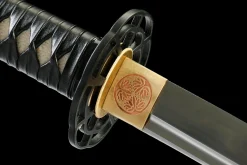
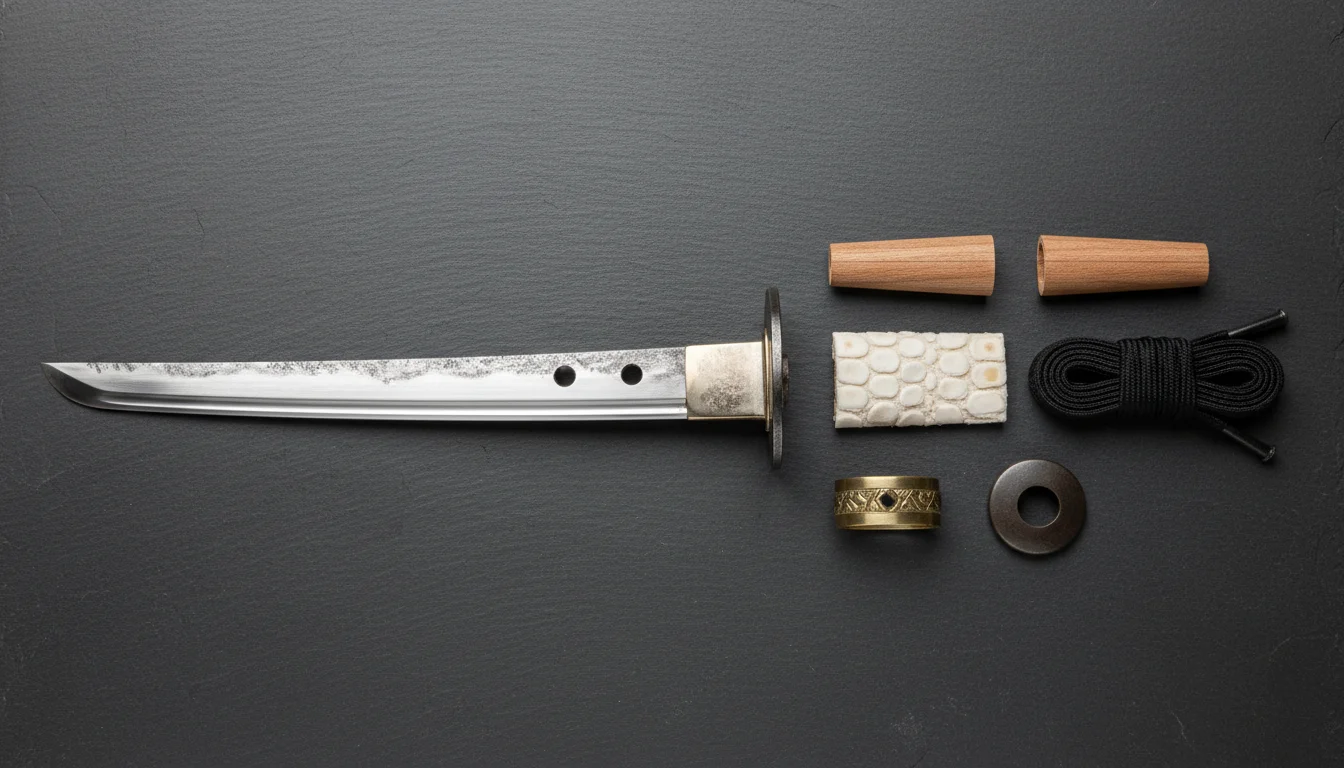
The tang is the portion of the blade steel that extends into the handle. On a full tang katana, that extension runs the entire length of the tsuka, from the habaki collar all the way to the kashira cap at the butt end. The handle scales, wrap, and fittings are built around it, not instead of it.
On a traditionally constructed katana, the full tang is relatively narrow compared to Western full-tang knives. It tapers slightly toward the end and sits inside a precisely fitted wooden tsuka core. Two mekugi pegs, typically made from bamboo, pass through holes in the tang and tsuka to lock everything in place. That system has been refined over several hundred years of actual use in combat and training.
What makes a full tang structurally sound is the load path. When you cut, the force of impact travels from the kissaki through the blade body, across the habaki, and into the tang. A full tang distributes that shock along its entire length before it ever reaches the handle fittings. The wood, the wrap, and the mekugi all share the load together.
Our sword buying guide covers this in the context of choosing your first blade, but the short version is simple: if you plan to cut anything, the tang construction is the first specification to verify, not the last.

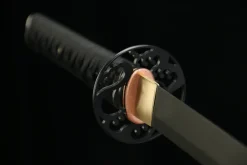
Ink Meteor
Three-layer San Mai construction, full tang, $775. Our flagship cutting sword.
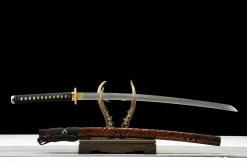
Silent Thunder
T10 high speed tool steel, full tang, clay tempered, $280.
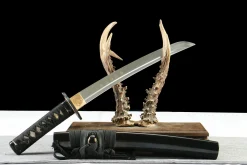
Dark Ravine
T10 high speed tool steel, full tang, clay tempered, $340.
What Is Rat Tail Tang?
A rat tail tang, sometimes called a threaded tang or welded tang, is exactly what it sounds like. Instead of the blade steel continuing into the handle as a solid, tapered extension, a thin rod of a different metal is welded onto the base of the blade. That rod runs through the handle and is fastened at the end, usually with a threaded nut hidden under the kashira.
The rod is significantly narrower than the blade itself and is often made from cheaper mild steel rather than the same high-carbon alloy used for the blade. There is no structural relationship between the handle and the blade steel. All the load from a cut concentrates at the single weld point where the rod meets the blade base.
Rat tail construction exists because it is cheap and fast to produce. You can machine a handle with a simple drilled hole, thread a rod through it, tighten a nut, and finish the exterior to look identical to a properly constructed sword. From the outside, you cannot tell the difference without disassembly.
It is worth stating clearly: rat tail tang swords are not appropriate for cutting practice. Some are sold as decorative pieces and perform adequately in that role. The problem is when they are marketed without clear disclosure, and a buyer uses one for tameshigiri or heavy suburi training without knowing the risk they are taking.
Why It Matters for Safety
A full tang failure is rare and usually gradual. A mekugi peg might crack or work loose over time, giving you warning signs before anything dangerous happens. The tsuka wood may develop play, the handle may feel slightly loose at the habaki. You notice it, you replace the mekugi, you keep training.
A rat tail failure is sudden. The weld shears or the rod snaps under load, and the blade separates from the handle at speed. If you are mid-cut, the blade goes wherever momentum carries it. In a dojo, in a backyard cutting session, with other people nearby, that outcome is serious.
There are documented cases of this type of failure in online cutting communities, particularly with lower-cost swords sold on general retail platforms. The swords looked fine. The fittings were decorative and attractive. The tang construction was never disclosed in the listing. The failures happened during cuts that any properly built sword should handle without question.
Our steel comparison guide focuses on blade alloys, but the lesson applies to construction too: the specification that does not appear in the marketing copy is often the one that matters most.
How to Check Your Sword’s Tang
You can often identify a rat tail tang without fully disassembling the sword. Start by removing the mekugi pegs. Use a brass punch or a dedicated mekugi tool, never a steel nail, to avoid damaging the tsuka wood. Tap gently from the opposite side and push the peg out.
With both mekugi removed, hold the tsuka firmly and pull the blade assembly free. A full tang will slide out with the blade, revealing a flat, tapered piece of steel the same color and grain as the blade itself. A rat tail tang will show a narrow threaded rod emerging from the base of the blade, visually distinct from the blade steel and significantly thinner than the blade at the habaki.
One detail that experienced buyers know: on a genuine full tang with proper clay tempering, you will sometimes see the hamon activity faintly continuing onto the tang itself near the habaki. The clay coating used during heat treatment covers part of the tang, and the tempering differential shows. You will not see that on a welded rat tail assembly.
If your sword has a fixed, non-removable handle with no visible mekugi holes, that is another warning sign. It may indicate the handle cannot be disassembled for inspection, which is sometimes by design on rat tail constructions. Our sword care guide covers handle maintenance and when to inspect your mekugi, which is good practice at least once a year on any sword used for cutting.
Our Full-Tang Guarantee
Every sword we ship from Longquan is full tang. That is not a marketing claim, it is a construction standard we hold across every price point in our katana collection. The Silent Thunder at $280 shares the same tang construction philosophy as the Ink Meteor at $775. The materials and blade alloys differ. The structural integrity does not.
Our smiths in Longquan forge the tang as a continuous piece with the blade. There is no welding, no threading, no assembly shortcut. The taper is shaped by hand, the mekugi-ana holes are drilled at specific positions calculated for the blade’s balance point, and the fit inside the tsuka is checked before the handle goes on. A loose tang is rejected. It does not leave the workshop.
We also document our steel. The Dark Ravine uses T10 high speed tool steel, heat treated to HRC 58-60 with a differential clay temper. You can see the hamon. You can pull the handle and inspect the tang yourself. That transparency is deliberate. If you want to look at the construction before buying, our product pages include full disassembly reference details, and our team answers technical questions directly.
For buyers interested in our Damascus steel options, the same principle applies. The pattern-welded construction ends at the habaki. The tang behind it is solid, continuous forged steel, built to the same standard as every other sword we produce.
Frequently Asked Questions
Ready to Find Your Blade?
