




Buying Guides
How to Choose Your First Katana: Complete 2026 Guide
Why Your First Katana Matters
Most people buy their first katana based on how it looks in a photo. A few months later, they are back online searching for a second one, because the first one taught them what they actually needed to know. That is a frustrating and expensive way to learn.
The blade you choose first shapes everything: how you train, what maintenance habits you build, whether you develop an eye for quality or just an eye for aesthetics. Buy something too cheap and you are handling a blade with inconsistent heat treatment and a handle that loosens after fifty cuts. Buy something that does not match your purpose and it sits on a wall gathering dust instead of doing what it was made to do.
This guide is written by people who handle swords every day out of a workshop in Longquan, the city that has been producing blades continuously since the Spring and Autumn period. We are not here to upsell you. We are here to help you make a decision you will not regret.
Our full katana buying guide goes deeper on some of these topics if you want to follow up on specific sections.
Understanding Steel Types: 1065, 1095, T10, and Damascus
Steel is where the conversation has to start. Every other variable, from handle wrap to blade geometry, is secondary to what the blade is actually made of. Here is a practical breakdown of the four types you will encounter most often as a first-time buyer.
1065 Carbon Steel
Carbon content sits around 0.65%, which puts this steel in the medium-high carbon range. It is tough and forgiving, meaning it bends under lateral stress before it snaps. For beginners doing cutting practice, that flex tolerance is not a flaw. It is a safety margin that keeps you from breaking a blade because of an off-angle cut.
Heat treated correctly, 1065 lands around HRC 55-57. That is softer than T10, so the edge will not hold as long, but it is easier to resharpen in the field with basic equipment. If you are just starting out and plan to do regular tameshigiri, 1065 is a reasonable entry point.
1095 Carbon Steel
At 0.95% carbon, 1095 is harder and holds an edge noticeably longer than 1065. Heat treated to HRC 57-60, it is one of the most common steels you will see in the $200-$400 range. The tradeoff is brittleness under lateral force. A blade in 1095 that takes a hard sideways impact, from a poor cutting angle or contact with a solid object, is more likely to chip than one in 1065.
For controlled practice environments, 1095 is excellent. Keep your cuts clean and this steel will reward you with a durable, consistent edge.
T10 High Speed Tool Steel
T10 is where things get significantly more interesting. This is a tungsten-alloyed tool steel with roughly 0.95-1.05% carbon and small additions of silicon and tungsten. The tungsten increases wear resistance at the micro level, meaning the carbides that form during heat treatment are finer and harder than those in plain high-carbon steel.
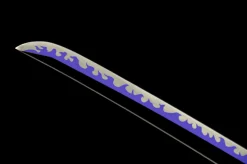
When clay tempered, T10 produces a genuine hamon, the visible temper line along the blade. More importantly, differential hardening gives the edge a hardness of HRC 60-62 while keeping the spine at HRC 40-42. That combination, a hard cutting edge with a tough, flexible spine, is what traditional Japanese swordsmiths were chasing with tamahagane. T10 achieves it with modern consistency.
Three of our most popular blades use T10: the Silent Thunder, the Dark Ravine, and the Dark Gold. If your budget allows, this is the steel we recommend for a first serious katana.
Damascus Steel
Damascus is a construction method, not a single steel type. Two or more steels, typically a high-carbon and a low-carbon variety, are forge-welded together and folded repeatedly until the layers number in the dozens or hundreds. The etching process after grinding reveals the grain pattern, which varies with every billet.
Forty layers of folded steel, four hours at the forge, one blade with a grain pattern that will never repeat. That is what Damascus means when it comes from Longquan. Performance depends entirely on the base steels used and the quality of the forge welding. A well-made Damascus blade performs as well as its component steels. Our Damascus steel collection uses high-carbon core steel for edge retention with a wrought iron or mild steel jacket for toughness.
For a detailed side-by-side comparison of these steels, including carbon content tables and hardness data, see our steel comparison guide.
Functional vs Display: Defining Your Purpose
Before you look at a single blade, answer this question honestly: what are you actually going to do with it? The answer changes everything about what you should buy.
If You Plan to Cut
You need a full-tang blade with a properly peened or pinned handle. The tang runs the full length of the handle and is secured at the pommel end with a mekugi peg through the tsuka. Some handles use one peg, better ones use two. Give the handle a firm twist before you ever swing the blade. Any movement at all is a problem.
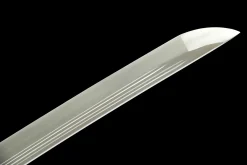
For tameshigiri (target cutting), look for blades with a shinogi-zukuri geometry, that is the ridged cross-section that creates a primary and secondary bevel. That geometry is not just traditional, it is mechanically superior for clean cuts through tatami omote or water-soaked bamboo. Blade length for cutting practice typically runs 70-73cm, with a curvature (sori) of 1.8-2.2cm.
If You Plan to Display
Display swords have more flexibility in materials and construction, but even here, do not settle for cast zinc fittings or a blade that is peened with low-grade copper. The fittings oxidize, the finish cracks, and after a year it looks worse than the day you hung it up. Brass and iron fittings age well. Synthetic sageo holds color longer than cheap cord. These details matter even when the blade never leaves the wall.
If You Plan to Practice Kata
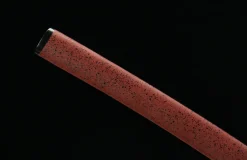
Iaido and kenjutsu practitioners have specific needs. A blade used for forms needs consistent balance, and that means checking the point of balance (typically 15-20cm from the tsuba for most kata styles). The saya fit matters too. The first time you draw a properly fitted blade from its saya, you will feel a slight resistance at the habaki. That snug fit is intentional, it protects the edge and keeps moisture from reaching the blade. A loose saya that rattles is a sign the blade was fitted carelessly.
The 5 Things to Check Before You Buy
1. Tang Construction
Full tang only, for any functional sword. A rat-tail tang, where the blade narrows to a thin rod that threads into the handle, is a structural failure waiting to happen under cutting stress. Ask the seller directly, or look for product descriptions that specify “full tang” with dimensions. Our blades include tang measurements in the specifications.
2. Heat Treatment Method
Through-hardened blades are heat treated uniformly. Clay-tempered blades have clay applied to the spine before quenching, which slows cooling on the spine and creates differential hardness. Through-hardening is cheaper and faster. Clay tempering takes more skill and time. For cutting blades, clay tempering in T10 is the benchmark worth aiming for.
3. Handle Construction and Wrap
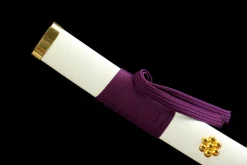
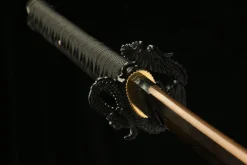
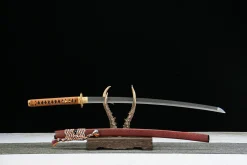
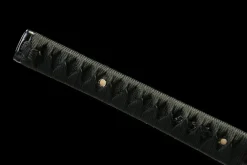
The tsuka (handle) should be wrapped in genuine ray skin (samegawa) under the silk or cotton ito. Run your thumb across the handle wrap and feel whether it is tight and even. A loose or uneven wrap shifts under your palm during cuts. The mekugi peg, typically bamboo, should fit snugly through the tsuka and tang hole without wobbling.
4. Fittings Material
Iron, brass, and copper alloy (shakudo) fittings are traditional and durable. Zinc alloy fittings are a cost-cutting measure that corrodes faster and feels noticeably lighter. Compare the weight of the tsuba between two blades in your hands and you will feel the difference immediately.
5. Seller Transparency
Any seller who cannot tell you the exact steel type, carbon content, hardness (HRC), blade length in centimeters, and tang construction method is selling you something they do not actually know much about. Those numbers are not optional extras in a product listing. They are the minimum information a buyer needs to make an informed decision.
Recommended Katanas by Budget
$100-$200: Entry Level
At this price point, expect 1065 or 1075 carbon steel with through hardening. Construction will be functional but not refined. The Dark Night Slash at $230 sits just above this range and uses T8 steel, which gives it better edge performance than most blades at $150-180. If your budget is firm at $200, T8 or 1075 with a full tang is the target.
One honest note: below $150, the mechanical reliability of a cutting blade becomes a real concern. For display, the budget works. For tameshigiri, stretch to at least $200 if you can.

Silent Thunder
T10 High Speed Tool Steel, clay tempered with visible hamon. $280.

Dark Ravine
T10 High Speed Tool Steel with full clay tempering and double mekugi. $340.

Ink Meteor
San-mai construction with layered steel jacket. Premium functional blade at $775.
$200-$400: The Serious First Blade
This is where T10 becomes accessible, and that changes the conversation meaningfully. The Silent Thunder at $280 gives you clay-tempered T10 steel, a genuine hamon, and iron fittings. For most people, this is the right first blade if cutting is the goal.
The Dark Ravine at $340 steps up with a longer blade geometry suited to two-handed cutting practice and slightly heavier fittings. Both blades are 70-73cm with sori in the traditional range. Either one will outlast a $150 alternative by years of regular use.
Browse the full katana collection to compare specifications side by side.
$400 and Above: When You Know What You Want
Above $400, you are moving into san-mai construction, hand-polished finishes, and custom fitting options. The Ink Meteor at $775 uses a three-layer (san-mai) construction: a high-carbon steel core wrapped in a softer steel jacket. The core takes the edge and holds it. The jacket absorbs lateral shock. This is the geometry that gives traditional Japanese swords their durability under hard use.
At this level, you are also getting a blade that a polisher has spent time on. The transition from the ji (flat surface below the shinogi) to the ha (edge bevel) is a product of grinding, stone work, and eye. That finish is not just cosmetic. A properly polished blade cuts cleaner than one that was machine-buffed to a shine.
Common Beginner Mistakes
These come up repeatedly, and most of them are preventable with a little foreknowledge.
Buying a stainless steel blade for cutting. Stainless steel contains chromium, which prevents rust but also prevents the blade from taking a proper heat treatment. The hardness ceiling on stainless is too low for reliable cutting performance. Display only, always.
Ignoring blade length relative to body size. A 73cm blade on a person with short arms and a narrow draw arc is a handling problem. The general guideline is that the blade length should correspond to your arm span and draw style. If you practice iaido, your instructor will give you a specific measurement. If you are self-directed, start with 70-72cm.
Storing the blade in the saya long-term without maintenance. A katana stored in its saya accumulates moisture between the blade and the wood. Without periodic removal, cleaning, and re-oiling, that moisture causes rust along the blade surface. Pull the blade monthly, wipe it clean, apply a thin coat of choji oil, and re-seat it. Our sword care guide covers the full maintenance process with step-by-step instructions.
Buying based on looks alone. A dramatic black finish or ornate tsuba is not a performance indicator. Focus on steel type, heat treatment, tang construction, and fittings quality. Aesthetics come after those boxes are checked.
Skipping the balance check. If you are buying in person, hold the blade horizontal at arm’s length and find the balance point with one finger. It should sit roughly 15-20cm from the tsuba for a well-proportioned katana. Too far toward the tip and cuts become harder to control. Too close to the handle and you lose cutting momentum. A balanced blade feels almost effortless in the hand. An unbalanced one feels like work from the first swing.
Frequently Asked Questions
Ready to Find Your Blade?
