






The Steel Guide · Five grades compared
1065, 1095, T10, Damascus
1065, 1095, T10, Damascus
and Spring Steel explained.
Choosing a blade is not about aesthetics first. The steel decides everything else: how sharp the edge gets, how long it holds that edge, whether the blade survives a heavy cut or shatters under torque, how much maintenance you owe it every season. Pick the wrong steel for your purpose and even the finest geometry and polish will let you down.
We forge and finish blades in Longquan. We handle these materials daily. This guide breaks down every steel type we work with, gives you honest numbers, and tells you exactly which steel fits your situation.
Full comparison matrix.
| Steel | Edge Retention (1-10) | Toughness (1-10) | Ease of Sharpening (1-10) | Corrosion Resistance (1-10) | Hamon Potential | Price Index |
|---|---|---|---|---|---|---|
| 1065 | 6 | 8 | 9 | 3 | Faint | $ |
| 1095 | 9 | 5 | 7 | 2 | Vivid | $$ |
| T10 | 8 | 7 | 6 | 3 | Stunning | $$$ |
| Damascus | 7 | 7 | 5 | 3 | N/A (visible layers) | $$$$ |
| Spring (65Mn / 9260) | 5 | 10 | 8 | 4 | None | $ |
Ratings are relative within this group, tested against our own production standards in Longquan. Your maintenance habits will shift these numbers up or down.
1065 Carbon Steel.
What It Is
1065 is a mid-range carbon steel, sitting at 0.60-0.70% carbon content. That number matters: enough carbon to harden well and take a working edge, not so much that the steel becomes brittle under lateral stress. Heat treated properly, a 1065 blade reaches HRC 54-58, which is the right range for a sword that will actually be swung.
Think of it as the Honda Civic of sword steels. Reliable, affordable, does everything you need without drama. A 1065 blade forgives a hard cut into an unexpected knot in the target. It will flex rather than chip when the angle is slightly off.
Practical Performance
Edge retention is moderate, scoring 6 out of 10. After extended cutting sessions, you will feel the edge round off before a T10 or 1095 blade would. Fortunately, it resharpens in minutes on a 1000-grit water stone, which is why beginners do well with it.
The insider detail most buyers miss: 1065 responds well to a convex grind. Our smiths deliberately leave slightly more meat behind the edge on 1065 blades because that geometry compensates for the lower hardness and improves long-term durability without sacrificing cutting feel.
Who It Is For
- First functional sword purchase
- High-volume tameshigiri practitioners who resharpen frequently
- Dojo use where blades change hands
- Budget-conscious buyers who refuse to sacrifice structural integrity
Featured Blade
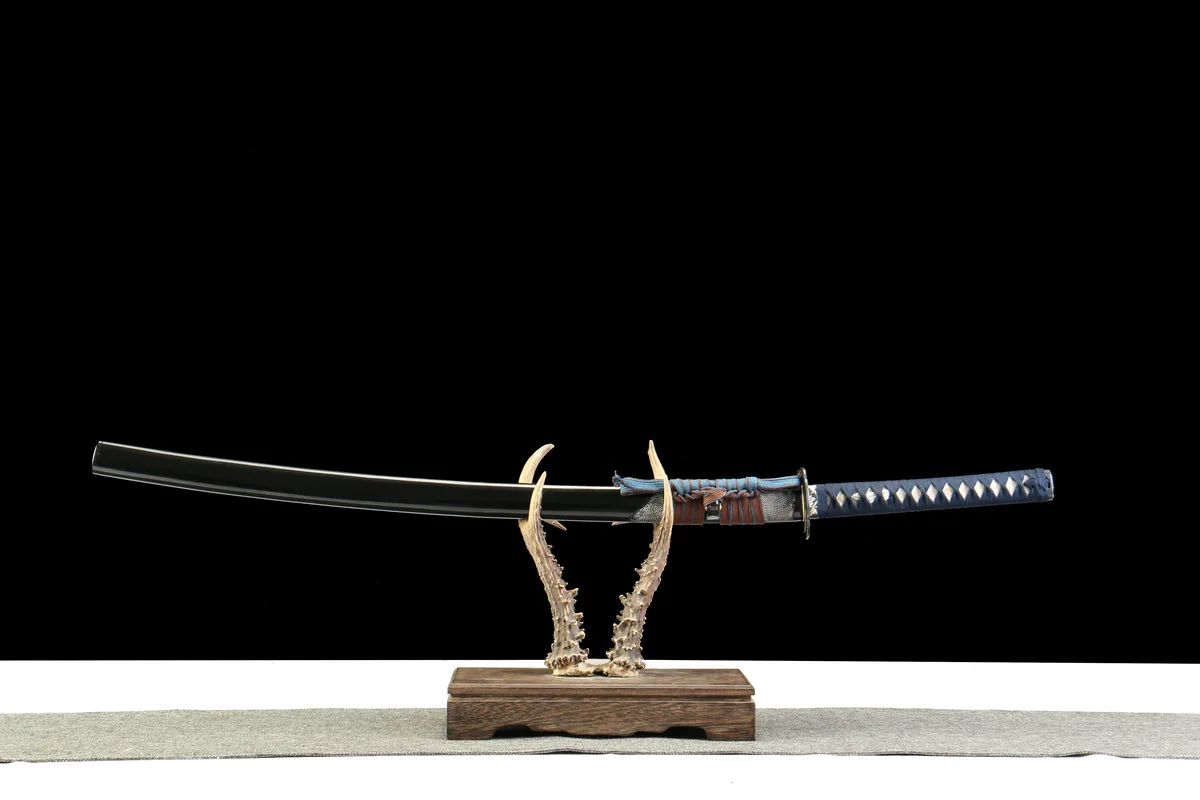
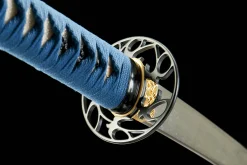
Azure Void – LQS-0051 — Hand-forged 自炼钢 construction, $1,350. Our smiths draw this one to roughly 3.2mm at the spine, giving it the backbone to handle sustained cutting practice without fatigue bending.

1095 High Carbon Steel.
What It Is
Push the carbon content to 0.90-1.03% and you get 1095. At HRC 58-62 after proper heat treatment, the steel holds an edge that will still shave cleanly after fifty cuts through rolled tatami. That performance comes at a cost: the same hardness that holds the edge makes the steel less tolerant of flex. A bad cut at the wrong angle can chip a 1095 blade where a 1065 blade would have survived.
Think of a sports car engine. Incredible performance, but it needs more attention to keep it running right.
The Hamon Factor
1095 responds to clay tempering better than almost any other steel in this class. The differential hardening process, where a smith applies clay to the spine before the quench, creates a transition zone between the hard edge (HRC 60+) and the softer spine (HRC 40-45). On 1095, that transition zone produces a vivid, active hamon with fine nie crystalline detail that catches light at every angle.
What most buyers do not realize: the hamon on a 1095 blade is not cosmetic. It marks the actual boundary between two functional zones of hardness. A blade with a visible hamon has genuinely been differentially tempered, and the hamon’s sharpness tells you how precisely the smith controlled the quench.

Maintenance Requirements
1095 has only 0.20-0.40% manganese and no chromium. That means it rusts faster than any other steel on this list. After every session, wipe the blade dry, apply a thin coat of choji oil, and store it horizontally. Skip that routine twice and you will see surface oxidation forming near the habaki.
Who It Is For
- Experienced cutters who want maximum edge performance
- Collectors focused on hamon aesthetics with real metallurgical meaning
- Buyers willing to commit to regular maintenance
Featured Blade

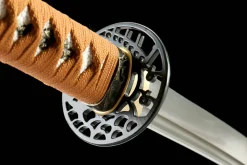
Silent Orchid – LQS-0082 — Clay-tempered 自炼钢, $1,275. The hamon on this blade runs a notoshi pattern along the full cutting edge, with visible nie detail in the boshi. Our polisher spent 18 hours on the kissaki alone to bring that out.
T10 Tool Steel.
What It Is
T10 is a tungsten-alloyed high-speed tool steel, designated W1 in Western classifications, with approximately 0.95-1.05% carbon and 0.10-0.20% tungsten. That tungsten addition is small by number but significant by effect: it refines the carbide grain structure, meaning the edge stays sharper longer under abrasive contact, and the steel resists softening even when it heats up during extended use.
Picture the tungsten-tipped drill bit. Built to outlast standard steel, with enough toughness to handle real work. At HRC 60-62 on the edge zone and HRC 40-45 at the spine after clay tempering, T10 outperforms pure carbon steels on virtually every cutting benchmark.
Clay Tempering on T10
T10 clay-tempered blades produce arguably the most complex hamon patterns of any steel we work with. The tungsten carbides in the transition zone scatter light differently than iron carbides do in 1095, producing a misty, layered activity in the nie and nioi lines that our polishers describe as having depth.
The sharpening caveat worth knowing: T10 is harder to reprofile on a basic whetstone than 1065 or spring steel. Those tungsten carbides resist abrasion from lower-grit stones. Use a quality Japanese water stone at 1000 grit minimum, and expect to spend twice the time you would on a 1065 blade. The edge you end up with is worth it.

Who It Is For
- Serious practitioners who want the best functional and aesthetic result from one blade
- Collectors with sharpening experience
- Buyers upgrading from 1065 or 1095 who want to understand what tungsten adds
Featured Blade
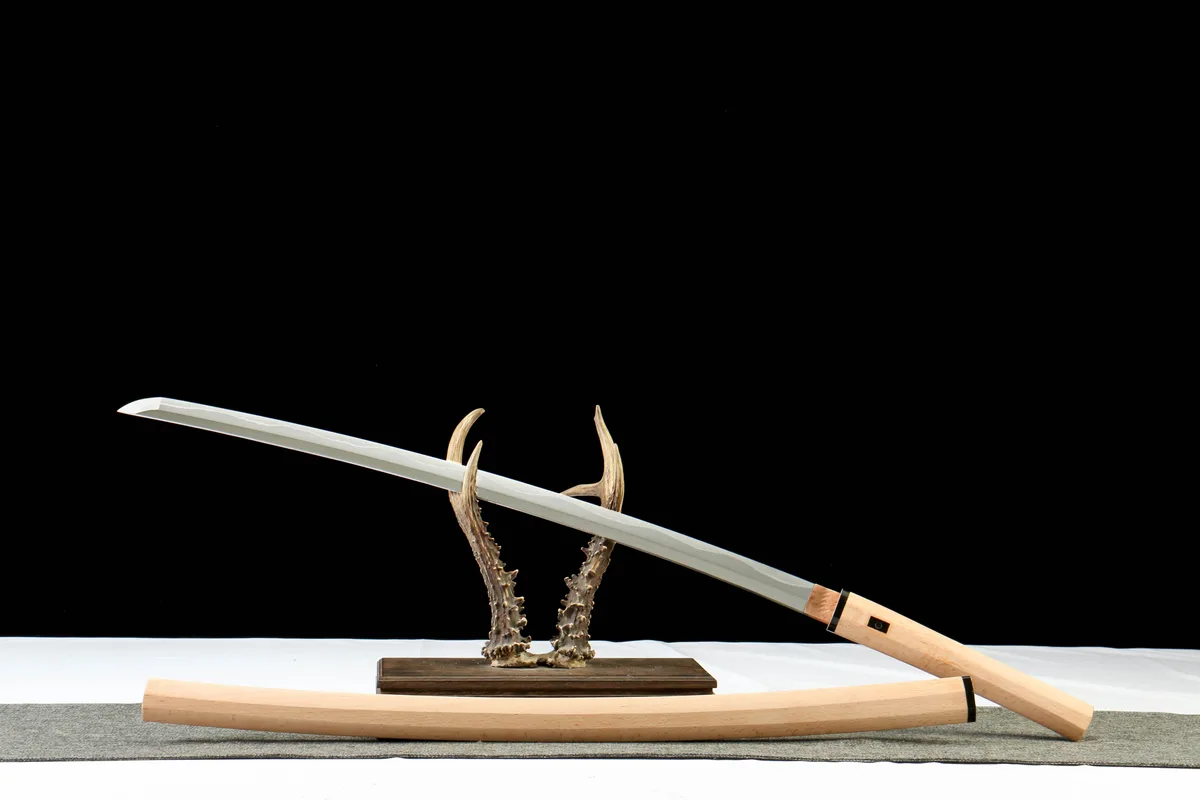
Silent Moment – LQS-0210 — T10 High Speed Tool Steel, clay-tempered, hand polished, $1,100. This blade goes through a seven-stage hand polish before it leaves Longquan. The final hazuya fingerstones alone take four hours to bring up the contrast between the ji and the hamon.
Damascus / Pattern-Welded.
What It Is
Forty layers of folded steel, four hours at the forge, one blade with a grain pattern that will never repeat. That is what Damascus means when it comes from Longquan. Our pattern-welded blades use alternating layers of high and low carbon steel, forge-welded together and drawn out repeatedly until the layers number in the dozens or hundreds. The acid etch after grinding reveals the layer boundaries as visible lines across the surface.
The 天梯纹 (Ladder of Heaven) pattern we use on several blades involves precise interrupted twisting of the billet before the final draw-out. Each interruption creates a rung in the ladder pattern. Two smiths work the same billet and still produce a different pattern every time, because the twist angle varies by fractions of a degree under the hammer.
Functional Reality
Pattern-welded Damascus performs at a level between its component steels, landing around HRC 58-60 depending on the carbon average of the mix. Edge retention sits at a solid 7, toughness at 7. Those are respectable numbers for a cutter. The honest comparison: our T10 clay-tempered blades cut harder and hold their edge longer. Damascus earns its premium through visual uniqueness and the labor intensity of the forging process, not through outright functional dominance.

Maintenance Note
The acid-etched surface on a Damascus blade is porous at a microscopic level compared to a polished monosteel. Oil it more frequently than you would a single-steel blade. Fingerprints left on the flat will show as corrosion spots within days in a humid environment. Wipe it down every time you handle it.
Who It Is For
- Collectors who want a blade that is visually unrepeatable
- Display and occasional cutting use
- Buyers who understand they are paying partly for the artist’s time at the forge
Featured Blades

Night Steel – LQS-0204 — 天梯纹 pattern-welded Damascus, $1,275. Damascus Blade – LQS-0194 — Same pattern family, $1,525. Both use the same layering process; the difference is fitting materials and geometry.
Spring Steel
65Mn / 9260.
What It Is
65Mn and 9260 are both silicon-manganese spring steels. The silicon content, around 1.80-2.00% in 9260, gives these steels a flex memory that carbon steels simply cannot match. A 9260 blade bent 30 degrees returns to true. Bend it again the same day and it returns again. That is not hyperbole: it is the same principle used in industrial leaf springs, and it directly translates to a sword that survives contact stress that would crack a harder blade.
Heat treated to HRC 54-58, spring steel sits at the lower end of the hardness range in this group. The tradeoff is deliberate. Below HRC 60, the steel retains enough ductility to deform slightly rather than fracture under sudden shock loads.
The Edge Retention Trade-off
At a 5 out of 10 for edge retention, spring steel dulls faster than anything else on this list under heavy cutting. The softer matrix that enables the flex is the same reason the edge rolls under sustained abrasive contact. Good news: it sharpens back to a clean working edge in minutes on a medium-grit stone. The silicon in the matrix actually makes it feel smooth under a whetstone compared to higher-carbon steels.
One detail only regular users notice: a 9260 blade that takes a very slight permanent set from an accidental hard contact can often be straightened by a smith without re-heat treating. The resilience works both ways.
Who It Is For
- Heavy cutters who chip or set harder blades and need a steel that absorbs bad contact
- Tameshigiri practitioners doing repeated tatami sessions where ductility matters more than edge retention
- Beginners learning swing mechanics who would rather resharpen than replace a blade
- Demonstrators and reenactors needing a sword that holds up to repeated stress without re-tempering
Featured Blade

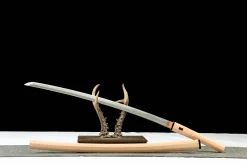
Frost Moon Blade – LQS-0094 — Hand-forged 65Mn spring steel, $289.99. Drawn to a flex profile that returns to true after deep bend tests, with a working edge polish geared for cutting practice rather than display.

Find the steel that fits
your hand.
Free worldwide shipping on orders over $500.