







Sword Education
Longquan: 2,600 Years of Swordmaking History

Most sword-producing regions have a history measured in centuries. Longquan measures its in millennia. Swordsmiths have been working iron and bronze in this corner of Zhejiang Province since the Spring and Autumn Period, around 600 BC. The mountain streams that cool our quench tanks today are the same waters that cooled blades for the armies of the ancient state of Yue. That is not a marketing claim. It is a geological fact: Longquan sits on mineral-rich water sources that have shaped this craft from the very beginning.
If you want to understand why Longquan swords are built differently, you need to understand where they come from. Not just geographically, but historically. The techniques in use here did not appear overnight. They accumulated, layer by layer, across dozens of dynasties, foreign trade, and two and a half thousand years of refinement.
The Legend of Ou Yezi
Every craft has its founding myth, and swordmaking in Longquan has Ou Yezi. According to historical records and regional legend, Ou Yezi was a master swordsmith commissioned by King Goujian of Yue during the Spring and Autumn Period. He is credited with forging the famous swords Zhanlu, Chunjun, Shengxie, Juque, and Longquan, the last of which gave this city its name. Longquan translates as “Dragon Spring,” a reference to the spring water Ou Yezi reputedly used for quenching.
The legend is specific in a way that matters: Ou Yezi did not simply find a location with good iron. He spent years testing water sources, charcoal types, and clay compositions before settling in what is now Longquan. That level of material obsession is not myth. It reflects a genuine understanding, documented across multiple ancient texts, that quench water chemistry directly affects the hardness and stress pattern of a finished blade.
Whether Ou Yezi is a single historical figure or a composite of early masters is debated. What is not debated is that Longquan swords were already famous enough to be presented as diplomatic gifts to foreign rulers by the 5th century BC. The reputation started that early.
Spring and Autumn Period Origins (770-476 BC)
Chinese bronze-casting technology was already sophisticated before Ou Yezi is said to have worked. The transition to iron-based blades happened gradually during the Spring and Autumn Period, driven partly by the arms race between competing warring states. Iron swords held an edge differently than bronze, required different forging temperatures, and demanded new quench techniques. Longquan smiths adapted.
The key material advantage in this region was always the water. The streams fed by Longquan’s surrounding mountains have a naturally low mineral content that produces a clean, controlled quench. Too many dissolved minerals in quench water create uneven cooling, which causes warping or catastrophic cracking. Longquan smiths, even working with primitive instruments, empirically understood this. They built their forges next to specific streams, not just any water source.
By the Warring States Period (475-221 BC), Longquan blades were standard issue for elite Yue soldiers. This was not a cottage craft. Archaeological records suggest organized production with division of labor between smelters, forgers, grinders, and polishers, a production model that still loosely describes how our workshop operates today.
Longquan Through the Chinese Dynasties
Han to Tang: Refining the Steel
The Han Dynasty (206 BC-220 AD) brought the widespread adoption of steel, not just iron, in Chinese blade production. Longquan smiths were early practitioners of bai lian gang, the hundred-fold forging technique, which involved repeatedly folding and hammering high-carbon steel to distribute carbon content evenly and expel slag inclusions. A blade described as “hundred-fold” in a Tang Dynasty poem is not using a round number loosely. It describes a documented process.
By the Tang Dynasty (618-907 AD), Longquan had become the official sword-producing center for the imperial court. Tang records show that government supervisors were stationed in Longquan to oversee quality for imperial orders. This is where systematic quality control in Chinese swordmaking begins, not in a modern factory, but in a 7th-century imperial oversight program.
Song to Ming: Technical Peak
The Song Dynasty (960-1279 AD) saw significant advances in steel classification. Longquan smiths began distinguishing between steels by hardness and carbon content with increasing precision, a proto-metallurgy that pre-dates European understanding of carbon’s role in steel by several centuries. The layered construction methods refined during this period form the direct technical ancestry of the sanmai and kobuse laminate structures still used in premium blades today.
Under the Ming Dynasty (1368-1644 AD), Longquan’s output scaled dramatically. The Ming military required enormous numbers of dao for its standing armies, and Longquan supplied a significant portion of that demand. High-volume production did not erase fine craftsmanship during this era. It formalized it. Grinding angles, blade geometry, and tempering protocols were standardized enough to be taught systematically across generations of apprentices.

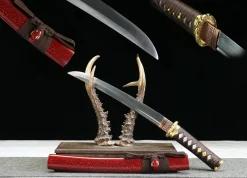
Ink Meteor
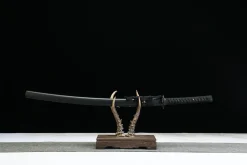
Three-panel San Mai construction, $775. Our flagship laminated blade, forged in the tradition Longquan refined over a thousand years of layered steel work.

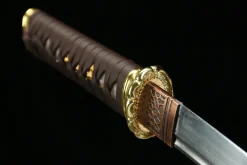
Silent Thunder
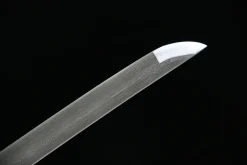
T10 High Speed Tool Steel, $280. Clay-tempered, hand-polished, ground to a 60° edge geometry in our Longquan workshop.

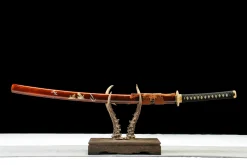
Dark Ravine
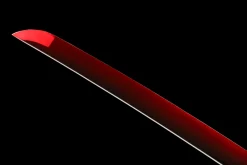
T10 High Speed Tool Steel, $340. A blade with a visible hamon line that shows exactly where the clay boundary sat during differential hardening.
The Longquan-Japan Connection
This section tends to surprise people who assume Japanese swordmaking developed in isolation. It did not. During the Tang Dynasty, Japanese imperial delegations visited China repeatedly, and their craftsmen returned with documented knowledge of Chinese forging methods. The curved blade geometry that defines the katana and its predecessor, the tachi, has Chinese parallels that pre-date Japanese curved swords by at least a century.
The relationship ran both directions. By the Song Dynasty, Japanese monks and traders were importing Chinese blades directly. Song-era port records list swords among high-value export goods shipped to Japan. These were not just trade goods. They were technical templates that Japanese smiths studied and adapted to their own aesthetic and martial traditions.
Longquan’s specific contribution to this exchange was the folded-steel laminate construction. The Japanese tamahagane smelting process produces steel with highly variable carbon content, which makes folding and sorting essential for consistent blade quality. That methodology had already been systematized in Longquan over several hundred years before it became central to Japanese sword production. Japanese smiths adapted it brilliantly to their own materials and traditions, and the katana that resulted is a masterpiece. But the underlying logic of multi-layer steel construction traces a line back through the Song and Tang dynasties to Longquan workshops.
Today, we build Damascus steel blades that make this layering visible. Forty or more layers of folded high-carbon and mild steel, etched to reveal the grain pattern. No two look the same. That is not an accident of decoration. It is the grain structure of the steel itself, made visible.
Modern Longquan: Supplying the World
After significant disruption during the 20th century, Longquan’s sword industry rebuilt systematically from the 1980s onward. Today, the city is home to over 600 registered sword workshops, ranging from small family operations to mid-scale production facilities. Longquan supplies the majority of hand-forged Chinese and Japanese-style swords sold globally outside of Japan’s domestic artisan market.
What separates production-grade Longquan blades from mass-market alternatives is the retention of core manual processes. Specifically: hand-hammering during profile shaping, individual clay application before differential hardening, and hand-grinding for edge geometry. These steps cannot be fully mechanized without losing the characteristics that define a functional blade. A grinder who has shaped 10,000 blades reads the steel’s response differently than a machine does. That experience is built into every blade we ship.
Our katana collection represents the current output of this tradition, steel grades from T8 through T10 and San Mai laminates, each with documented hardness ratings and traceable production methods. Before you buy, our buying guide will help you match the right steel grade to your intended use, whether that is tameshigiri practice, martial arts training, or display.
One detail that catches first-time buyers off-guard: Longquan-made blades arrive with the edge unsharpened from the workshop. This is deliberate. Shipping a razor edge internationally creates liability and damage risk. We set the edge to 60-70° per side, ready for your final sharpening to your preferred geometry. That finishing step is yours. Our sword care guide covers the process in detail.
Why Longquan Steel Is Different
The steel itself is worth a technical explanation. Longquan workshops primarily work with T10 high-carbon tool steel and T8, both tungsten-alloyed variants that offer more consistent carbon distribution than the 1095 or 1060 high-carbon steels common in budget production. T10 tests at HRC 60-62 at the edge after differential hardening, with the spine holding at HRC 40-42. That differential is what gives a properly tempered blade its combination of edge retention and spine flex.
The clay tempering process that creates this differential is applied by hand, blade by blade. A smith applies a thin layer of refractory clay along the edge, a thicker layer along the spine, and a sculpted boundary line in between. That boundary determines where the hamon forms during quench. No two clay applications are identical, which is why no two hamon lines are identical. A hamon is not painted on. It is the visible record of where hard and soft steel meet, created by physics during a controlled quench.
For our San Mai construction, as seen in the Ink Meteor, we sandwich a high-carbon core between two mild steel jackets. The core provides edge hardness. The jacket provides lateral flex and impact resistance. This is the same structural logic found in traditional Japanese laminate construction, applied here with T10 core steel and low-carbon outer layers, producing a blade that will flex significantly under lateral load without taking a set.
If you want to understand how these steel grades compare to each other and to alternatives like 1095 or Damascus, our steel comparison guide covers the metallurgy without oversimplifying it.
The Silent Thunder and Dark Ravine are both T10 blades that demonstrate what this steel looks like in practice: a visible hamon with a distinct nie structure along the boundary, a blade face that shows the polish marks of the final hand-ground finish. These are not cosmetic details. The nie structure tells you the quench hardening worked correctly. The hand-polish marks tell you a human being shaped that geometry to specification.
Two thousand six hundred years of accumulated knowledge does not guarantee a perfect blade every time. What it does guarantee is that the people building in Longquan today understand what a failure looks like, and why it happens, at a level that comes only from that kind of depth. That understanding is what we put into every blade we ship.
Frequently Asked Questions
Ready to Find Your Blade?
