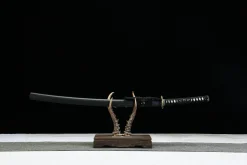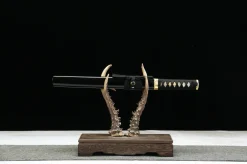










Brown Gleam – Hand Forged T10 Tool Steel Katana Sword
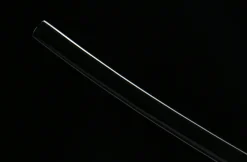
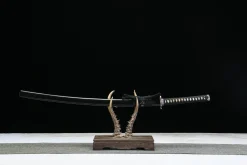
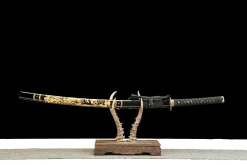
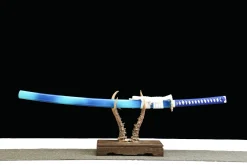
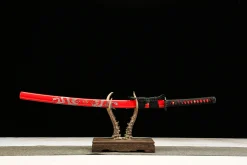
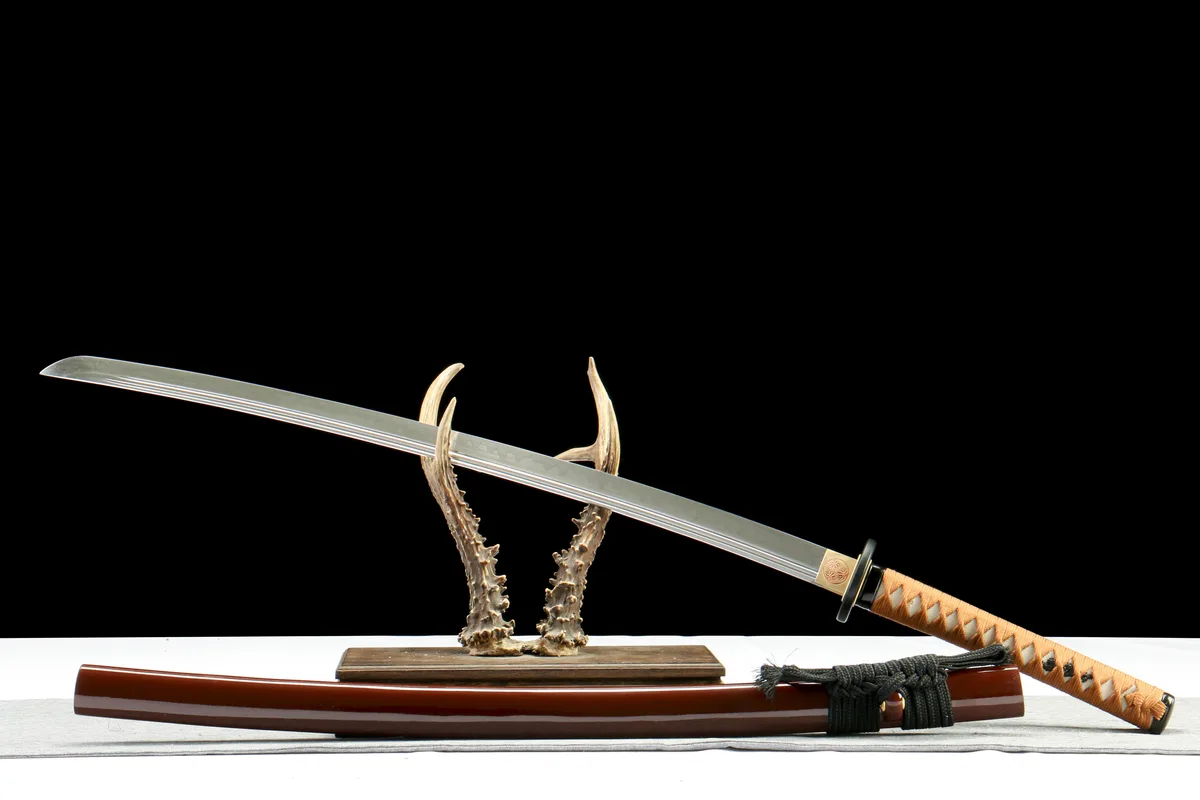
Hand-forged T10 Tool Steel katana (102cm total / 72cm blade), crafted in Longquan. Clay-tempered blade with a genuine hamon line — visible contrast between hardened edge and soft spine.
$429.99
Brown Gleam – Hand Forged T10 Tool Steel Katana Sword
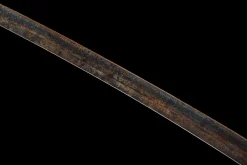
Not every clay-tempered T10 blade produces a hamon worth discussing. This one does. The Brown Gleam – 26寸 酒红烧刃, “burgundy-lacquered temper blade” in its Chinese designation – carries an active, uneven notare hamon (a gently undulating temper line) that rises and falls across the ji (body surface) in a pattern no two quenches ever replicate exactly. The iron fittings are deliberately unadorned, and that restraint is the right choice: nothing should compete with what the steel is already doing.
Specifications
| Blade Steel | T10 High Speed Tool Steel |
| Total Length | 102.0 cm / 40.2 in |
| Blade Length | 72.0 cm / 28.3 in |
| Blade Width | 3.2 cm |
| Blade Thickness | 0.7 cm |
| Weight | 1040 g / 36.7 oz |
| Heat Treatment | Clay Tempering (Differential Hardening) |
| Fittings | Iron |
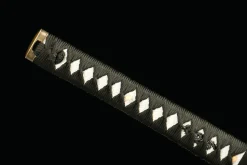
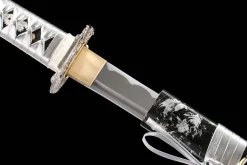
| Handle | Cotton Ito + Genuine Rayskin |
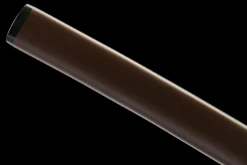
| Sheath | Hardwood, High-Gloss Lacquer |
Steel & Construction
T10 tool steel carries a tungsten additive that refines grain structure and extends edge retention beyond what plain high-carbon steels can sustain at equivalent hardness. When clay is applied to the spine and the blade enters the quench, the tungsten-influenced grain responds with unusual crystalline activity: nie (the individually visible martensitic crystals at the habuchi – the hamon boundary line) appear in concentrated clusters, and the ashii (the lines of activity projecting from the hamon toward the edge) are pronounced and readable without a loupe. The ha (edge zone) exits the quench at mid-to-upper Rockwell 50s hardness; the mune (spine) remains in the high 30s to low 40s. This differential is not incidental – it is the structural design of the blade. A uniform hard blade at this length would be brittle under torsional stress. The soft spine absorbs what the hard edge cannot.
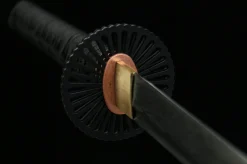
The shinogi-zukuri (ridgeline) forging profile contributes a defined central ridge that stiffens the blade against lateral deflection and creates the characteristic blade geometry – wide flat ji above the shinogi, angled niku (edge shoulder) below it – that has defined functional katana geometry since the Kamakura period. The iron tsuba (hand guard) and fittings carry a quiet, unfinished weight that emphasizes the craft of the blade rather than drawing attention to the mountings.
Handling
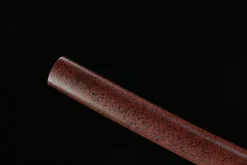
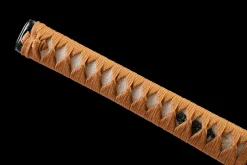
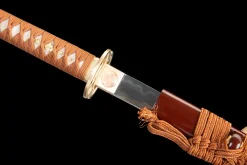
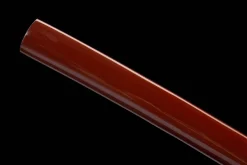
The 26 cm tsuka (handle) is wrapped in traditional hishigami-supported diamond-pattern cotton ito over genuine rayskin (same) – the raised nodule texture of the ray panels registers clearly through the wrap, creating grip-lock points that stabilize the hand under any cutting angle. At 72 cm, this is a blade that demands the full tsuka length in two-handed use: the rear hand settles naturally near the kashira (pommel), the forward hand sits just clear of the tsuba, and the spacing feels deliberate rather than incidental. The deep burgundy lacquer of the saya presents a close, clean fit at the koiguchi (scabbard mouth) – the draw is smooth without being loose, and the blade seats with a positive, audible click when returned to the saya.
Care Instructions
Iron fittings on the Brown Gleam will develop a natural patina over time – this is expected and should not be treated as damage. Keep the blade oiled with choji oil (traditional clove-based mineral oil) applied in a thin, even coat, and wipe down after any handling with a clean soft cloth. Store in the saya in a dry environment; T10’s tungsten content extends corrosion resistance slightly compared to plain carbon steels, but consistent oil maintenance remains non-negotiable.
| Weight | 1.32 lbs |
|---|---|
| Dimensions | 102.0 × 3.2 × 0.7 in |
| Hamon | Real Hamon (Clay Tempered) |
| Blade Steel | T10 Tool Steel |
| Total Length | 102.0 cm |
| Blade Length | 72.0 cm |
| Heat Treatment | Clay Tempering (Differential Hardening) |
| Handle Wrap | Cotton Ito + Genuine Rayskin |
| Sheath Material | Hardwood (High-Gloss Lacquer) |
| Fittings | Iron |
| Forging Style | Shinogi-Zukuri (Ridgeline) |
Related products