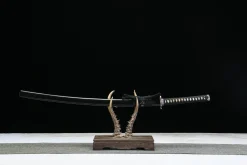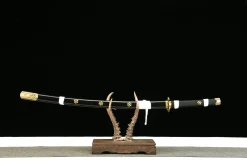


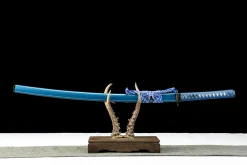







Dark Ravine – Hand Forged T10 Tool Steel Katana Sword
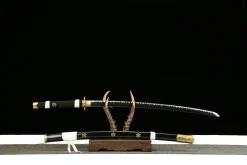
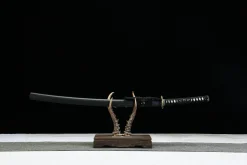
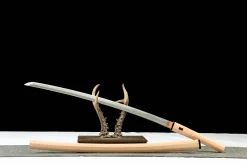
Hand-forged T10 Tool Steel katana (102cm total / 72cm blade), crafted in Longquan. Clay-tempered blade with a genuine hamon line — visible contrast between hardened edge and soft spine.
$499.99
Dark Ravine – Hand Forged T10 Tool Steel Katana Sword
The uto-zukuri (cormorant neck) profile is rare in production-tier work. Most forges do not attempt it at volume because the geometry is unforgiving – the absence of the standard shinogi ridge and the sharp drop from the flat blade body to the edge bevel demands precise stock removal and an edge geometry that, if ground incorrectly, will not hold. Dark Ravine is built on this profile in T10 high speed tool steel, clay tempered, with copper fittings throughout – a combination that signals intent at every decision point.
Specifications
| Blade Steel | T10 High Speed Tool Steel |
| Total Length | 102.0 cm / 40.2 in |
| Blade Length | 72.0 cm / 28.3 in |
| Blade Width | 3.2 cm |
| Blade Thickness | 0.7 cm |
| Weight | 1040 g / 36.7 oz |
| Heat Treatment | Clay Tempering (Differential Hardening) |
| Fittings | Copper |
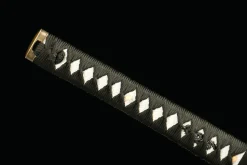
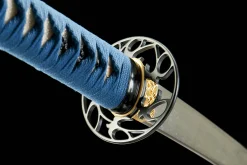
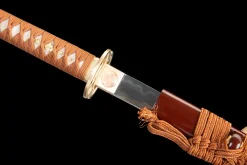
| Handle | Cotton Ito + Genuine Rayskin |
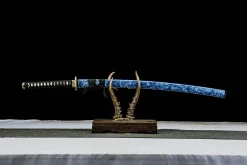
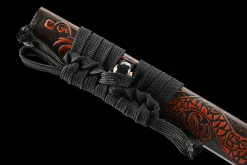
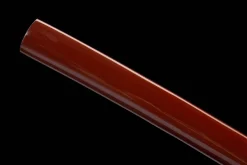
| Sheath | Hardwood (High-Gloss Lacquer) |
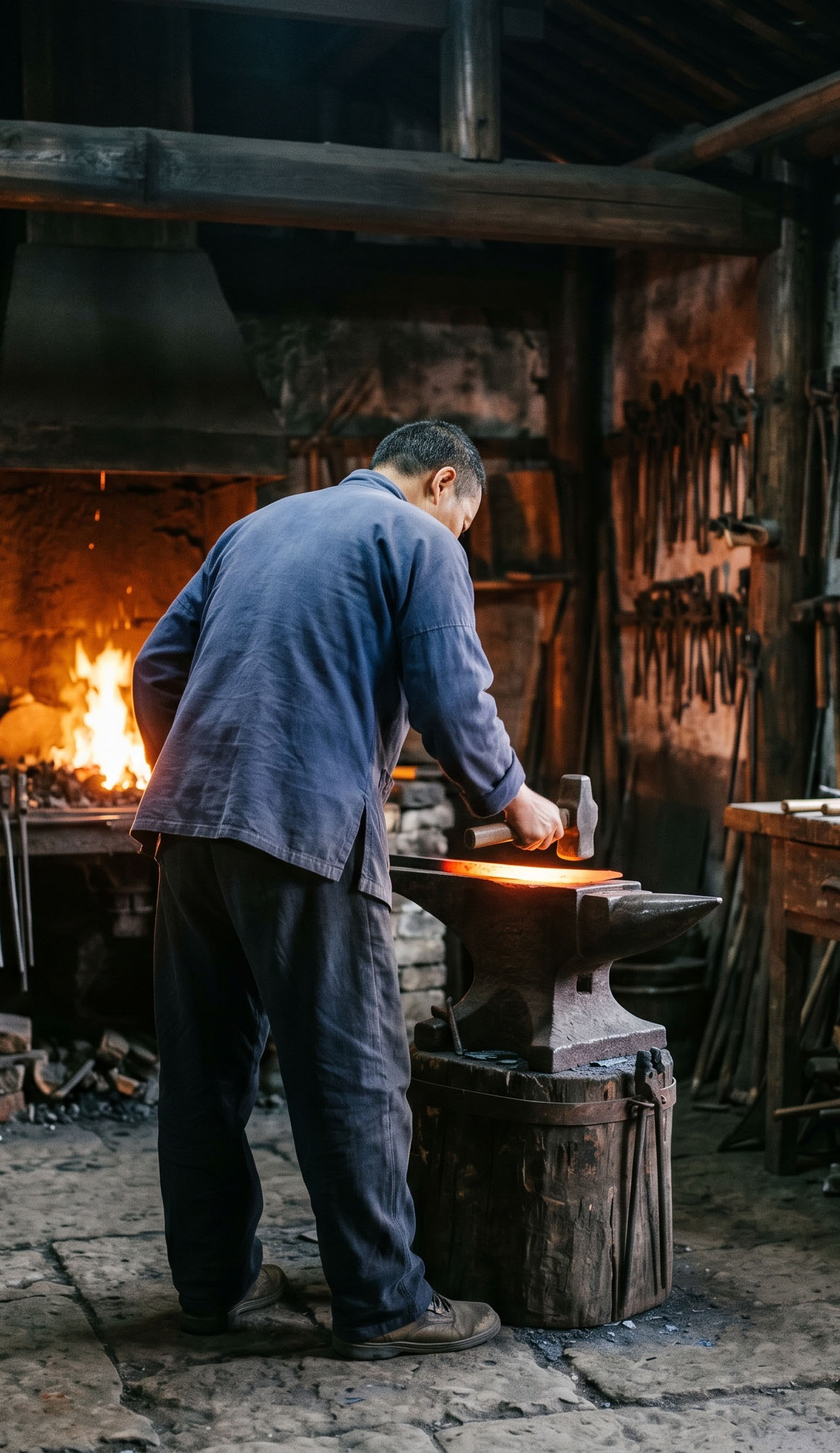
Forged in Longquan
T10 tool steel’s tungsten addition creates a microstructure that responds to clay tempering with particular visual richness. The clay – applied to the spine and most of the flat before quench, leaving only the ha (cutting edge) and a controlled border zone exposed – establishes a thermal gradient during quenching that drives the hardness differential between ha and mune (spine). The result is a hamon (temper line) that on the uto-zukuri profile reads differently than on a ridgeline blade: without the shinogi to interrupt the visual plane, the hamon runs across unbroken steel, and the nie (martensite grain at the temper boundary) has nowhere to hide. What you see is the full activity of the habuchi (transition zone) – the exact record of where the clay met the steel and where the heat escaped.
Copper fittings – tsuba (hand guard), fuchi (handle collar), and kashira (pommel cap) – were chosen here with clear reasoning. Copper ages toward a warm patina that deepens rather than degrades over time, and its color against a lacquered black saya and a tempered blade surface creates a tonal relationship that zinc alloy cannot replicate. This is not a cosmetic upgrade – it is a material choice with a thirty-year arc.
Weight, Balance, Draw
At 72.0 cm of blade and a 26.0 cm tsuka, the Dark Ravine sits in the hand as a full katana should – the ito wrap (cotton over genuine rayskin same) slightly textured under the fingers from the node pattern of the rayskin beneath, the grip long enough for a stable two-hand stance without the rear hand running out of handle. The lacquered hardwood saya draws cleanly, the koiguchi (sheath mouth) fitted to the specific blade geometry of the uto-zukuri cross-section – a detail that matters because this profile’s edge-to-spine shape is not interchangeable with a standard shinogi saya without slop in the fit.
Keeping It Sharp
Wipe the blade dry after any handling and apply choji oil (a traditional clove-mineral blend used in Japanese sword maintenance) with a soft cloth or nuguigami paper. The copper fittings will develop a natural patina – this is normal and desirable; do not use abrasive cleaners on them. Store in the saya with the edge upward, in a stable, low-humidity environment.
| Weight | 1.32 lbs |
|---|---|
| Dimensions | 102.0 × 3.2 × 0.7 in |
| Hamon | Real Hamon (Clay Tempered) |
| Blade Steel | T10 Tool Steel |
| Total Length | 102.0 cm |
| Blade Length | 72.0 cm |
| Heat Treatment | Clay Tempering (Differential Hardening) |
| Handle Wrap | Cotton Ito + Genuine Rayskin |
| Sheath Material | Hardwood (High-Gloss Lacquer) |
| Fittings | Copper |
| Forging Style | 鹈首造 |
Related products