
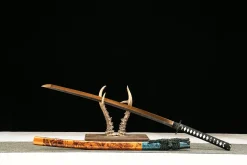
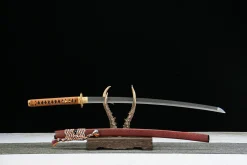



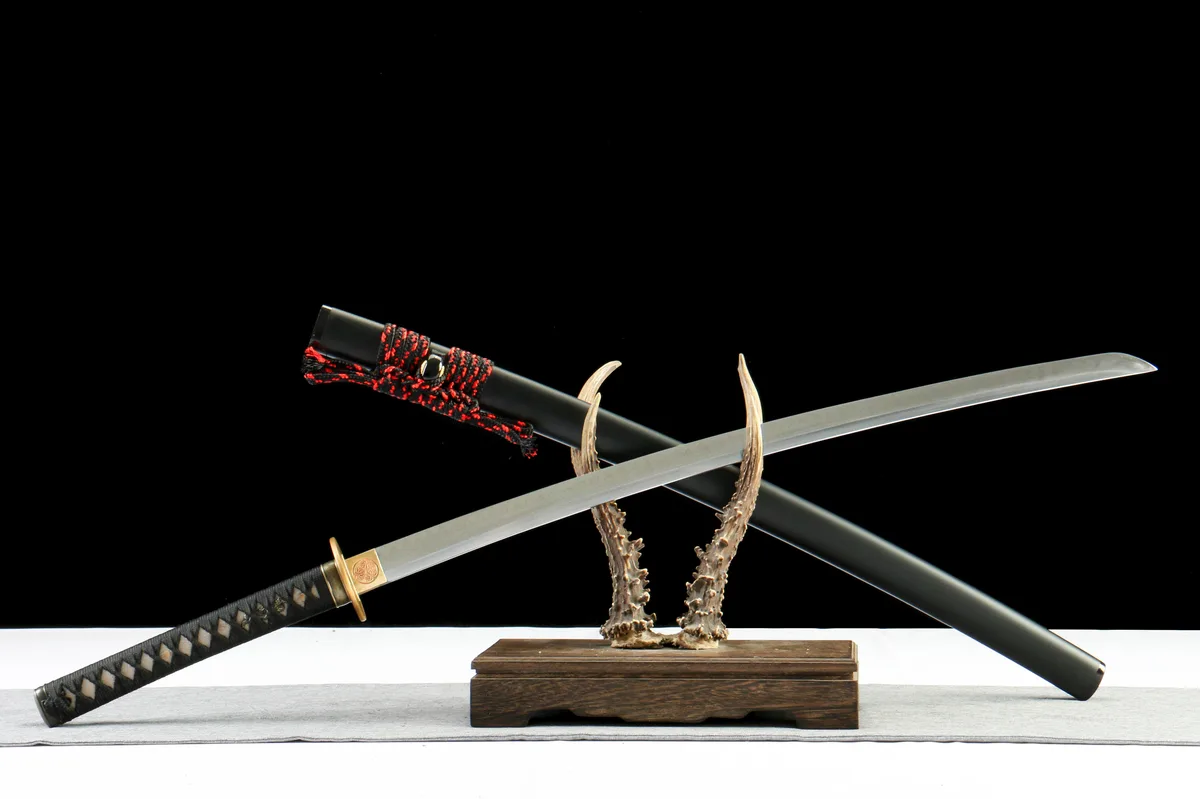




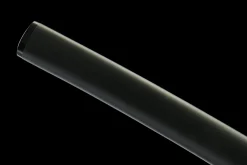


Rising Light – Hand Forged T10 Tool Steel Katana Sword
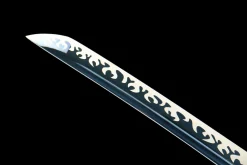
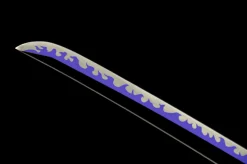
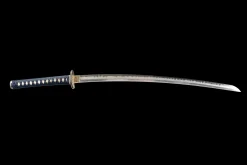
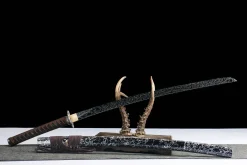
The Rising Light katana is named for the moment just before sunrise — that charged instant when darkness cedes to a spreading, unstoppable luminescence — and its clay-tempered T10 blade captures that metaphor in steel, with a hamon that seems to radiate upward from the edge like the first light of morning. Unlike other T10 clay-tempered katanas, the Rising Light is defined by its iron fittings suite, which brings a raw, austere samurai aesthetic that strips away decorative excess and focuses the eye entirely on the blade’s natural beauty. This shinogi-zukuri katana at $280 is a philosopher’s weapon: spare, purposeful, and quietly magnificent.
Specifications
| Blade Steel | T10 High Speed Tool Steel |
| Total Length | 102.0 cm / 40.2 inches |
| Blade Length | 72.0 cm / 28.3 inches |
| Blade Width | 3.2 cm |
| Weight | 1040 g / 36.7 oz (net) |
| Heat Treatment | Clay Tempering (Differential Hardening) |
| Fittings | Zinc Alloy |
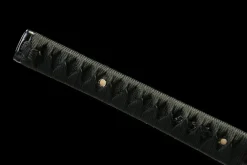
| Handle | Cotton Ito + Genuine Rayskin |
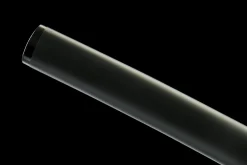
| Sheath | Hardwood (High-Gloss Lacquer) |
Craftsmanship & Materials
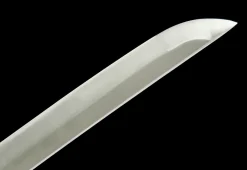
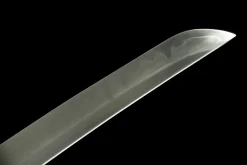
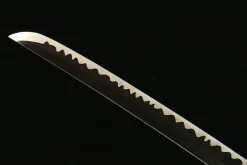
T10 tool steel’s tungsten alloying element is what elevates it above conventional high-carbon grades: tungsten forms carbides within the steel matrix that resist both wear at the cutting edge and deformation under high-impact loads. When the Longquan smiths apply the clay-tempering process to a T10 blank, the results are scientifically predictable but visually surprising every time — each blade produces a uniquely patterned hamon, a fingerprint of the fire that no two examples will ever replicate. The Rising Light’s name comes precisely from the way its hamon appears to ascend the blade, brightening toward the tip in a pattern that evokes light climbing a horizon.
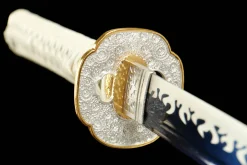
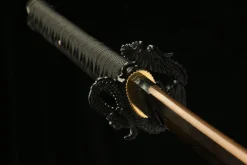
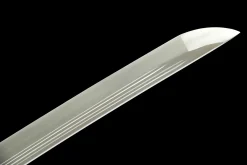
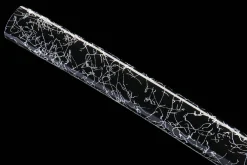
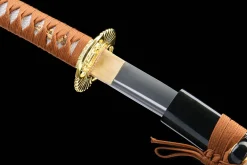
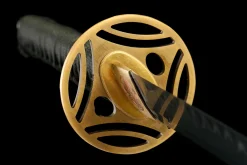
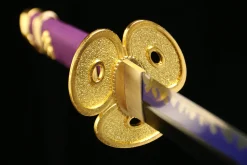
The choice of a restrained fittings package on this sword is a deliberate artistic decision rather than a cost compromise. Where more ornate katanas use decorative brass or copper hardware to draw the eye, the Rising Light’s tsuba and collar fittings in a dark, neutral tone serve as a visual frame that recedes, pushing all attention toward the blade’s active surface. This is how many historical pieces were configured — the sword’s soul was in the steel, and the fittings were its humble servant. The shinogi-zukuri ridgeline profile runs the full length of the 72 cm blade, providing structural stiffness while keeping the geometry true to classical Japanese form.
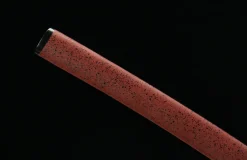
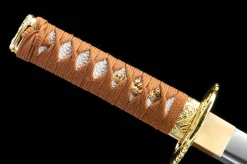
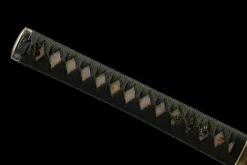
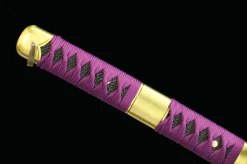
The handle construction follows the same philosophy of quality-under-restraint: genuine rayskin (same) forms the foundation beneath a tightly executed cotton ito wrap in a diamond-pattern that provides real mechanical grip rather than mere decoration. The high-gloss lacquered hardwood saya fits cleanly and draws smoothly, adding the satisfying tactile ritual of a well-fitted sheath to every draw and re-sheath.
Perfect For
- Minimalist collectors and aesthetes who appreciate the ‘ma’ — the Japanese concept of purposeful negative space — and want a katana whose beauty comes from restraint rather than ornament
- Intermediate martial artists who want the genuine functional advantage of a clay-tempered T10 edge for serious cutting practice without paying for decorative fittings they will never use
- Students of Japanese sword history who want an accessible example of how classical blade geometry and hamon patterns look in a historically informed configuration
Care & Maintenance
T10 high-speed tool steel is significantly harder than standard carbon steels, which is a performance advantage but also means the edge can be more susceptible to micro-chipping if used on targets with embedded hard materials — keep cutting practice to appropriate soft targets like tatami omote or bamboo. Oil the blade thoroughly with choji oil after any use or handling, paying special attention to the hamon zone where the hardness transition creates micro-surface variations that can trap moisture. Inspect the blade monthly in good light, looking for any early oxidation spots and treating them promptly with fine polishing film before they can deepen.
Frequently Asked Questions
What is T10 high speed tool steel and why is it in the Rising Light katana?
T10 tool steel is a tungsten-alloyed high-carbon steel prized for its exceptional hardness and wear resistance, making it one of the top-tier steels for performance katanas. In the Rising Light, T10 is clay tempered to create differential hardness — a razor-sharp, hard edge paired with a resilient, flexible spine. This combination delivers outstanding cutting performance and produces the iconic hamon temper line that serious collectors and martial artists value.
What does clay tempering mean for the Rising Light’s blade performance?
Clay tempering on the Rising Light involves applying a clay mixture to the spine of the T10 blade before quenching. The exposed edge cools rapidly, hardening to a high Rockwell rating for sharp, durable cutting. The clay-insulated spine cools slowly, remaining tough and flexible to resist breaking under impact. This process also creates the authentic hamon temper line — a visual signature of genuine differential hardening and a hallmark of traditional Japanese sword craft.
Is the Rising Light katana good for tameshigiri (test cutting)?
Yes. The Rising Light is fully battle ready and well suited for tameshigiri. Its clay-tempered T10 blade provides the edge hardness and geometry needed for clean cuts through rolled tatami mats or similar targets. The shinogi-zukuri (ridgeline) blade profile is the classic functional design used historically for cutting. At 72 cm blade length and 1040 g, the balance and weight are appropriate for serious cutting practice by intermediate to advanced users.
How does the Rising Light differ from the Shadow Sun if both are clay-tempered T10 katanas at $280?
The Rising Light (黑色铁装烧刃) and Shadow Sun (黑色烧刃) share identical steel, heat treatment, dimensions, and price. The key difference lies in their aesthetic presentation: the Rising Light features iron fittings and a distinct visual theme inspired by its name, while the Shadow Sun emphasizes its burned-blade black finish. Both deliver the same functional performance — the choice between them comes down to personal aesthetic preference in fittings and overall style.
Is $280 a fair price for a clay-tempered T10 katana like the Rising Light?
Yes, $280 is competitive for a genuine clay-tempered T10 katana. Many swords with authentic differential hardening and T10 steel are priced $300–$500 or more. The Rising Light includes genuine rayskin, cotton ito, a lacquered hardwood saya, and a shinogi-zukuri blade profile — all hallmarks of quality craftsmanship. The zinc alloy fittings are the primary concession at this price. Buyers wanting copper fittings with the same blade can upgrade to the Sand Light at $320.
| Weight | 1.32 lbs |
|---|---|
| Dimensions | 102.0 × 3.2 × 0.7 in |
| Sword Type | Katana |
| Blade Steel | T10 Tool Steel |
| Total Length | 102.0 cm |
| Blade Length | 72.0 cm |
| Heat Treatment | Clay Tempering (Differential Hardening) |
| Handle Wrap | Cotton Ito + Genuine Rayskin |
| Sheath Material | Hardwood (High-Gloss Lacquer) |
| Fittings | Zinc Alloy |
| Forging Style | Shinogi-Zukuri (Ridgeline) |
Related products

1065 Carbon Steel


1065 Carbon Steel
1065 Carbon Steel
1045 Carbon Steel

1045 Carbon Steel
Black Heaven Feather – Hand Forged 1045 Carbon Steel Katana Sword

1045 Carbon Steel
1045 Carbon Steel
White Celestial – Hand Forged 1045 Carbon Steel Katana Sword