






History & Culture
Tamahagane: The Traditional Steel Behind Japanese Swords

What Is Tamahagane?
Tamahagane is a bloom steel produced by smelting iron sand and charcoal together inside a clay furnace called a tatara. The name translates roughly to “jewel steel,” which sounds poetic until you understand where that description comes from. A fresh bloom of tamahagane, cracked open after three days of smelting, has regions that catch the light with a silvery, almost glassy surface. Those bright zones are where the carbon content sits between 0.6% and 1.5%. That specific range is what a swordsmith needs.
What makes tamahagane unusual is that a single bloom contains steel of wildly varying carbon content. Some pieces run as low as 0.1% carbon, which is almost soft iron. Others hit 1.5%, which is close to cast iron and would shatter under a hammer. The swordsmith’s first job is to break the bloom apart with hammers and sort the pieces by eye, by spark, by sound when struck. Selecting the right pieces from a 1,200-pound bloom is a skill that takes years to develop.
The sorted pieces are then stacked, heated, and forge-welded into a consolidated billet. From there, the process of repeated folding begins. Folding distributes carbon more evenly, drives out slag inclusions, and creates the fine grain structure that gives tamahagane blades their characteristic strength and flexibility in combination.
This is not a process you can shortcut. A single katana from start to finish, using tamahagane through traditional methods, can take two to three months of skilled labor. Most of that time is not spent at the forge.
The Tatara Smelting Process
A traditional tatara is a clay furnace roughly 1.2 meters tall, 3 meters long, and 1 meter wide. It is built fresh for each smelt and destroyed when the bloom is extracted. You do not reuse a tatara. The clay absorbs heat, moisture, and chemical byproducts during the smelt in ways that compromise the structure. Each firing begins with a new furnace, built by hand over several days.
The raw material is satetsu, iron sand found in riverbeds in certain parts of Japan, particularly around the Chugoku region. Satetsu has a relatively low titanium content compared to other iron ores, which matters during smelting. High titanium raises the melting point of the slag and makes separation from the steel more difficult.
The smelting operation itself runs for approximately 72 hours without interruption. Workers feed alternating layers of satetsu and charcoal into the furnace at timed intervals, maintaining specific ratios throughout. Temperature inside the tatara reaches around 1,200 to 1,400 degrees Celsius, but the smelters do not use instruments. They read the color of the flame, the sound of the furnace, and the behavior of the slag flowing from the tap holes at the base.
At the end of the smelt, the furnace is broken apart. Inside sits the kera, a rough bloom of mixed steel, iron, and slag weighing 2,000 to 3,000 kilograms. The tamahagane is extracted from the top and sides of the kera, where conditions during the smelt produced the right carbon range. The center of the bloom, called zuku, is cast iron and gets set aside for different uses.
There is only one organization in Japan still operating a full-scale tatara regularly: the Society for the Preservation of Japanese Art Swords. They run a smelt each winter in Shimane Prefecture. The output, perhaps 700 to 800 kilograms of usable tamahagane per smelt, is distributed by application to registered swordsmiths. Demand consistently exceeds supply.
Swords Forged in the Traditional Spirit

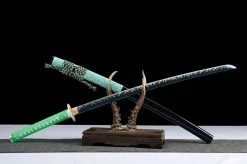
Ink Meteor – San Mai Construction
Three-layer laminated blade (三枚合) built on traditional construction principles. $775.

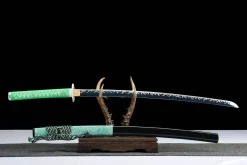
Silent Thunder – T10 Tool Steel
Clay-tempered T10 with a vivid hamon. The closest modern parallel to tamahagane performance. $280.

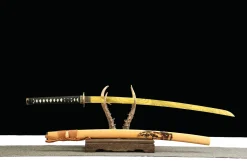
Dark Ravine – T10 Tool Steel
Hand-forged T10 with differential hardening and a well-defined hamon line. $340.
Why Modern Steels Replaced Tamahagane
The short answer is consistency. A modern production run of 1095 high-carbon steel arrives at the forge with a known carbon content of 0.90-1.03%, predictable grain size, and documented impurity levels. Every billet behaves the same way under the hammer. Tamahagane does not work like that. Each piece from each bloom is different, and the swordsmith must adjust their technique accordingly. That unpredictability is part of what makes working tamahagane a craft rather than a manufacturing process.
Western steel production, introduced to Japan in the Meiji period, offered something tamahagane could never match at scale: volume. A single electric arc furnace can produce in an afternoon what a tatara smelt produces in three days. Modern militaries and industrial applications needed steel by the ton, not by the kilogram. Tamahagane never had a chance against that economics.
There is also the matter of labor. A tatara smelt requires a team of six to eight workers operating continuously for three days. Training those workers takes years. The charcoal fuel alone, from carefully selected pine, is a significant production cost. By the early 20th century, the economics had made traditional smelting nearly extinct in Japan.
What survived did so because of cultural preservation efforts, not because tamahagane outperformed modern alternatives in a technical sense. For decorative and ceremonial swords, and for art swords submitted to shinsa (official appraisal), tamahagane remains the required material. For a functional cutting tool, modern high-carbon steels match or exceed tamahagane performance at a fraction of the cost.
Can You Still Get a Tamahagane Sword?
Yes, but the path is narrow. Authentic tamahagane, forged by a registered Japanese swordsmith (mukansa or above), and submitted through proper channels, is a licensed process in Japan. The finished sword will require a torokusho, a registration certificate, before it can legally leave Japan. Import into most countries requires additional documentation.
Prices start around $10,000 for a blade from a relatively junior registered smith. Work from established masters runs $30,000 to $80,000 or higher. Wait times are measured in years. These are art objects as much as weapons, and they are treated accordingly by Japanese law and by the smiths who make them.
Some Chinese smiths have experimented with producing tamahagane-adjacent steel using modified clay furnace smelting methods. The results are interesting from a metallurgical standpoint, but they are not tamahagane in the traditional sense. Here in Longquan, we do not claim otherwise. What we do claim is that our forging techniques, clay-tempering methods, and finishing processes draw directly from the same functional tradition that made tamahagane swords worth preserving in the first place.
If you want to understand what to look for in any traditionally-made blade, our katana buying guide covers geometry, fit and finish, and how to evaluate hamon quality before you commit to a purchase.
Modern Equivalents Worth Understanding
When Japanese smiths working outside the tamahagane system look for a modern substitute, they typically reach for steels with similar carbon content and comparable behavior under differential hardening. Two steels come up repeatedly in that conversation: 1095 and T10.
1095 runs 0.90-1.03% carbon with minimal alloying. It responds well to clay tempering and produces a vivid hamon. Edge retention scores 9 out of 10 in our steel comparison guide, though toughness sits at 5 out of 10. Think of it as a steel that rewards precise technique. Abuse it and it will tell you.
T10 tool steel adds approximately 0.4% tungsten to a similar carbon base. That tungsten content refines grain size and increases wear resistance without significantly compromising toughness, which scores 7 out of 10. Edge retention comes in at 8 out of 10, and the hamon it produces under clay tempering is, frankly, stunning. Our katana collection includes several T10 blades that show exactly what differential hardening looks like on a modern alloy.
The Silent Thunder is T10, clay-tempered, with a hamon line that took three separate polishing sessions to bring out properly. The Dark Ravine is also T10, built with a slightly longer kissaki for a more aggressive point geometry. Both are functional cutters and both show what happens when you apply traditional heat treatment methods to a predictable modern steel.
For collectors interested in layered construction that echoes tamahagane’s composite structure, the Ink Meteor uses san mai (三枚合) construction. A hard cutting core steel is sandwiched between softer outer layers, the same mechanical logic that tamahagane folding aimed to achieve. It is not tamahagane, but the engineering problem it solves is identical.
Browse our Damascus steel category if layered construction interests you from a visual standpoint. Damascus layers are visible on the surface rather than hidden inside the billet, which some buyers prefer for display pieces. Our sword care guide covers how to maintain both Damascus and high-carbon blades properly, since the care requirements differ in a few important ways.
Frequently Asked Questions
Ready to Find Your Blade?
