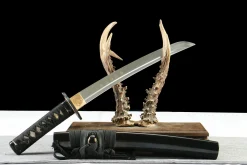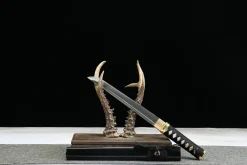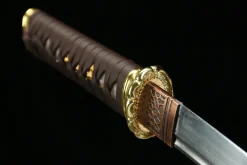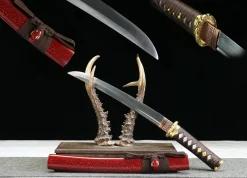
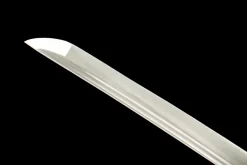
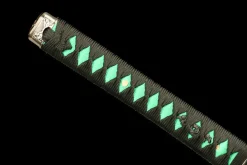
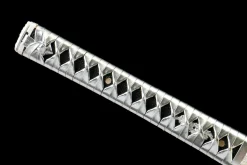
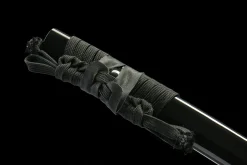
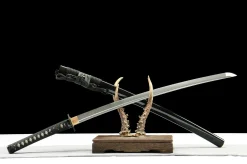
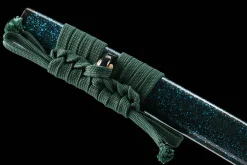
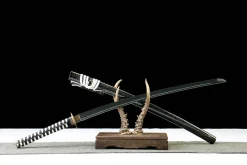
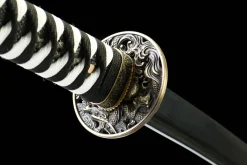
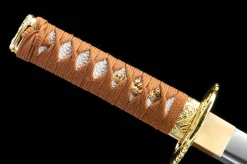
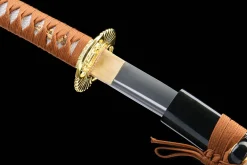
A tanto blade under 30cm is no compromise. These are purpose-built daggers with the same steel, the same heat treatment, and the same geometry standards we apply to every full-length katana that leaves our workshop. Browse all eight tanto below, ranging from 1065 high carbon entry pieces at $130 to T10 tool steel and Damascus builds at the top of the range.

Why Choose a Tanto Dagger

The tanto originated in the Heian period (794-1185) as a close-combat stabbing weapon. Samurai of every rank carried one, and the women of samurai households kept a smaller version, called a kaiken, for personal protection. That history shaped a blade geometry built entirely around controlled force in tight spaces.

Most tanto use hira-zukuri geometry, meaning the blade is flat-ground without a shinogi ridge. That produces a thick, stiff spine behind a very acute point. The tip holds up better than you might expect, because the thick cross-section behind it distributes impact load efficiently. It is a design that has not needed significant revision in a thousand years.

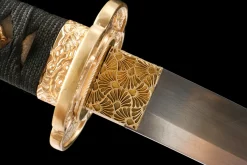
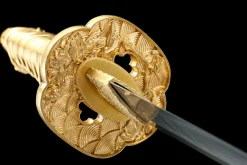
Many of our tanto are mounted aikuchi-style, without a tsuba guard. That is historically accurate, and it also gives the piece a cleaner profile for display. Where a tsuba is included, it is fitted tight against the habaki. You should feel no rattle when you grip the handle.

How to Choose the Right Tanto

Steel grade first. Our 1065 high carbon tanto, like the Cold Radiance and Red Brocade, are correctly hardened and fully functional. They are a sound starting point at $130. Step up to T10 tool steel, which contains trace vanadium, and you get a finer grain structure and better edge retention. The Shadow Carve Tanto in clay-tempered T10 shows a visible hamon and reaches HRC 58-60 at the edge.

Consider the mounting. A tanto with an ornate handle and ray-skin wrap is a display and collection piece. A plain linen-wrapped handle with a single mekugi pin is closer to a working blade. Both are valid choices. Know which you are buying before you decide on a budget.

Damascus or mono-steel. The Ink Jade uses pattern-welded Damascus. The surface grain pattern is unique to that blade. If the visual appeal of folded steel matters to you, Damascus is worth the price step. If edge performance is the priority, T10 mono-steel is more consistent.

Matching a set. Tanto are the shortest piece in the traditional daisho. If you are building a three-piece set with a katana and wakizashi, check that handle materials and fittings coordinate. See our sword buying guide for notes on matching furniture across pieces.

Frequently Asked Questions

A tanto is a specific Japanese blade form with a blade under 30cm (under 1 shaku), typically flat-ground in hira-zukuri geometry. A western dagger is a broader category that includes double-edged blades with very different cross-sections. Tanto are single-edged and built for thrusting, with a thick spine that keeps the tip rigid under impact load. The construction method, the steel, and the mounting conventions are all specific to the Japanese tradition.
That depends on the individual blade, and the product listing will tell you directly. All tanto with T10 or Damascus steel and a proper clay-tempered hamon are fully functional, hardened to HRC 58-60 at the edge. Our 1065 high carbon tanto are also correctly hardened and functional. None of our tanto are decorative wall-hangers with soft zinc alloy fittings. That said, “battle-ready” does not mean maintenance-free. See our sword care guide for oiling intervals and storage recommendations.
Yes, and many collectors begin here for good reason. The shorter blade means lower price, easier storage, and a more forgiving introduction to sword handling and maintenance. The Cold Radiance at $130 and the Red Brocade at $130 are both solid first pieces. If you want to start with something more technically interesting, the Shadow Carve Tanto in clay-tempered T10 at $220 gives you a visible hamon to study without a large investment.
Clay tempering, also called differential hardening, means we coat the spine of the blade in a clay mixture before the final quench. The spine cools slowly through the clay and stays relatively soft, around HRC 40. The edge, exposed to the quench directly, hardens to HRC 58-60. That hardness difference creates the curved hamon line you can see on the steel. It also gives you a blade that is hard where you need it (the edge) and tough where you need it (the spine). On a tanto, that combination is especially useful given how much stress the tip takes during thrusting use.
The same principles apply. Wipe the blade down after every handling session with a clean cotton cloth. Apply a light coat of choji oil every two to three months, or more often in humid climates. The shorter blade means the job takes about two minutes instead of five. One thing to watch on tanto: the habaki, the metal collar at the base of the blade, sits closer to the hand grip than on a katana. Keep that junction clean and dry, because moisture trapped between the habaki and the handle materials will start to degrade the wood core over time. Our sword care guide covers the full maintenance routine in detail.

Eight tanto. Eight different takes on the same 30cm brief.

[
[/row]